05.11.2026
How to Remove Salt Stains from Leather and Suede Shoes: A Couturier's Guide
How to Remove Salt Stains from Leather and Suede Shoes: A Couturier's Guide
By Vlad Bykov, Founder and Couturier, VLAD BYKOV Couturier House, Dubai · Published 5 November 2026
To remove salt stains from leather shoes, brush off the dry crust, then wipe the white line with a cloth dampened in equal parts white vinegar and water, working from the top towards the sole. Finish with plain water, dry the pair at room temperature away from heat and condition it. Suede is treated across the whole panel.
How do you remove salt stains from leather shoes?
In five steps: brush off loose salt, wipe the shoe with a warm, damp cloth in one direction, treat any white line that remains with diluted white vinegar, finish with plain water, and let the pair dry slowly before conditioning. Each material changes the method, so suede, nubuck and crocodile follow rules of their own.
- Brush off what is dry: a soft brush lifts loose crystals before any liquid touches the leather, so you are not dissolving them back into it.
- Wipe in one direction with a cloth dampened in warm water, from the top of the shoe down towards the sole, turning to a clean part of the cloth after each pass.
- Where a white tide mark remains, dissolve it with equal parts white vinegar and water on a cloth that is damp, not wet.
- A second cloth with plain water lifts the dissolved salt and the vinegar with it.
- Dry at room temperature with shoe trees inside and no heat; conditioner goes on only once the leather is fully dry.
The same steps work for leather boots, loafers and mules. The rest of this guide explains why salt does what it does and takes each material in turn: first the city winter, then the sea.
Why do road salt and de-icers damage leather?
Because salt draws moisture out of leather. Road salt is mostly sodium chloride, often blended with calcium or magnesium chloride; when meltwater on a shoe evaporates, the salt stays in the surface as a white line and keeps pulling water from the fibres. Dry leather stiffens, and at the crease of the vamp it eventually cracks.
The most common form of road salt is sodium chloride, with calcium chloride and magnesium chloride used as well, especially in colder places; in the United States alone, road salt use runs to tens of millions of tons a year. Calcium chloride is hygroscopic and deliquescent, which is why it is also used as a desiccant, and it melts ice at lower temperatures than ordinary salt. A substance chosen for its thirst should not spend the night on a pair of shoes.
Moscow's main road de-icer has for years been a modified calcium chloride in granules, and RIAMO reported in 2016 that around 300,000 tonnes of de-icers are spread on the city each winter. The same report notes calcium chloride on the roads of Austria, Switzerland and the United States; road salt there dates from the late 1930s, when New Hampshire began experimenting with it.
The white line is only what you see. As the shoe-care writer at Shoegazing explains, the stain looks bad, but the main damage is that salt dries the leather until it cracks. Not every white mark comes from the street, either: some leathers, usually cheaper ones, release chromium salts from tanning when they are soaked, and those dry on the surface in a similar way.
What should you do in the first ten minutes?
Wipe the shoes before the salt dries into them. Dampen a cloth in warm water and wipe from the top of the shoe down towards the sole, always in one direction, moving to a clean part of the cloth each time. Finish with one pass along the sole edge from heel to toe, then insert shoe trees.
The usual mistake is to move salt around rather than remove it: the shoes look clean at night and show white lines in the morning. Wiping from the top down leaves the saltiest area, near the sole, for last. Rinse the cloth in warm water and repeat at least twice wherever salt was visible.
Suede is the exception in these ten minutes. Blot it with a dry cloth, pressing straight down without wiping, stuff the shoes loosely with unprinted paper, and leave the nap alone until it is completely dry: brushing wet suede flattens it and can fix a watermark.
Then let the pair stand on a mat or a sheet of paper in a room at normal temperature. A shoe left in a pool of meltwater by the door keeps drinking salt from below, through the welt and the edge of the sole.
What ratio of vinegar to water removes salt stains?
Equal parts white vinegar and water is the standard mix for smooth leather. Dampen a cloth in it and never soak the leather. Wipe in one direction, from the top towards the sole; on a single white line, start at its edge and move inwards, so you do not push dissolved salt into clean leather. Finish with plain water.
Reviewed gives the same one-to-one ratio and a sensible warning: there is no need to soak the shoes, so play it conservatively. Use clear white vinegar and test the mix first on the inside of the heel or under the tongue. Repeating a gentle pass works better than strengthening the solution.
On smooth calf, a little saddle soap can follow once the shoe is dry, to lift what the vinegar left, though the leather comes out slightly darker. Saddle soap has no place on suede, nubuck or crocodile, and neither do neat vinegar, alcohol or household cleaners: they take more moisture out of leather than the salt did.
When the cloth stops picking up white, stop. The leather will look darker while damp; judge the result only when it is dry.
How do you get salt stains out of suede?
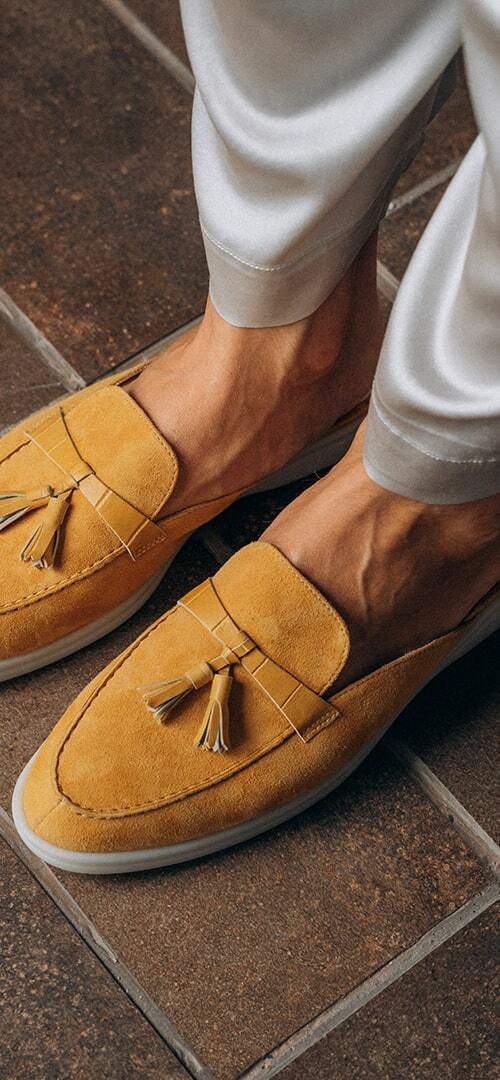
Dry first, then brush. Once suede is completely dry, a suede brush lifts most salt out of the nap and a suede eraser takes the rest. A ring that survives is treated across the whole panel with a suede cleaner or a mild vinegar solution, never as a spot, then dried slowly and brushed back up.
Spot cleaning is the classic error. Liquid applied to one patch dries with a new edge around it, and the salt line becomes a water line. Dampen the whole panel evenly, from seam to seam; On suede, the solution goes on more evenly with an application brush. The full routine, from brushing to the protector spray, is in our suede care guide.
Calf nubuck has a shorter, finer nap than suede and follows the same rules: dry, brush, erase, whole panel. Neither takes conditioner or oil, which darken the colour and flatten the nap for good.
Colour decides how much a salt line shows. Pale sand, grey and light blue suede show it soonest; darker suede forgives more. That is not a reason to give up light suede, only to keep it for dry days.
How do you clean salt off crocodile leather?
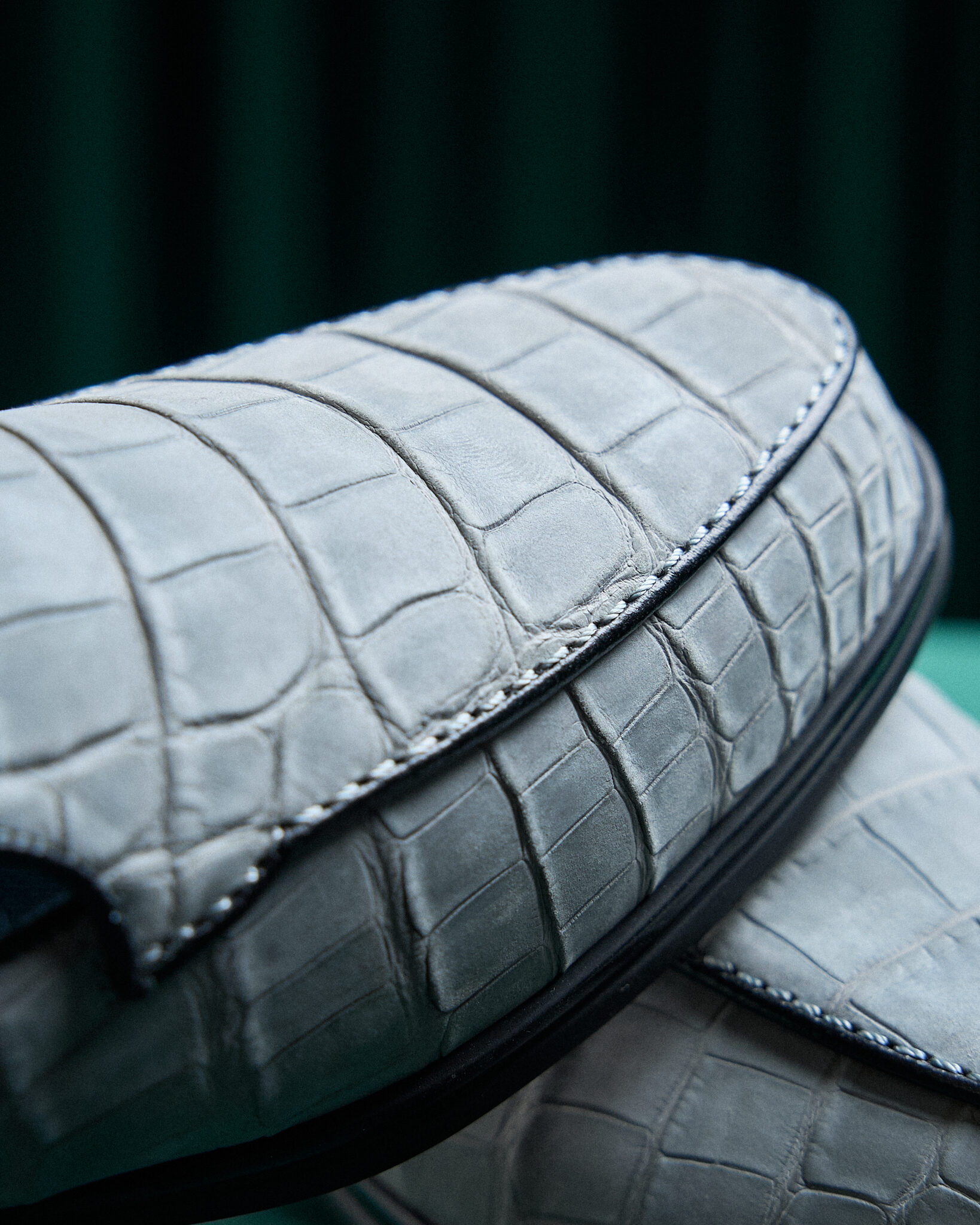
With water rather than chemistry. Wipe the salt away with a soft cloth barely damp with fresh water, following the direction of the scales, and let the shoes dry slowly at room temperature. Once they are dry, feed the skin with a conditioner made for exotic leather. Soap, alcohol and household cleaners stay in the cupboard.
Salt settles in the seams between the scales. Work along them, not across, and never scrub: crocodile is a skin with a finish on top, and abrasion takes the finish first. Glazed crocodile tolerates moisture best and matte follows closely, as we set out in the crocodile leather care guide; salt water is harder on both than rain. If a mark does not lift on the first gentle pass, stop and show the pair to a specialist.
The same routine protects the rest of a crocodile wardrobe. A belt or a bag that met slush or spray is cleaned the same way, and if you are choosing one now, the guide to choosing a crocodile leather bag explains why semi-gloss and matte finishes forgive daily life better than a high gloss.
What about nubuck crocodile and combined pairs?
Treat nubuck crocodile like suede, only more carefully. Keep water off it, let any salt dry, then lift it with a soft brush along the scales. On a combined pair of crocodile and suede, clean each material by its own rules and work towards the seam, never across it, so liquid from one does not run into the other.
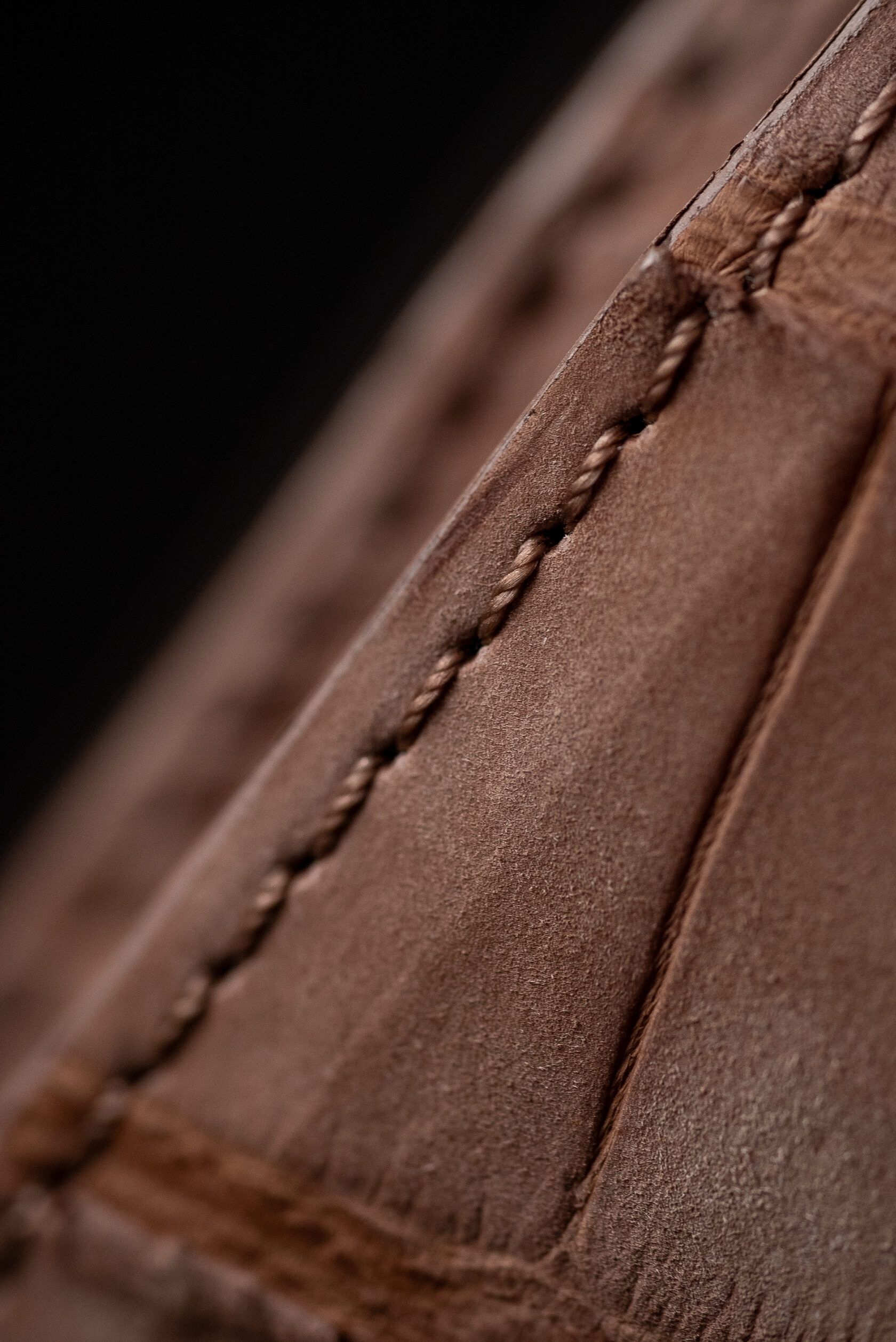
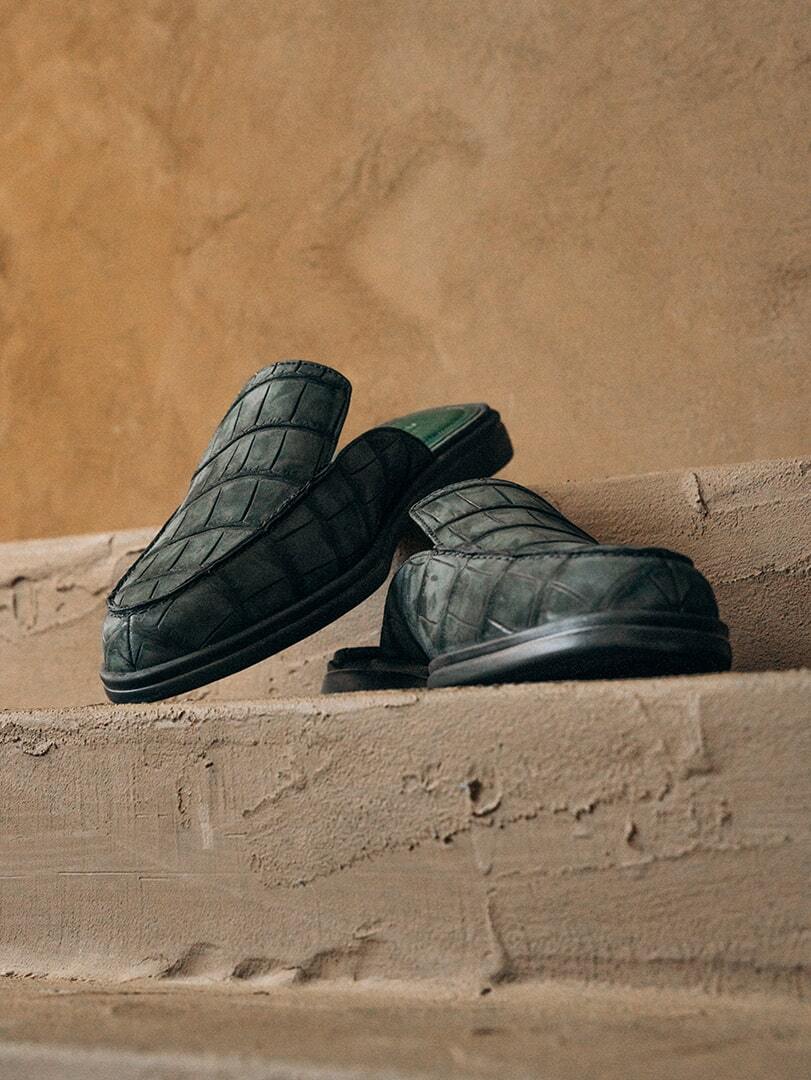
Nubuck crocodile is crocodile buffed to a velvety nap. The House uses it for mules, for belts and for the tassels on suede mules, and of all the finishes it is the least tolerant of water: a ring on it is difficult to lift at home. If brushing does not take the salt out, it is a specialist's job.
On a combined pair, start with the crocodile, using the barely damp cloth, and let the shoe dry. Only then brush the suede, because a damp crocodile panel next to dry suede is how a water line crosses from one material to the other.
Why should you never dry shoes with a hair dryer or on a radiator?
Because fast heat does what salt does, only quicker. It drives moisture out of leather unevenly, shrinks and hardens it, and on suede it sets a flattened nap that brushing cannot undo. Dry each pair at room temperature, on shoe trees or stuffed with paper, for as long as it takes: overnight for leather, a day or two for suede.
Reviewed puts it plainly: "Sustained periods of intense, concentrated heat can destroy leather, causing it to crack." The same applies to a heated floor, a car heater aimed at the footwell and a sunny windowsill. Cedar shoe trees help, because they hold the shape while drawing moisture out of the lining.
In my essay on people who build history I wrote: "Yet everything I truly value in a material, a cut or a finished piece required time that could not be shortened without losing the substance." Drying a good pair is a small version of the same rule. A night of patience costs nothing; a cracked vamp cannot be undone.
Does sea salt in Dubai, Miami or on a yacht stain shoes the same way?
Yes, and often faster. Seawater is about 3.5% salt by weight, so every splash that dries on a shoe leaves salt behind, and heat speeds the drying. Rinse the salt off the same day with a cloth dampened in fresh water, dry the pair slowly in the shade and condition leather once it is dry.
The figure comes from the U.S. Geological Survey: sodium and chloride make up over 90% of the ions dissolved in seawater, the same pair as on a winter road. In a city winter salt arrives with slush; by the sea it arrives with spray, a wet deck, the walk back from the beach. Chlorinated pool water is no kinder to leather.
Heat adds a second source of salt, inside the shoe. A salt or sweat ring on a suede mule worn without socks is treated like any other ring, across the whole panel, and cedar shoe trees after every wear deal with the moisture behind it.
When you travel, keep a damp pair in its own soft bag so the salt stays away from everything else, and follow the guide to travelling with luxury shoes for the rest of the suitcase.
How do you care for leather after removing salt?
Only once it is clean and dry. Then restore what salt and cleaning took: conditioner for smooth leather and crocodile, followed by cream and, if you like, a little wax on calf. Suede and nubuck get no conditioner; brush the nap and renew the protector spray. Never seal leather over salt that is still in it.
Shoegazing makes the last point firmly: if cream, wax or a waterproofing spray goes on before all the salt is out, the salt is sealed in and keeps working on the leather. Check the shoe in daylight first; if any white is still visible, clean again.
On crocodile, less is more: a thin layer of conditioner for exotic skins, worked in with the scales, and a gentle buff a few hours later. A heavy hand leaves product in the seams, exactly where the salt sat.
Are salt stains permanent?
Usually not, if you act within days. Fresh salt dissolves and comes off; the risk is salt left for weeks, which dries the leather until it cracks or leaves a shade where the line sat. If no white is visible after cleaning but a darker trace remains, the salt is gone and what you see is the mark it made.
A trace like that often softens with conditioning and time, because the surrounding leather evens out. Repeat a gentle clean on another day and keep the solution as mild as before. On suede, two or three cycles of whole-panel cleaning and brushing usually bring the colour back together.
Cracks are different. Leather that has dried and split at the crease does not close again; it can only be kept from spreading with regular conditioning. That is the real argument for the ten-minute wipe: it costs a minute, and the alternative is a pair you cannot repair.
How do you protect shoes from salt before the season?
Before the first salted street or the first day by the sea: smooth leather gets cream and a layer of wax, suede and nubuck a protector spray in two light coats, renewed every four to six weeks. Then make wiping a habit: a damp cloth every time you come in from salted pavements stops most stains before they form.
Two light coats from about 20 cm, with time to dry in between, protect better than one heavy coat. In a climate like Dubai's or Miami's, renew the spray more often, because heat and perspiration break the treatment down faster.
Keep wiping into early spring. Salt often stays on the streets after the snow has gone, so March can mark a pair as badly as January.
Rotation helps too. A pair that rests for a full day between wears dries properly inside and out, and leather that is dry before it goes out takes salt far less readily than leather that is still damp from yesterday.
Which shoes handle salted streets and the sea best?
Darker colours and denser materials. Matte or glazed crocodile and dark smooth leather shrug off a splash that would mark pale suede, and a pair that combines crocodile with suede sits between them. Keep light suede for dry days, and choose a rubber sole, which does not soak up meltwater the way a leather sole does.
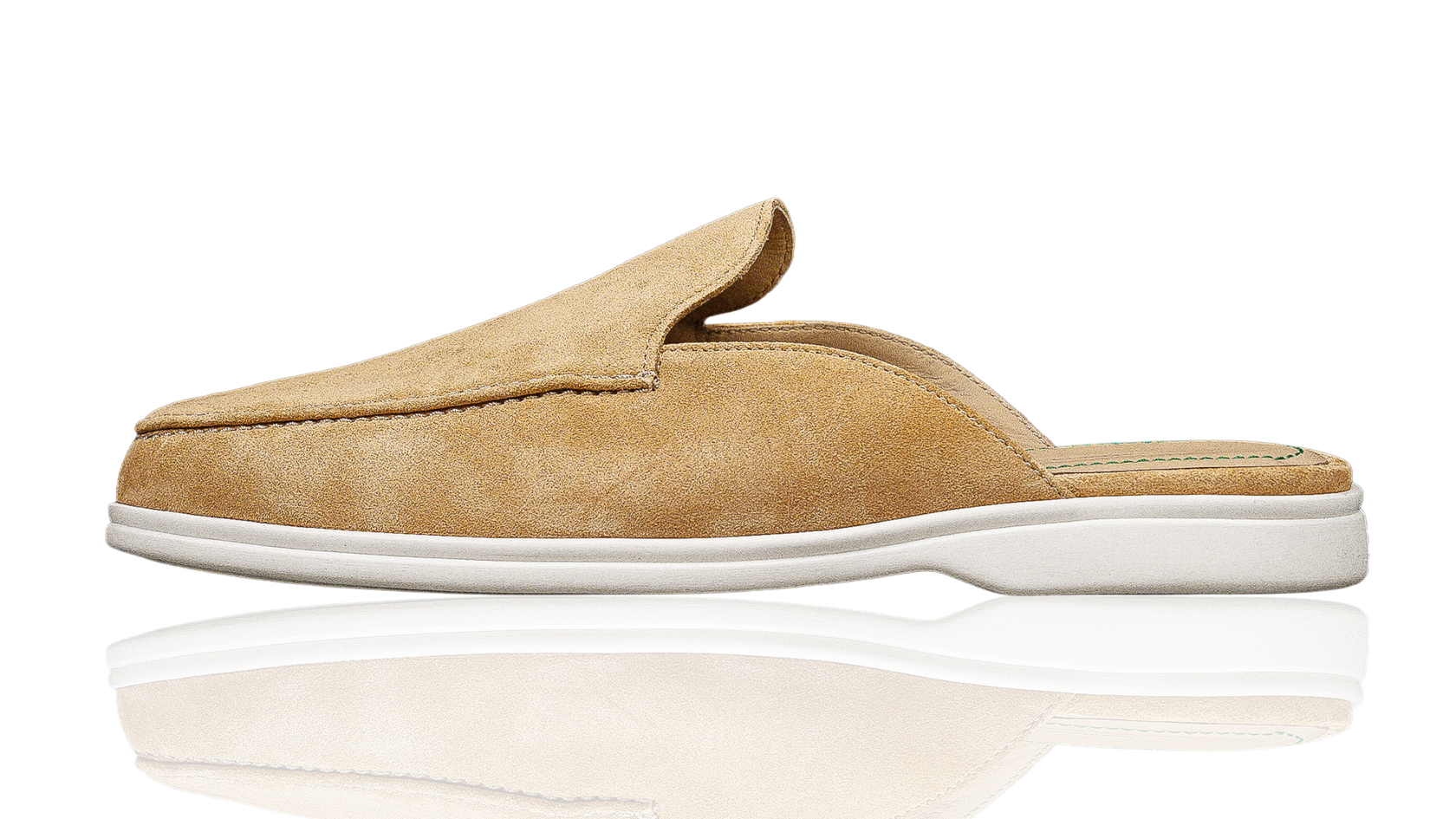
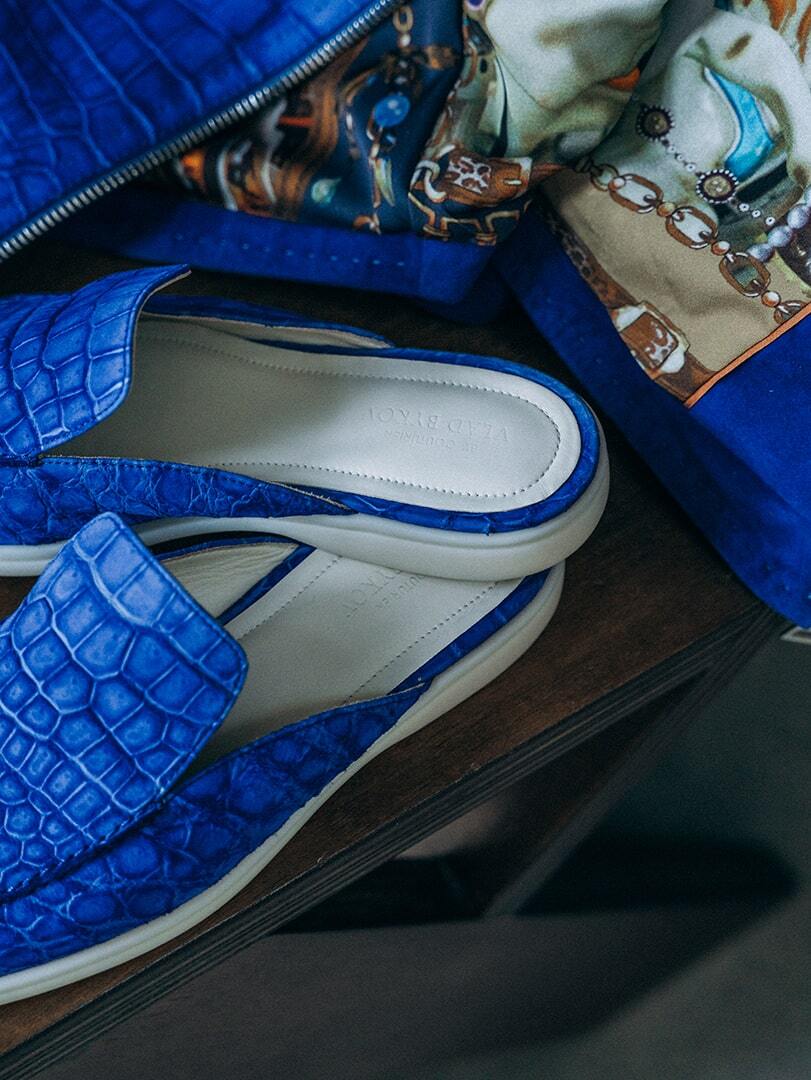
The mules and loafers of the House are built this way: a natural calfskin lining, a natural leather insole and a caoutchouc sole, with uppers in Italian suede, matte, glazed or nubuck crocodile, or crocodile combined with suede. The man who wears them often lives between a European winter and the coast of Dubai, so the same pair may meet a salted pavement in January and a marina in February.
Every pair is priced on request. Send the model, colour and size to your advisor through Contact or on WhatsApp, and the quote comes back individually; consultations take place in person in Dubai or by video call. If you prefer to choose from a screen, the guide to buying crocodile shoes online explains what to check before you order.
Frequently Asked Questions
Does vinegar damage leather?
Not when it is diluted and used briefly. Equal parts white vinegar and water on a damp cloth, followed by a cloth in plain water, removes salt without harming a sound finish. Neat vinegar or repeated soaking dries leather, so condition the shoes once they are dry.
Can you use soap and water on salt stains?
Not on suede, nubuck or crocodile: soap and water spread the residue and can leave a new ring. On smooth calf, a little saddle soap may follow the vinegar clean once the shoe is dry, though it leaves the leather slightly darker.
How long should shoes dry after you remove salt?
Overnight at least for smooth leather and crocodile, and a full day, sometimes two, for suede. Dry them at room temperature on shoe trees or with paper inside, away from radiators, heaters and direct sun, and condition or brush only once they are completely dry.
Why do salt stains come back after cleaning?
Because the salt was moved, not removed. Wiped in circles, it dissolves, spreads and dries again as a new line by morning. Wipe in one direction towards the sole, turn the cloth to a clean area after each pass, and finish with plain water.
Can you put salt-stained shoes in the washing machine?
No. Soaking and tumbling push salt deeper into the leather, distort the shape and flatten suede. Fine leather shoes are cleaned by hand, a panel at a time, with a damp cloth or a brush, and always dried slowly at room temperature.
Does sea salt leave the same stains as road salt?
Yes. Seawater is about 3.5% salt by weight, according to the USGS, so dried spray leaves the same white line. Rinse it off the same day with a cloth dampened in fresh water, dry the pair slowly in the shade and condition leather once it is dry.
Can you wear suede shoes in winter?
Yes, on dry, cold days, once the pair has been treated with a protector spray. Wet slush full of de-icer is the real risk, so on those days choose smooth leather or crocodile, and keep the suede for the days when the pavement is dry.
How often should you wipe your shoes in winter?
Every time you come in from salted pavements, before the meltwater dries. It takes a minute with a damp cloth and prevents most stains. Keep doing it in early spring, because salt often stays on the streets after the snow has gone.
Should you polish shoes before walking on salted streets?
Yes, for smooth leather. A nourishing cream and a light layer of wax on clean, dry leather keep meltwater on the surface for longer. Never polish over salt that is still in the leather: clean and dry the shoes first, then polish.
What does price on request mean for VLAD BYKOV shoes?
Each pair is quoted individually, not from a list. Crocodile is priced against the skin a pair will be cut from, and bespoke sizes are confirmed before payment, so the figure comes from your advisor once the model, colour and size are known.
Written at VLAD BYKOV Couturier House, Dubai. About the House · Ready-to-Wear · Commission a bespoke piece · Contact · Privacy Policy
Shoegazing, Reviewed, RIAMO and other names mentioned in this article belong to their respective owners and are referenced for context only. Mention does not imply partnership, licence or endorsement.