03.11.2026
How to Choose a Crocodile Leather Bag: A Couturier's Buyer's Guide
How to Choose a Crocodile Leather Bag: A Couturier's Buyer's Guide
By Vlad Bykov, Founder and Couturier, VLAD BYKOV Couturier House, Dubai · Published 3 November 2026 · Updated 3 November 2026
To choose a crocodile leather bag, judge the skin before the brand: front panels cut from the belly with even, square scales matched across the bag; a finish that suits how you live; hand stitching and painted edges; solid hardware and a leather lining; a silhouette you will carry. Then confirm the skin is genuine crocodile, not embossed calf.
How do you choose a crocodile leather bag?
Check eight things in the hand, in this order: where the skin was cut, how the scales are matched, the finish, the depth of the colour, the stitching and edges, the hardware, the lining and the silhouette. Each one is visible on a finished bag, and together they separate a fine crocodile bag from an expensive disappointment.
That is what to look for in a crocodile handbag. The rest of this guide takes each check in turn, then the questions that follow: what a crocodile bag costs, whether it holds its value, how it compares with the Birkin, and whether to buy ready-made, choose a one-of-one or commission your own.
Which part of the crocodile skin makes the best bag?
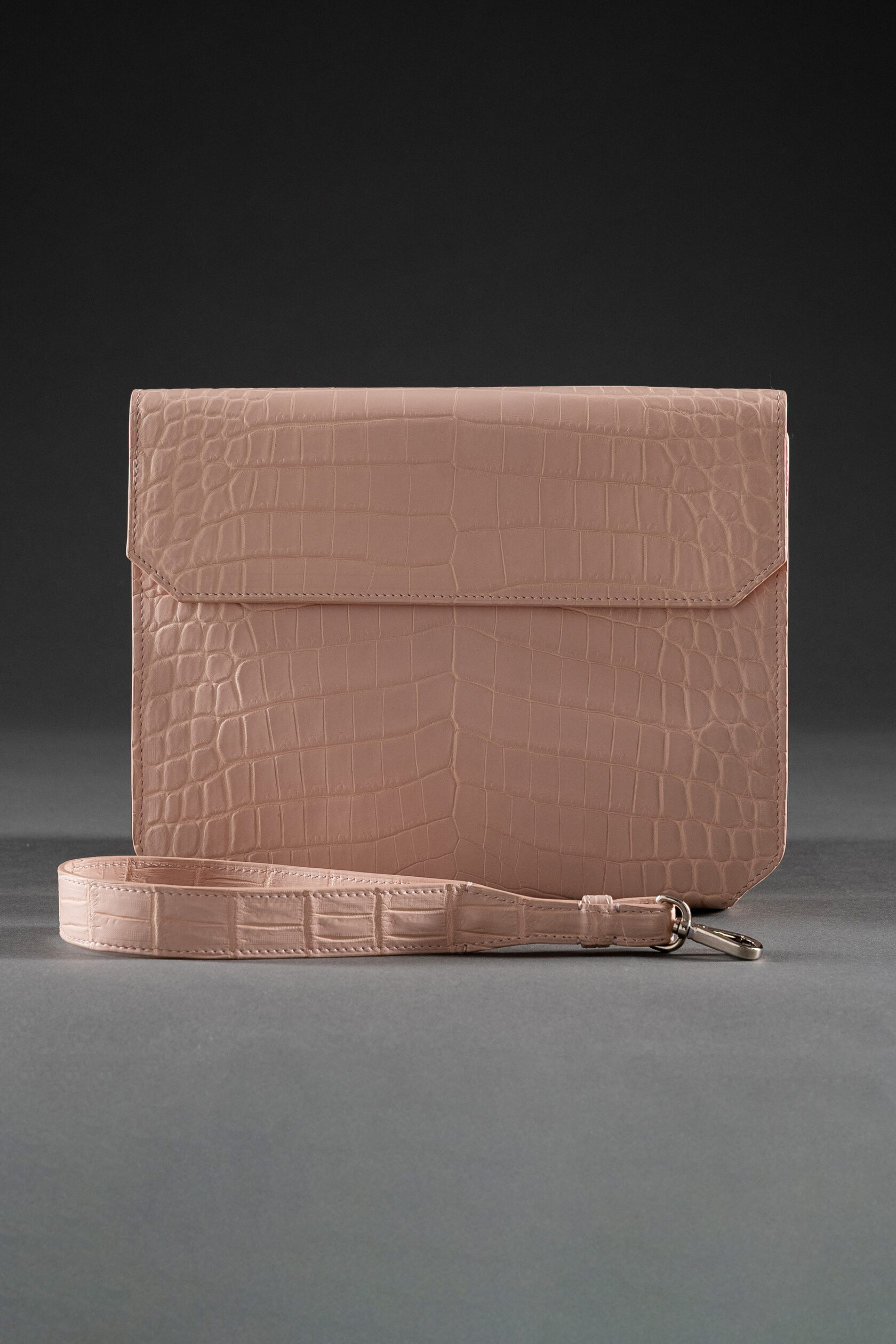
The belly. It gives the broadest, most regular scales: rectangular tiles that grow smaller towards the edges in a calm, symmetrical pattern. On a fine bag the front and back panels come from the belly, with the centre line of the skin running down the middle of the bag, and the flanks are kept for gussets, straps and handles.
The flanks carry smaller, rounder scales that flex easily, which suits the parts of a bag that bend. The back, the hornback, carries raised, bony ridges: a deliberate, architectural statement for a bag designed around it.
The crocodiles most valued for fine bags are the Nile crocodile, Crocodylus niloticus, and the saltwater crocodile, Crocodylus porosus. Whatever the species, look at the front panel first. If its scales are small and round, the bag was cut from a part of the skin that costs less, whatever its price says.
Low on the front panel of some bags sits a small, irregular mark: the umbilical scar, where the belly of the animal closed. It is not a defect. Some makers place it deliberately as a signature of the real skin; others cut around it.
Why do scale size and symmetry matter so much?
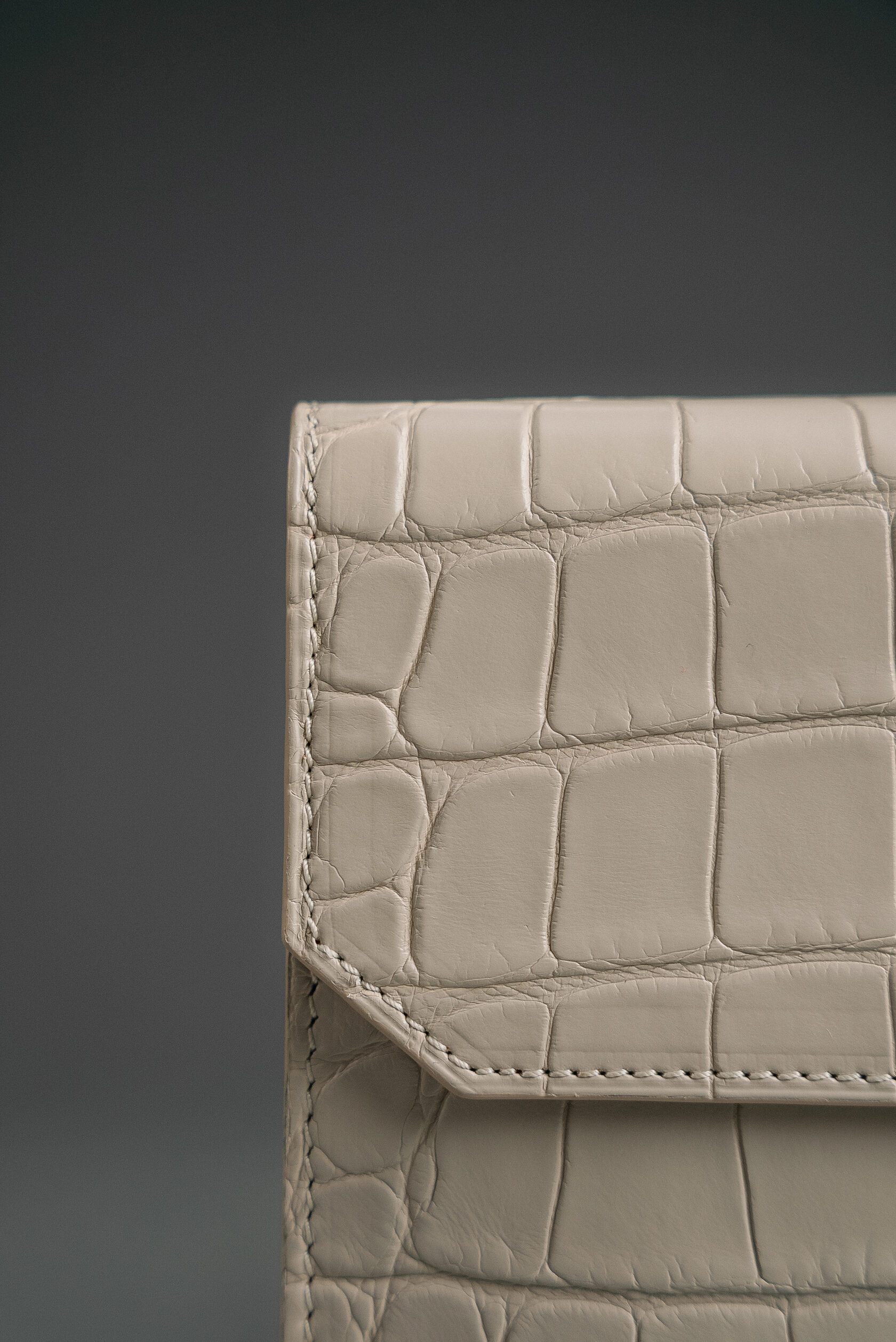
Because the pattern is the face of the bag. Scales should run in straight, centred rows and continue across the flap, body and gusset as if they were one surface, grading evenly in size. Fine, small scale patterns are the rarest, and a pattern that breaks or changes direction at a seam is the clearest sign of hurried cutting.
Symmetry is decided at the cutting table. Every panel is planned on the skin before the knife touches it, with the centre line placed where the eye will fall. On the Hermès Birkin, saltwater crocodile with small scale patterns is rarer than large ones, and the logic holds across the category: the finer and more regular the tiling, the more skin has to be examined, and often set aside, to find it.
Matching is harder than it looks, because a bag uses several panels and often more than one skin, and two skins differ in scale size, tone and the way they take dye. Turn the bag over and look at the base and the gussets. That is where shortcuts hide.
Matte, semi-gloss, glossy or nubuck: which finish suits your life?
Choose by how you will use the bag. Glossy crocodile is the most formal and shows every scale, but also every scratch. Semi-gloss keeps a soft glow and forgives daily wear. Matte reads quietly and suits the day. Nubuck, buffed to a velvety nap, looks the softest of the four and tolerates water the least.
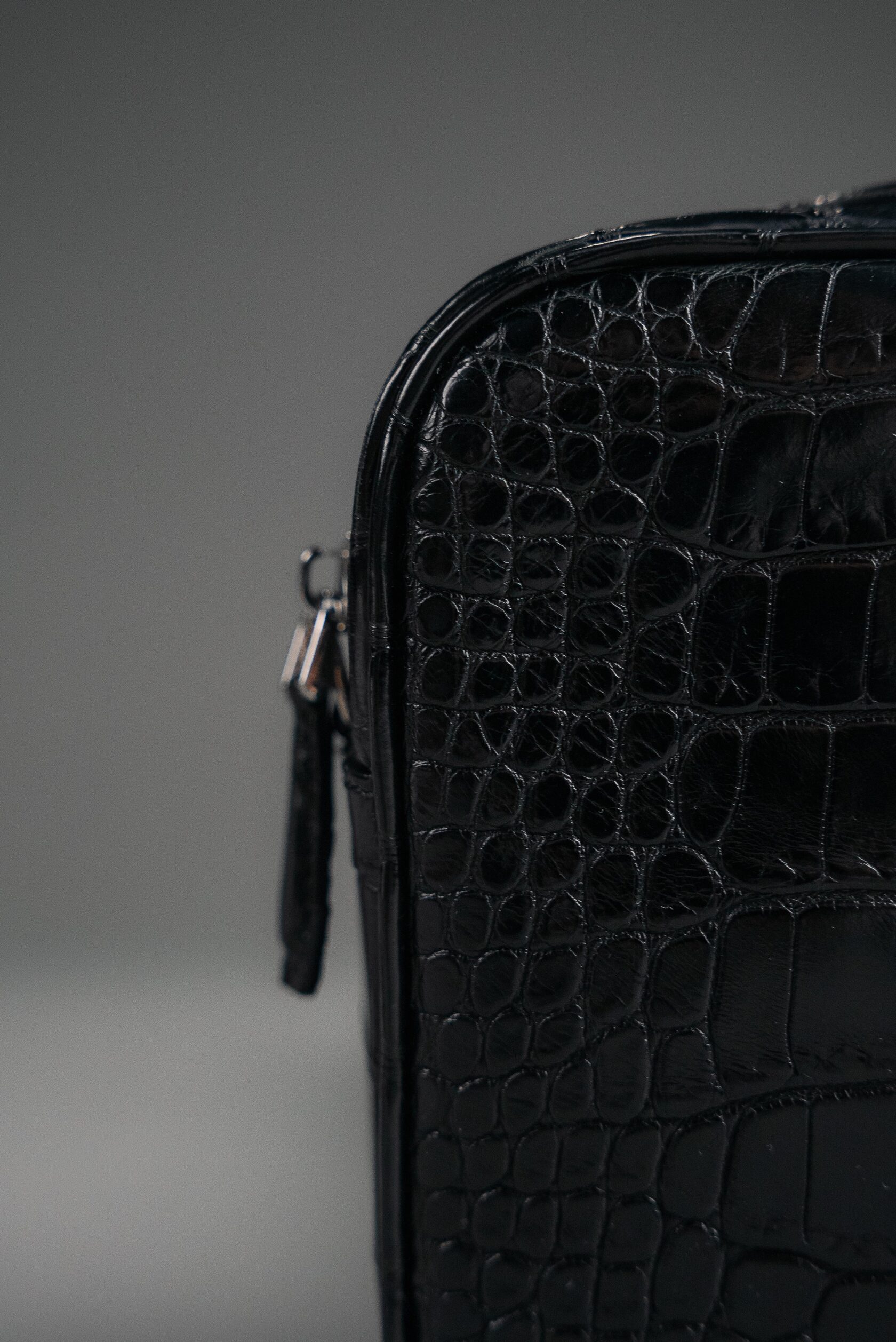
Glossy crocodile is polished after dyeing until the scales hold a deep, lacquered shine, the look most people picture when they think of a crocodile bag; the House's ready-to-wear cross-body is glazed black crocodile. Nubuck goes the other way: the surface looks almost like suede made of scales. In The Divine Dozen, black, deep blue and terracotta are nubuck.
A practical rule: for a bag carried every day, in and out of cars, offices and airports, choose semi-gloss or matte. Keep glossy for evenings and nubuck for the days you plan for.
How can you tell good tanning and dyeing on a finished bag?
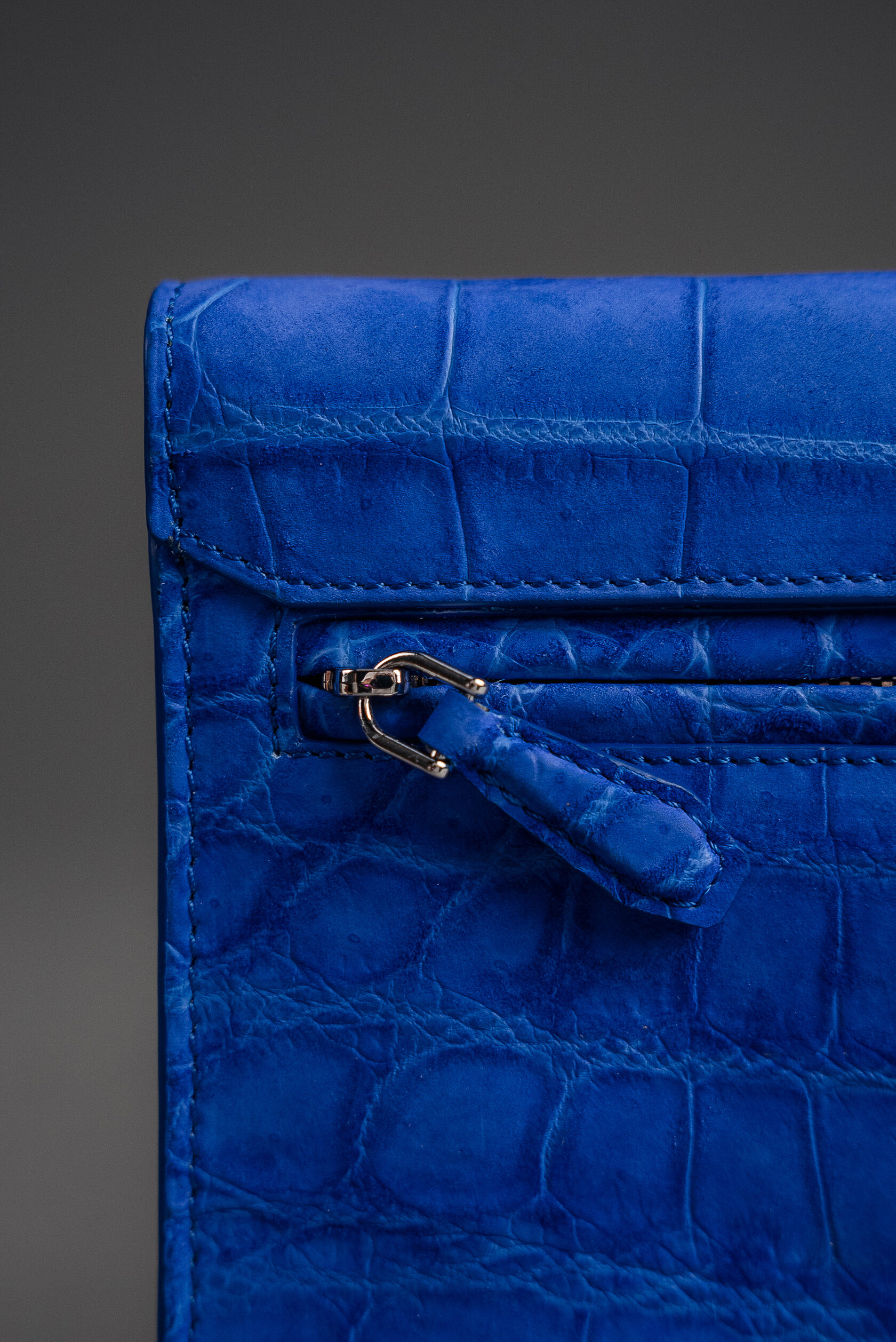
Look at the colour at the edges and in the folds. Well-tanned crocodile is supple, never plasticky, and its colour is even across every panel and carried through the skin, so a cut edge or a bend shows no pale core. A patchy tone between front and back usually means mismatched skins or a heavy surface coating.
Press the surface gently: good crocodile flexes as one continuous skin, and the scales move together without cracking along their borders. Then check the colour in daylight, which shows whether a black has a blue or a brown undertone and whether every panel agrees. If the finish looks like a plastic layer sitting in the hollows between the scales, ask what is underneath.
What does real handwork look like on a crocodile bag?
Straight, evenly spaced stitches that sit tight in the leather, edges painted and polished in thin layers until they are smooth to the touch, and corners that turn without wrinkling the scales. On fine bags the stitching is often a saddle stitch, sewn by hand with two needles on one thread, so one broken stitch does not unravel a seam.
Edges tell you most. Run a finger along the flap and the handles: a well-made edge is rounded, dense and glossy; a careless one is raw or coated in thick paint that cracks within a season. Inside, look at how the lining meets the body and how the stitching ends: secured and hidden, not knotted and glued.
A handmade crocodile bag takes weeks. At the House a bag takes approximately four to five weeks to make, as I set out in the guide to Bespoke, Made-to-Order, Private Order and One of One.
What should the hardware and lining tell you?
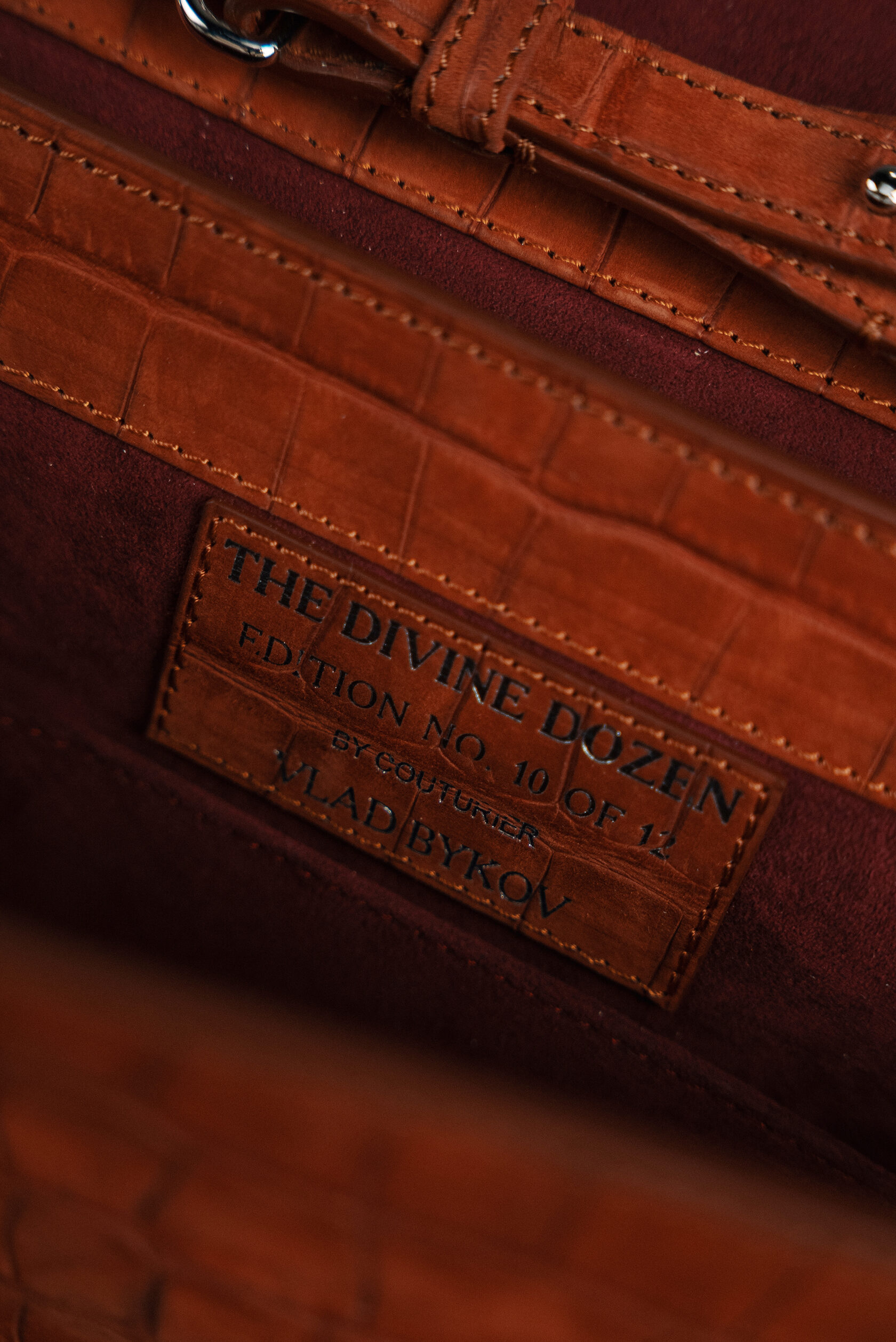
That the maker spent as much on what you touch as on what you see. Clasps, rings, feet and zips should feel heavy and be finished cleanly, without sharp edges or thin plating, and a zip should run smoothly along its full length. Inside, a leather lining fitted without puckering shows that the bag was built to last.
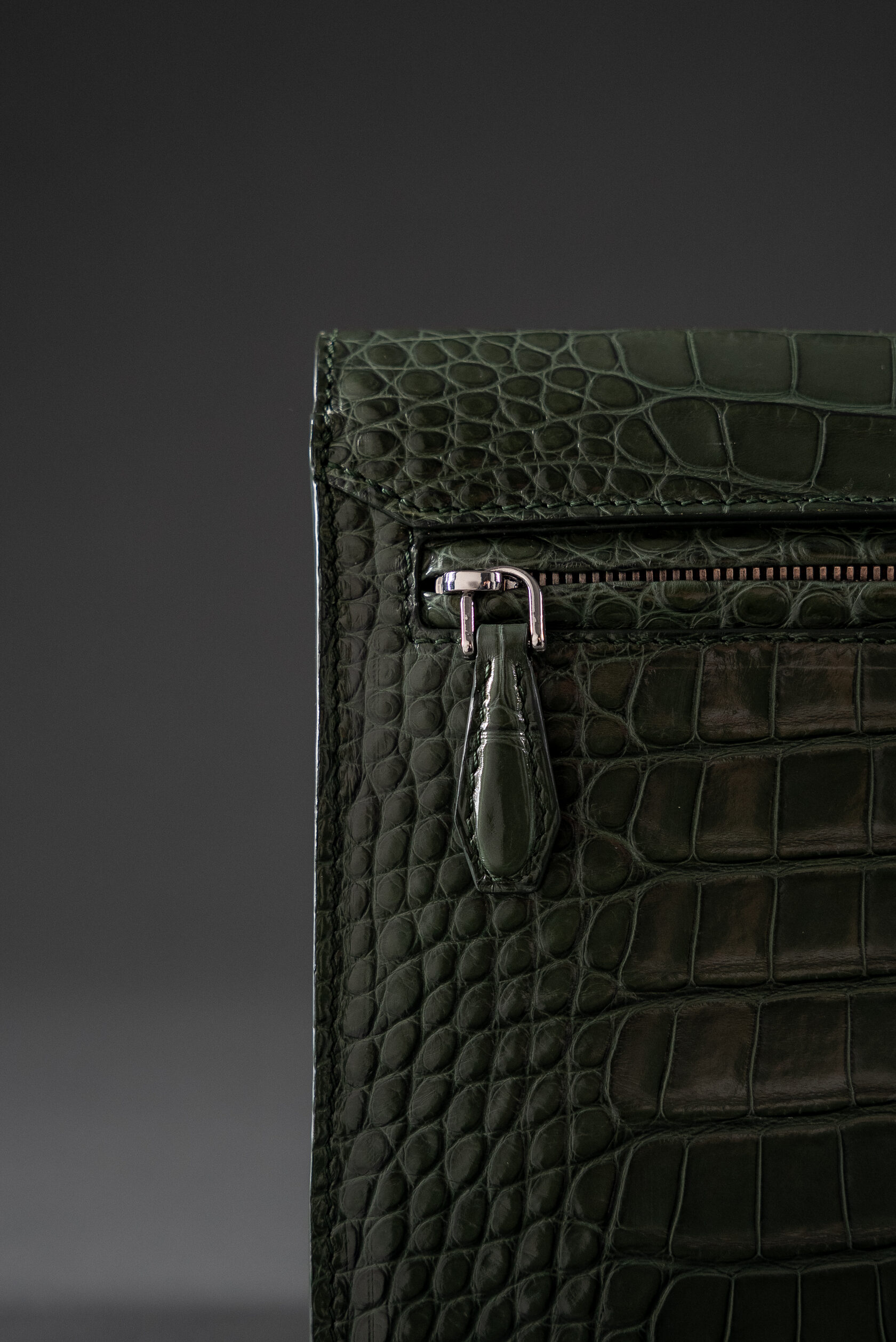
Hardware is where costs are most often cut on a luxury bag, because buyers check it last. Weigh the clasp, look at the screws and rivets, and check that metal matches metal. In The Divine Dozen, bag 3 in glossy brown crocodile carries gold hardware, and on several bags the zip pull itself is covered in the same crocodile as the body.
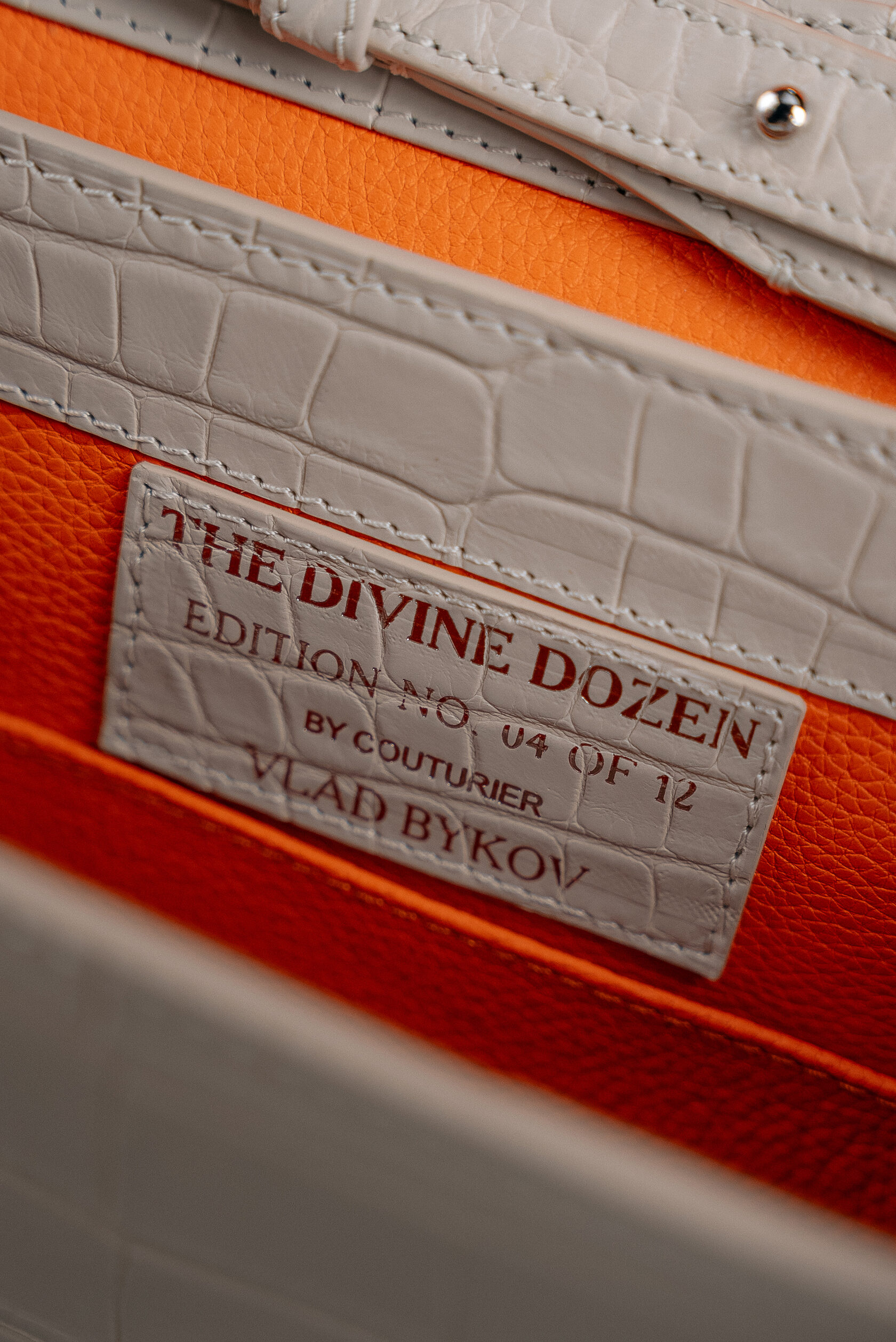
A leather lining is heavier and more costly than fabric, and it lasts as long as the skin outside. Its colour is a choice: the cross-body bag in glazed black crocodile is lined in natural orange leather, as are bags 4 and 5 of The Divine Dozen, so the colour appears only when the bag is opened.
How do I know if a crocodile bag is real?
Look for a tiny dot near the edge of each belly scale. True crocodiles carry a small sensory organ on almost every body scale. Then check that the scales vary naturally in size and that the pattern never repeats. Embossed calf repeats, has no dots and flattens at a bend.
There is science behind the dot. A study in the Journal of Experimental Biology found that in alligators and caimans these integumentary sensory organs occur only on the head, while in true crocodiles they appear on virtually every scale of the body; the paper also cites their use in identifying crocodilian skins.
Two cautions follow. A bag without dots may still be genuine alligator or caiman, a different animal with a different value. And a skilled imitation can stamp dots too, so no single test is enough.
Embossed leather is usually calfskin pressed with a crocodile pattern. The same scale shape repeats, the relief is shallow, the thickness is perfectly even, and at a fold the pattern stretches flat instead of bending scale by scale. Finally, ask the maker which species and which part of the skin the bag is cut from: a house that works with crocodile answers at once. A crocodile skin bag priced like a calfskin one is almost never what its label claims.
Which silhouette and size should you choose?
The one that fits what you carry every day. A cross-body keeps the hands free for travel and city days; a top-handle bag suits meetings and dinners; a clutch is for evenings; a tote or a briefcase carries a laptop. Smaller bags can be cut entirely from belly panels, so a small crocodile bag often shows the finest scales.
A larger bag needs more skin, often more than one, and every extra panel is another place where the pattern has to match. Structure matters too: a structured bag keeps its shape and shows the scales flat and even, while a soft bag moves with the body and develops character. Neither is better; the question is whether the bag is for every day or for occasions.
Measure what you actually carry: phone, cards, keys, glasses, perhaps a passport. The House's cross-body bag is 17 cm high and 23 cm wide, enough for those essentials and small enough to wear close to the body.
What should a man look for in a crocodile bag?
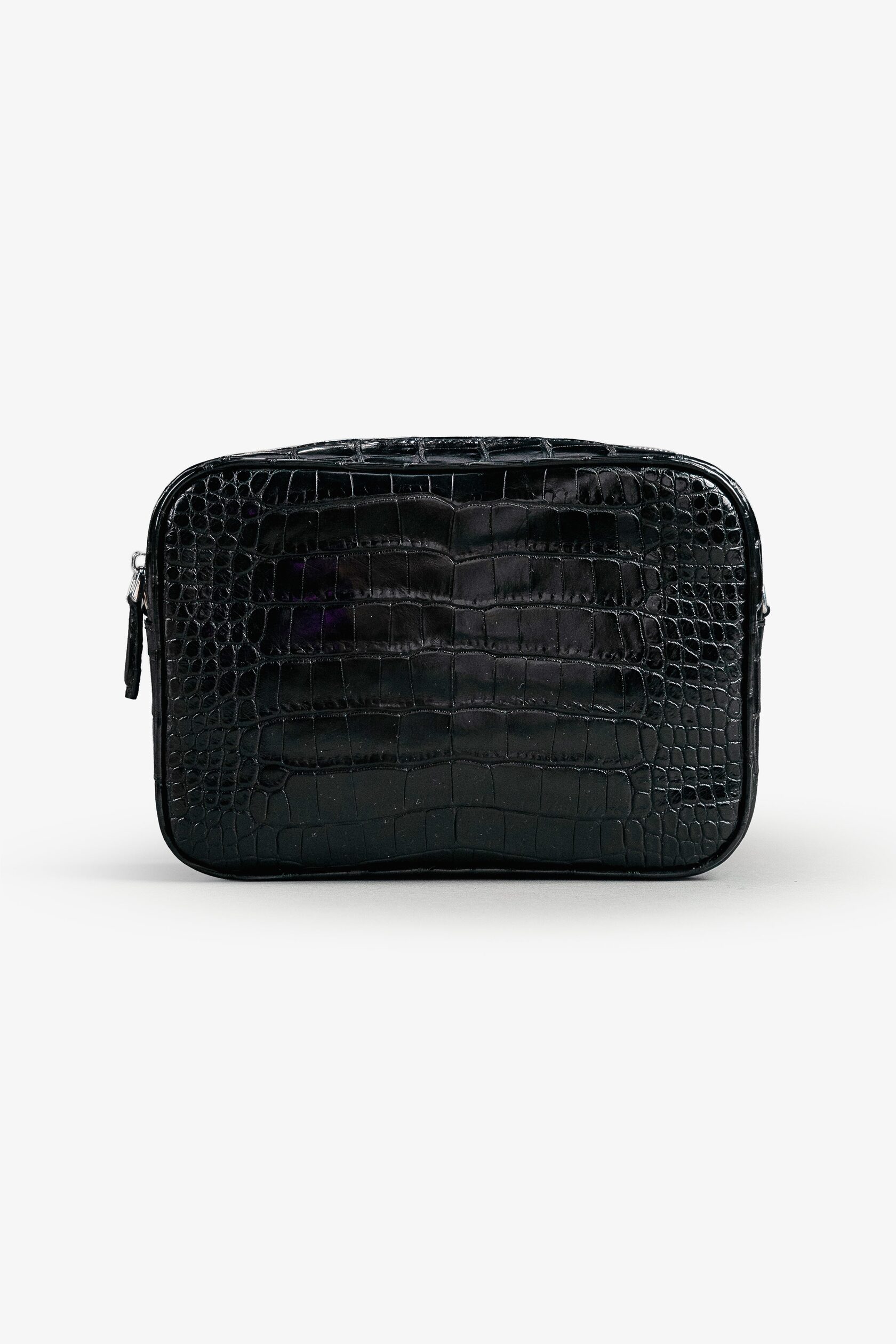
Restraint in colour and finish, and a shape that works with tailoring. Black, dark brown, khaki and deep blue read as quietly confident; matte, semi-gloss and nubuck look more natural by day than a high gloss. A cross-body, a compact document case or a travel bag in crocodile carries more authority than a larger, louder bag.
Men tend to carry a crocodile bag every day, so the finish has to survive a working week. In The Divine Dozen, bag 1 in khaki semi-gloss is described as calm power and masculine elegance, and bag 11, a very dark brown that is almost black, as strength that does not seek attention.
A bag also has to agree with the shoes. Choose it in the same family of tone and finish as your crocodile loafers or mules: a matte bag with glossy shoes looks considered, two identical glosses look like a uniform. The same checks apply when buying crocodile shoes online: belly scales, a matched pair, an honest finish.
How much does a crocodile bag cost?
Prices start in the thousands of dollars and reach six figures for the rarest skins at auction. At VLAD BYKOV every crocodile bag is priced on request: the ready-to-wear cross-body in glazed black crocodile, each bag of The Divine Dozen and every bespoke commission, which is quoted once the skin and the design are agreed.
Why are crocodile bags so expensive? Because of what this guide has covered: the part of the skin, how many skins it takes to match the panels, the finish and the hours of handwork. Rarity of the skin comes on top: the matte white Himalaya Birkin in the table was reported by FashionUnited as the most expensive bag ever sold at auction at the time, and so the most expensive crocodile bag too. Each bag of The Divine Dozen has its own skin, colour and finish, so each is priced individually when a guest asks about a particular number.
Do crocodile bags hold their value?
Some do, but resale value is not guaranteed. Christie's names size, style and condition as the factors that set the value of a designer handbag; its specialist adds supply and demand. A designer crocodile bag that scores well on all of them keeps its value best. One without them is a beautiful object, and should be bought as one.
Resale value follows the material too: Christie's has called Porosus crocodile the finest of all the mediums Hermès uses for its handbags. Condition is the one factor entirely in the owner's hands: crocodile ages well when its shape is supported and it is stored away from heat and damp, and our crocodile leather care guide sets out the routine.
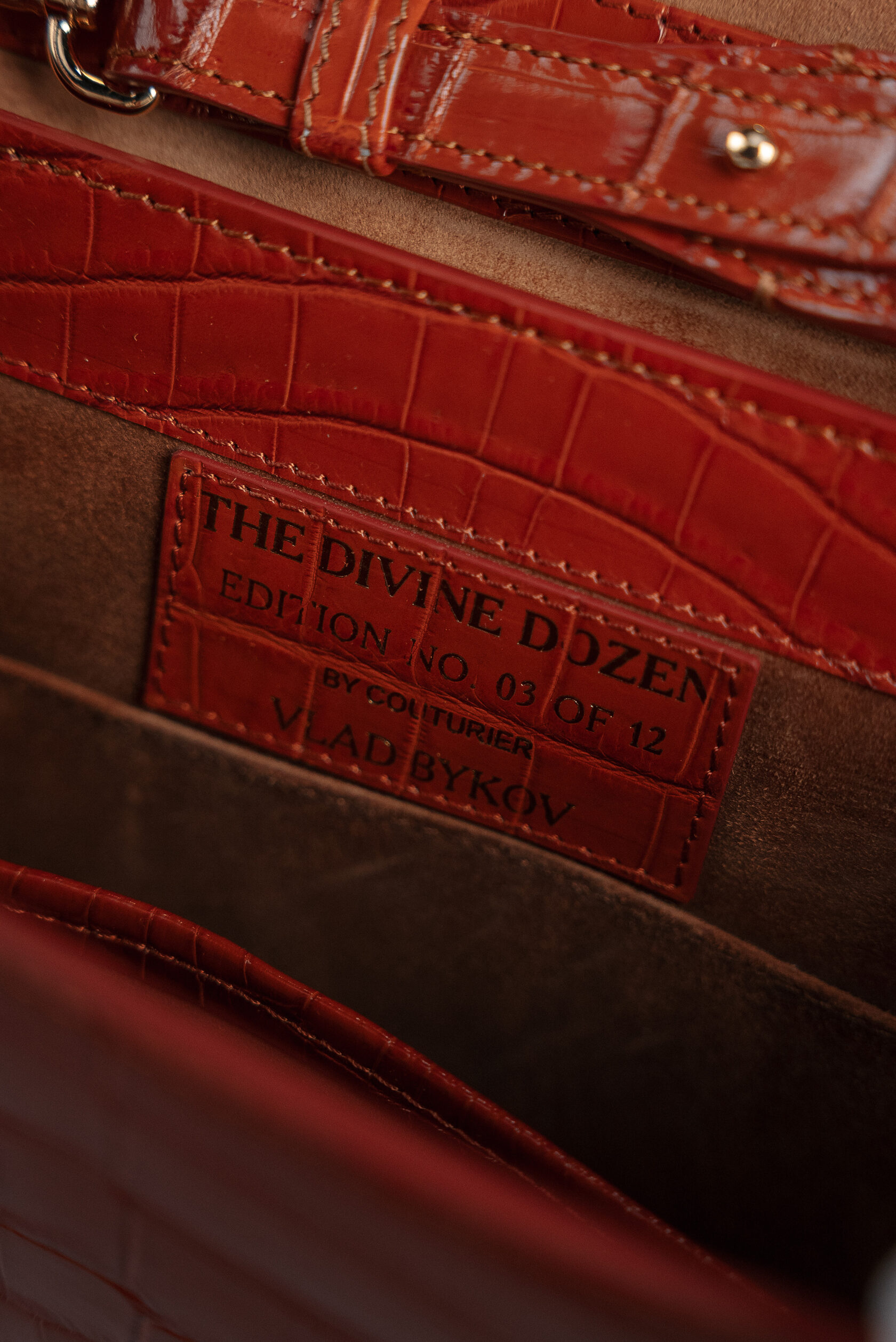
I would add provenance. A bag that is signed, numbered and recorded by its maker can always prove what it is. That is the logic of The Divine Dozen: every bag carries an edition label with its number, and we keep the record.
How does a crocodile Birkin compare with a one-of-one crocodile bag?
They answer different questions. The Birkin is a model Hermès has made since 1984, each bag by a single craftsman in 15 to 20 hours, in many sizes, colours and skins. A one-of-one bag, such as each of The Divine Dozen, exists once, in a colour and finish no other bag shares, and will never be made again.
Buyers often weigh the two, so I set them side by side to inform the choice without ranking one bag above the other. A one-of-one does not try to replace a Birkin: the Birkin offers a name everyone knows, the one-of-one an object no one else will own.
Ready-to-wear, one of one or bespoke: which crocodile bag should you buy?
Ready-to-wear if you want a finished bag and like its design; one of one if you want a bag no one else will ever carry; bespoke if you want the colour, size and form decided around you. At the House all three exist: the cross-body, the twelve bags of The Divine Dozen, and commissions made to a guest's brief.
A one-of-one is a finished bag too. Each of the twelve bags of The Divine Dozen is signed, numbered and archived, and none will be recreated. Numbers 4, 8 and 10 have found their owners. Write to me and I will let you know which bags are still available.
A custom crocodile bag starts from a conversation about how you live: the size of your laptop, the strap you prefer, the colour you want to see each time you open it. It will be one of one, but it will not carry a Divine Dozen number, because that collection is closed at twelve. Consultations take place in person in Dubai or by video call, and you can write to me at private@vladbykov.ae. We deliver worldwide, including the USA and Europe.
How does a couturier judge a crocodile skin?
In person and in daylight, by hand before by eye. A photograph flattens the relief of the scales and hides how the skin flexes and changes colour, so I want a guest to hold the bag, open it and bend the strap before deciding. Most checks in this guide take a minute once the bag is in your hands.
In my essay on Loro Piana fabrics I put it this way: "For this reason, I always encourage clients to meet the material in person when possible. To touch it, place it next to the skin, see it in daylight, and compare it with other options." I wrote it about cloth, and it is truer still of crocodile, where no two skins are the same.
So is a crocodile bag worth it? It is, if you choose the bag you will carry. A crocodile bag that lives in a cupboard is an object; one that is carried and cared for becomes part of a life.
Frequently Asked Questions
How many crocodile skins does it take to make a handbag?
It depends on the size of the bag and how strictly the panels are matched. A small bag can be cut from the best part of a single skin; a larger one often needs more than one, because every panel must agree in scale size and tone.
What is the umbilical scar on a crocodile bag?
A small, irregular mark on the belly where the umbilicus of the animal closed, found only on genuine skins. Some makers place it deliberately on the front panel as a signature of real crocodile; others cut around it, so its absence proves nothing.
Is alligator the same as crocodile?
No. Alligators and caimans belong to a different family. True crocodiles carry a tiny sensory organ on almost every body scale, while alligators and caimans have them only on the head. Both give genuine leather, of different value.
Is a glossy crocodile bag harder to look after than a matte one?
Glossy crocodile shows scratches and water marks more readily, though its shine can be restored. Matte and semi-gloss hide daily marks better. Nubuck asks for the most care: keep it from rain and clean it with a soft brush.
What does price on request mean for a crocodile bag?
We confirm the price of each bag individually, because each has its own skin, colour and finish. I will share the price of your chosen bag on request. This applies to all our crocodile bags, from the ready-to-wear cross-body to bespoke commissions.
How long does it take to make a crocodile bag?
Several weeks, because every panel is planned on the skin and cut and finished by hand. In my House, we make a bag in approximately four to five weeks; for a special leather, we confirm the timeframe individually before payment.
Can I order a crocodile bag in my own colour?
Yes, through bespoke: colour, finish, size, lining and hardware are decided around your brief, and the bag is made once. The twelve bags of The Divine Dozen cannot be reordered in another colour; none of them will be recreated.
Where can I buy a genuine crocodile handbag?
From a maker who will name the species and the part of the skin, and let you see the bag. Our ready-to-wear bag is on vladbykov.ae, The Divine Dozen on vladbykovbrand.com, with private viewings in Dubai or by video call. We deliver worldwide, including the USA and Europe.
Which crocodile bag colour is the most versatile?
Black, dark brown and deep blue work with almost everything in a wardrobe, by day and at night. Khaki is a quieter daytime choice. Light colours such as grey, nude or peach are beautiful, show wear sooner and make an excellent second bag.
Are The Divine Dozen bags still available?
Numbers 4, 8 and 10 have found their owners. Write to me and I will let you know which bags are still available. A sold number leaves the collection for good, and The Divine Dozen stays closed at twelve bags.
Written at VLAD BYKOV Couturier House, Dubai. About the House · Ready-to-Wear · Commission a bespoke piece · Contact · Privacy Policy
Hermès, Birkin, Christie's and other names mentioned in this article belong to their respective owners and are referenced for context only. Mention does not imply partnership, licence or endorsement.