12.11.2026
Hand-Stitched or Machine-Stitched: The Anatomy of a Loafer Explained
Hand-Stitched or Machine-Stitched: The Anatomy of a Loafer Explained
By Vlad Bykov, Founder and Couturier, VLAD BYKOV Couturier House, Dubai · Published 12 November 2026
A hand-stitched loafer has its key seams, the apron around the toe first, sewn by a craftsman with two needles: stitches vary slightly, lean at an angle, each pulled tight by hand. Machine seams are perfectly regular. The larger difference lies underneath: how the sole is attached decides how long a pair lives and whether it can be resoled.
What is the difference between hand-stitched and machine-stitched shoes?
A machine sews along a fixed path at speed, so every stitch is identical. By hand, a craftsman opens each hole with an awl and passes two needles through it from opposite sides, setting the tension stitch by stitch. Hand seams are slower and slightly irregular, and they follow tight curves; machine seams are faster and perfectly uniform.
Neither is a mark of quality on its own. Modern machines sew strong, clean seams, and almost every shoe made today, fine ones included, combines the two. Quoddy, a maker of moccasin-construction shoes in Maine, describes its process plainly: the shoe is "mostly" stitched on sewing machines, then tacked onto a last, and a hand sewer closes it with a curved awl and two needles, locking each stitch around the toe and heel.
So the useful question is which seam, and how. A machine stitch on the straight seam of a lining changes nothing for the wearer. A hand stitch on the apron of a moccasin toe, where the leather is gathered around a curve and the vamp bends with every step, changes how the toe looks and how it ages.
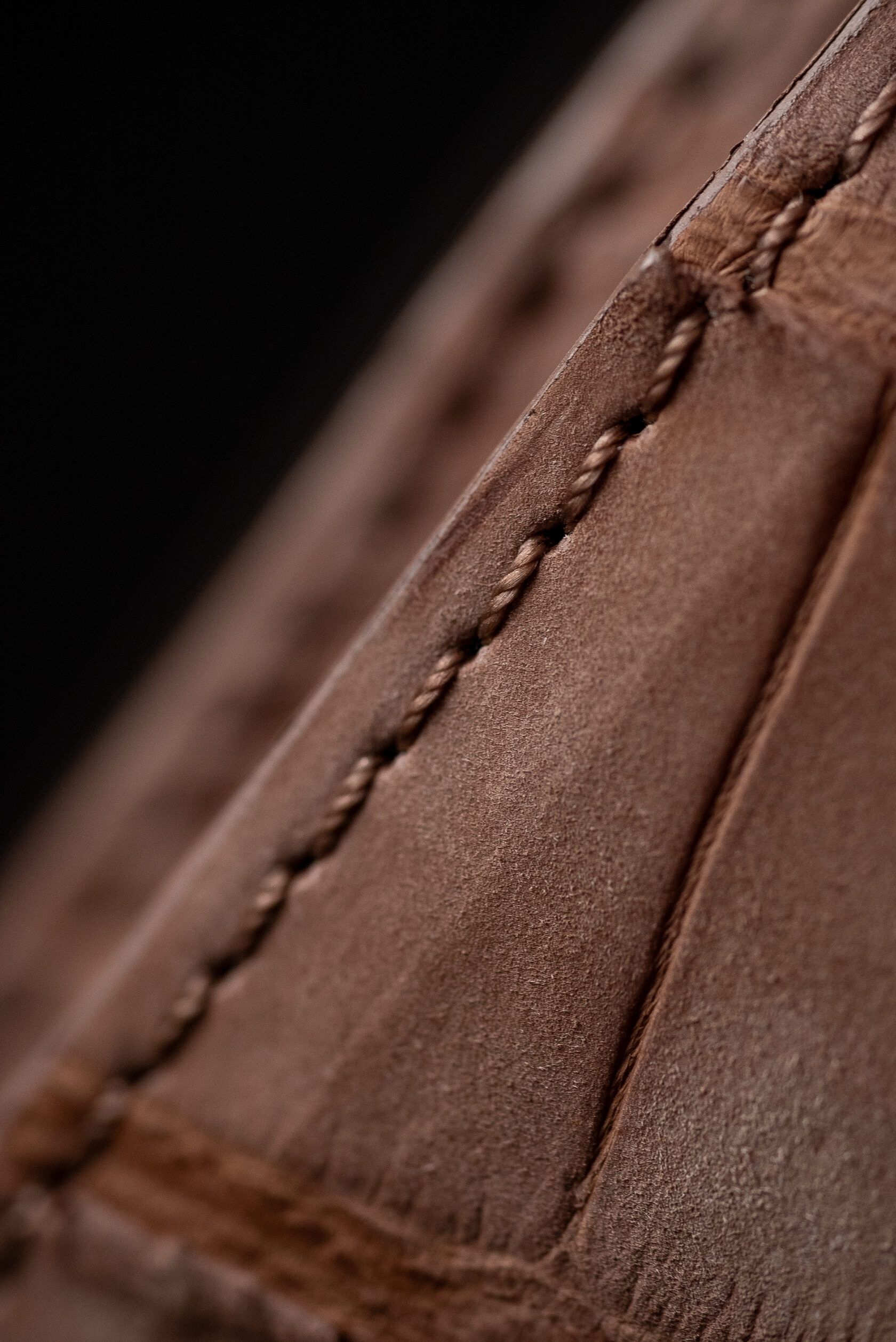
What are the parts of a loafer?
An upper and a bottom, shaped together over a form called the last. The upper is the vamp with its apron, the quarters, the heel counter and the lining; the bottom is the insole, the sole and the heel. Many loafers add a saddle across the instep. Each part tells you how the pair was made.
The parts that matter most are the ones you see least. Insoles are usually made of cellulosic paper board or synthetic insole board; a leather insole costs more and moulds to the foot. Heel counters follow the same logic: the glossary of Shoegazing describes leather board, leather dust pressed with glue, as conforming less than a real leather counter.
The last is the part a guest never sees. Its shape decides the toe, the grip at the heel and the room over the instep, and in a slip-on that grip is everything: there are no laces to correct a loose heel.
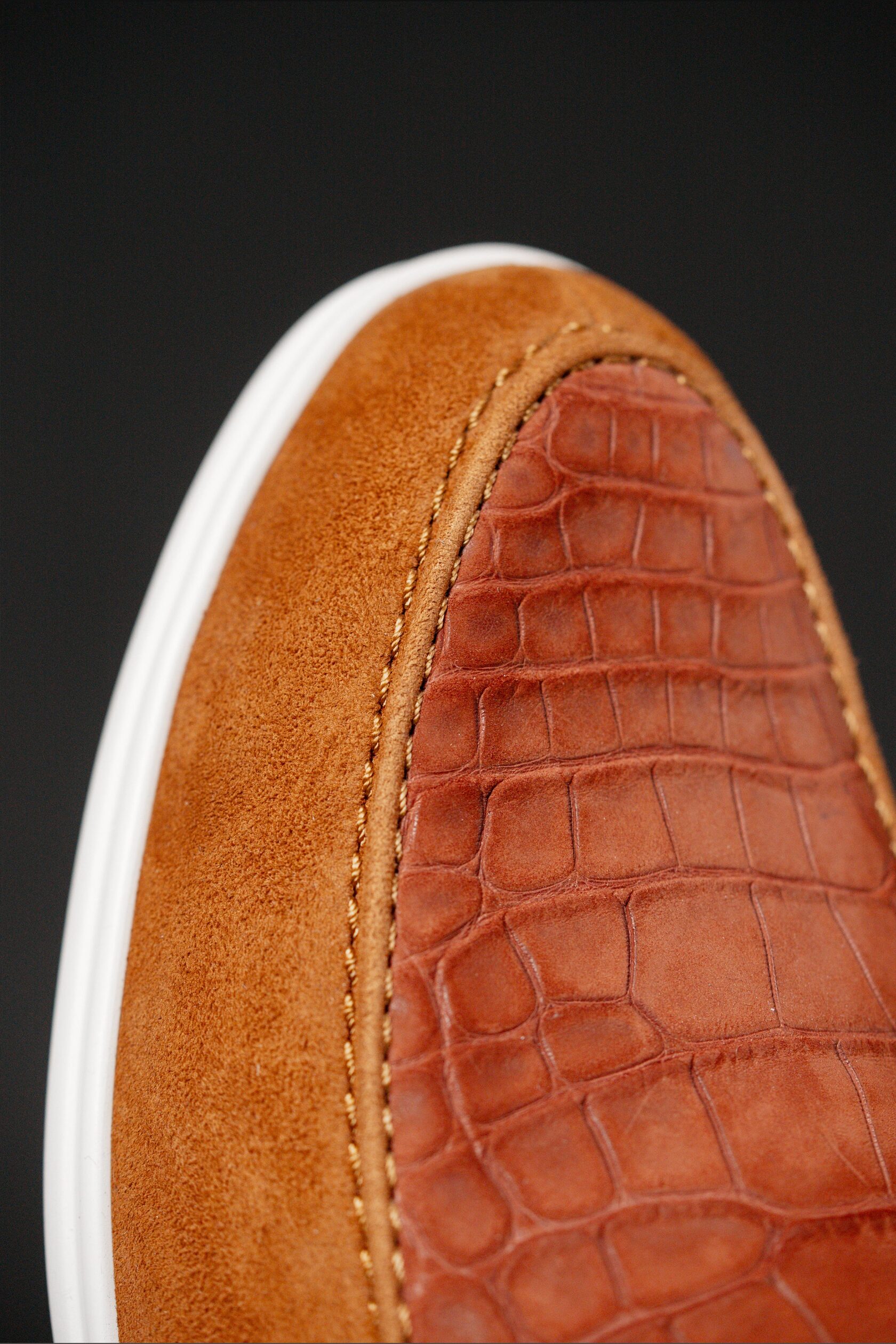
What is moccasin construction in a loafer?
The leather of the vamp wraps around the foot from underneath, and an oval apron is sewn onto the top to close it. That raised seam around the apron is the signature of the loafer and the place where hand sewing shows most. Adding a sole and a heel turns the moccasin into a loafer.
The moccasin itself is a shoe of soft leather whose sole and sides are one piece, stitched together at the top, sometimes with an additional panel over the foot. The loafer keeps that architecture: the most common slip-on shoe has a moccasin construction.
G.H. Bass gives a precise example in describing its Weejuns: a tubular moccasin cut in four parts, with the counter and collar machine-stitched first, then the shoe attached to the last for hand stitching, where two needles form the gathered "beefroll" edge around the vamp. The outsole is then stitched through the upper.
Not every loafer with an apron seam is a true moccasin: many are built the conventional way, on an insole, with the apron seam sewn on top for its line. Both are legitimate; what separates them is how the sole is attached.
How is the sole attached to a loafer?
In one of five ways: stitched to a hand-closed moccasin, Blake-stitched through the insole, Blake Rapid with a midsole and a second stitch, Goodyear-welted to a strip of leather around the edge, or cemented with adhesive. Each gives a different weight, flexibility and water resistance, and a different answer to whether the sole can be replaced.
The details come from the sources this guide relies on: Shoegazing on the Blake construction, Wikipedia on the Goodyear welt and Primer Magazine on cemented shoes. Glue alone is not a verdict: even a Goodyear-welted sole is attached by a combination of stitching and adhesive.
Blake vs Goodyear welt: which is better for a loafer?
For most loafers, Blake or a hand-closed moccasin: both keep the shoe slim, light and flexible, which is what a slip-on is for. A Goodyear welt suits a loafer meant for rain, long city days and many resolings, at the price of weight and a stiffer start. Blake Rapid sits between them: slim outside, welt-like in durability.
Both machines were built to replace hand sewing. Lyman Reed Blake received his patent on 6 July 1858 for a machine that sewed soles to uppers and removed the heavy work of sewing them by hand; Gordon McKay bought it and filed an improved patent in 1862, and the McKay stitcher made shoes far faster than hand stitching. The welt machine began with Auguste Destouy's curved needle in 1862 and was improved from 1869 by mechanics employed by Charles Goodyear Jr., as a machine alternative to the traditional hand-welted method.
Climate is part of the choice. Shoegazing notes that Blake is most common among quality makers in the south, in Italy and France, where neat, light shoes suit a warm, dry climate. Dubai is hot rather than dry, but the logic carries: a slim, light, flexible sole is easier to wear in heat; for wet winters, a welt.
A welt is also slow to make. Crockett & Jones, a Northampton maker of Goodyear-welted shoes since 1879, says each pair takes up to eight weeks and over 200 operations. That is a factory working at the highest standard, and it shows how much of a fine shoe's cost is time.
What is Blake Rapid, and how is it different from Blake?
Blake Rapid adds a midsole. The upper and insole are Blake-stitched to that midsole, and the outsole is then sewn to it with a second stitch around the outside edge. The result looks almost exactly like a welted shoe, keeps out water nearly as well and is resoled the same way, while staying slimmer and lighter.
Shoegazing calls it a construction too often mistaken for plain Blake. From the outside it cannot be told from a Goodyear welt, because the midsole looks like a welt; inside the shoe you can usually see the Blake seam running along the insole. To resole it, the cobbler removes the outer stitch and sews on a new outsole, and the Blake seam is never touched.
Plain Blake is resoled differently: the stitch runs straight into the shoe, so the cobbler needs a Blake machine, which not every cobbler has, and each resoling makes new holes in the upper. After a few rounds the leather can no longer hold a seam.
What does a cemented loafer mean?
The sole is glued to the upper with industrial adhesive and nothing is stitched through. Cementing makes a shoe light, fast and inexpensive to produce, and it allows foam and moulded soles. The cost comes later: when the sole wears through or the bond fails, the shoe is usually finished, because it was not built to be resoled.
Glued shoes are not new: a process for stitchless, glued shoes was developed in 1910. Traditional shoemakers used more than fifteen techniques, from English welted and Norwegian to moccasin and Blake-stitched.
Primer Magazine gives a rule of thumb for mainstream retail, and applies it especially to shoes under $200: when a product page does not name the construction, it is probably cemented. Look at the sole edge too. On a cemented shoe there is usually no stitching around the outsole, or only a decorative line moulded into the rubber, and the joint between sole and upper is a smooth glue line.
How to tell if shoes are handmade?
Look at the seams, not at the label. Hand stitches vary slightly in spacing and angle, sit pulled into the leather and follow curves without wandering. Then check what is costly to fake: a leather insole and heel counter, a leather lining, a stitched sole. Finally, ask the maker which steps are done by hand.
A checklist for the loafer in your hands:
- The apron seam: even tension, a slight natural variation, no puckering at the tightest curve of the toe.
- The stitch: hand stitches often sit at a slight angle and may show the marks of the awl; machine stitches line up like print.
- Inside: a stitch line under the insole means Blake; a smooth insole with stitches around the sole edge means a welt or Blake Rapid.
- The sole edge: real stitches you can count, not a line moulded into rubber.
- The heel: leather springs back when you press the counter, and keeps its curve.
- The lining: leather all the way, fitted without loose edges or traces of glue.
- The word "handmade": printed on an insole, it proves nothing; the construction does.
No single sign is proof. A gifted hand can sew almost as evenly as a machine, and a machine can imitate irregularity. That is why the test is a conversation: a maker who works by hand can tell you exactly which seams were sewn by hand and which by machine.
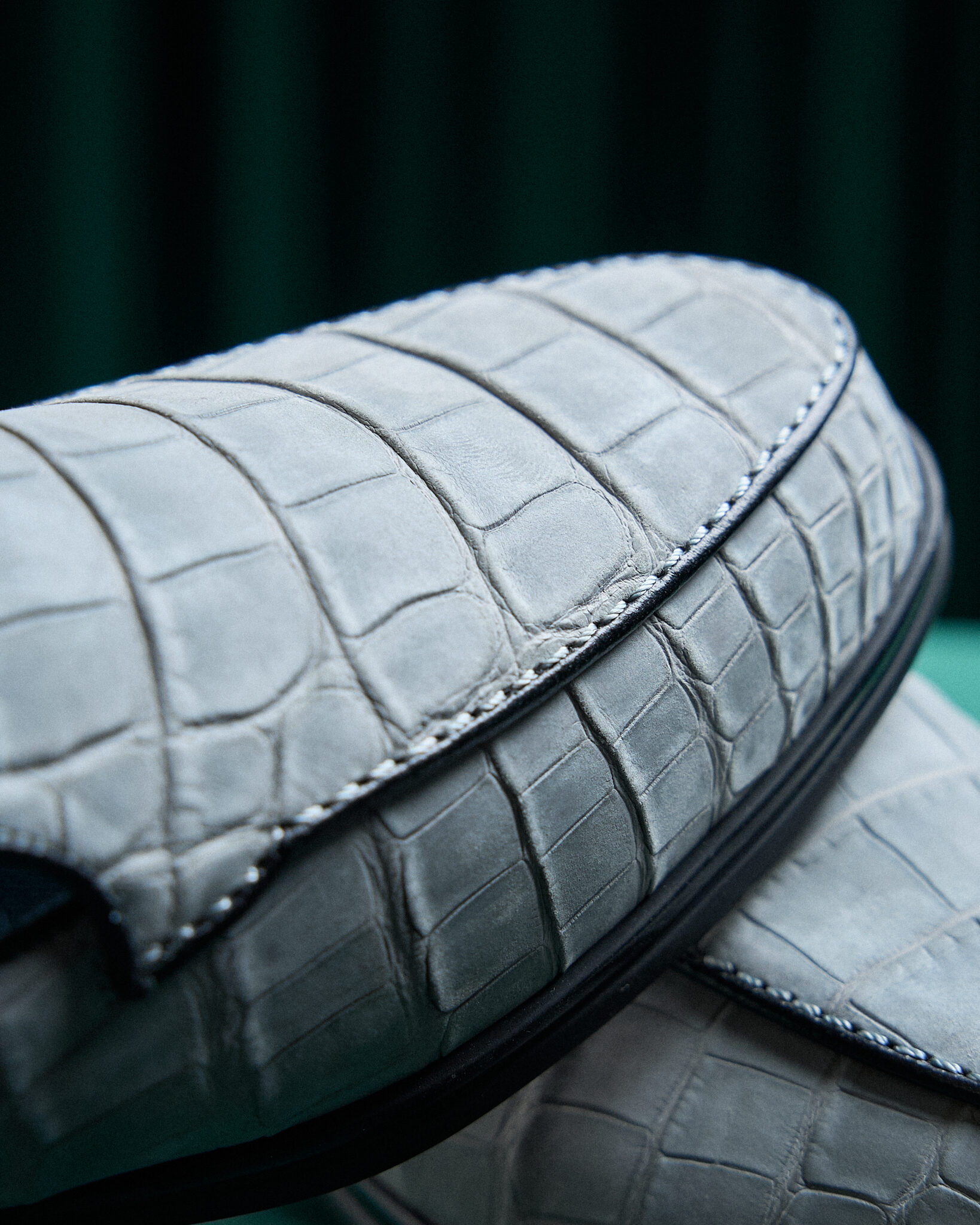
Where does hand stitching matter most in a loafer?
At the apron, where the leather is gathered around the tightest curve of the toe and the vamp bends with every step. Sewn by hand, that seam can be tensioned stitch by stitch to the shape of the last. Next come the closing of a moccasin and the edge where the upper meets the sole.
Elsewhere a machine is often the better tool. A straight seam on a quarter or a lining is cleaner when it is perfectly regular, and no guest gains anything from it being slower.
In my essay on Modern Sprezzatura I wrote that the effort a well-made piece conceals "has moved inside the piece: into the last, the choice of leather, the hand stitching visible only up close." That is where to look on a loafer: up close, at the seams that bend.
How does a handmade loafer differ from a mass-produced one?
In time, materials, fit and repair. A handmade pair takes weeks; it uses leather where mass production uses board, plastic and synthetics; it is built on a last chosen for the foot; and its construction lets it be resoled. The price difference follows from all four.
Time is the clearest measure. At the House, Made-to-Order with material in stock takes two and a half to three weeks, and a pair built to measurements three and a half to five weeks; I set out why in how long bespoke production really takes.
Leather is the other half of the story, and the words on a label mean less than they suggest: what full grain, top grain and genuine leather actually promise is a subject of its own.
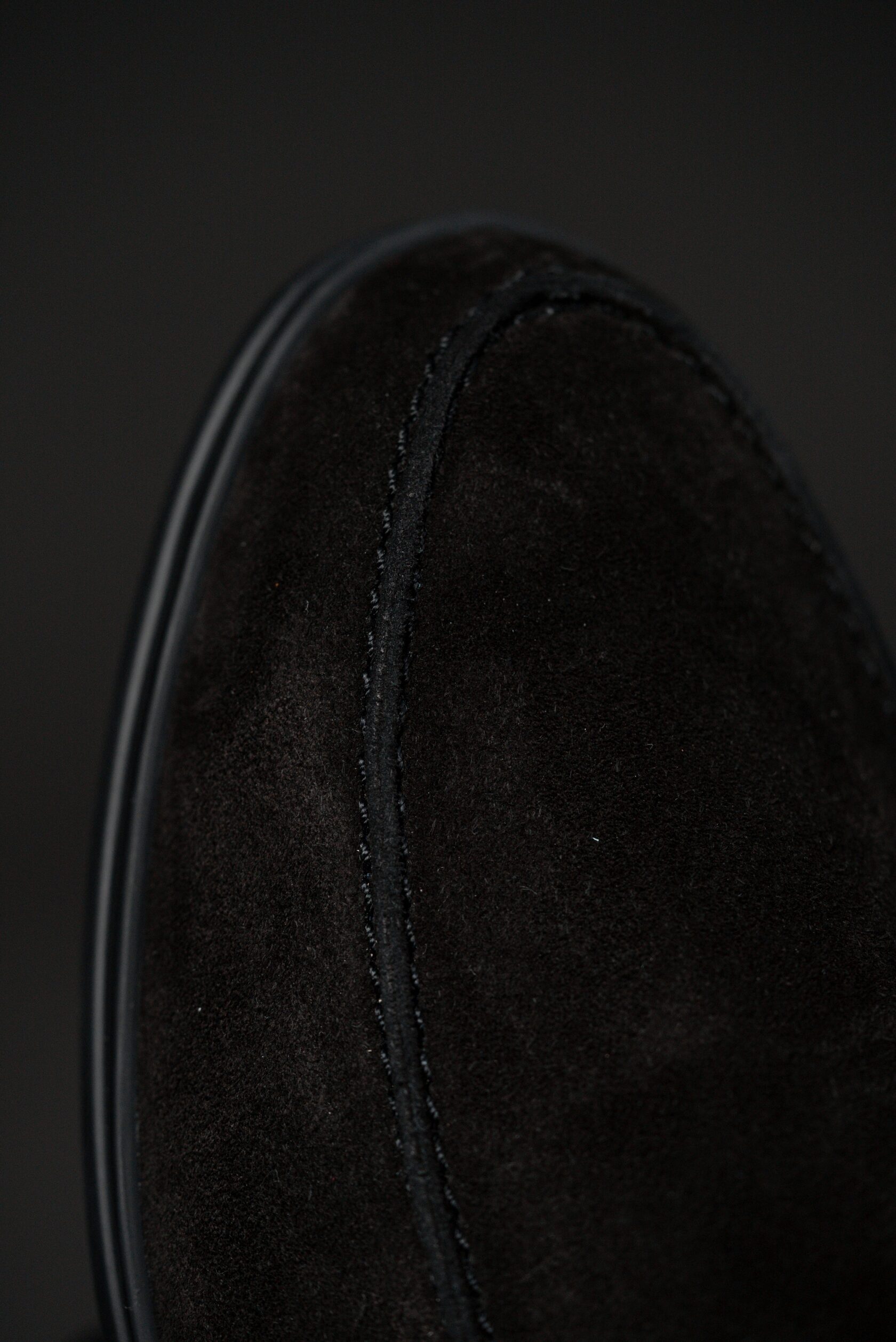
Can loafers be resoled?
Most well-made loafers can. A Goodyear-welted or Blake Rapid pair is resoled by removing the outer stitch and sewing on a new outsole, as often as the upper allows. A Blake pair needs a cobbler with a Blake machine, and only a few times. A cemented pair is rarely worth it.
Resoling is also a moment to choose the sole again. Leather reads more formal; rubber grips better and copes with wet streets. Dress shoes often have leather or resin rubber outsoles, casual shoes natural rubber or polyurethane.
A new sole only helps an upper that is still sound: rest a pair for a day between wearings, keep it on cedar shoe trees and never leave it in a hot car.
How are VLAD BYKOV loafers made?
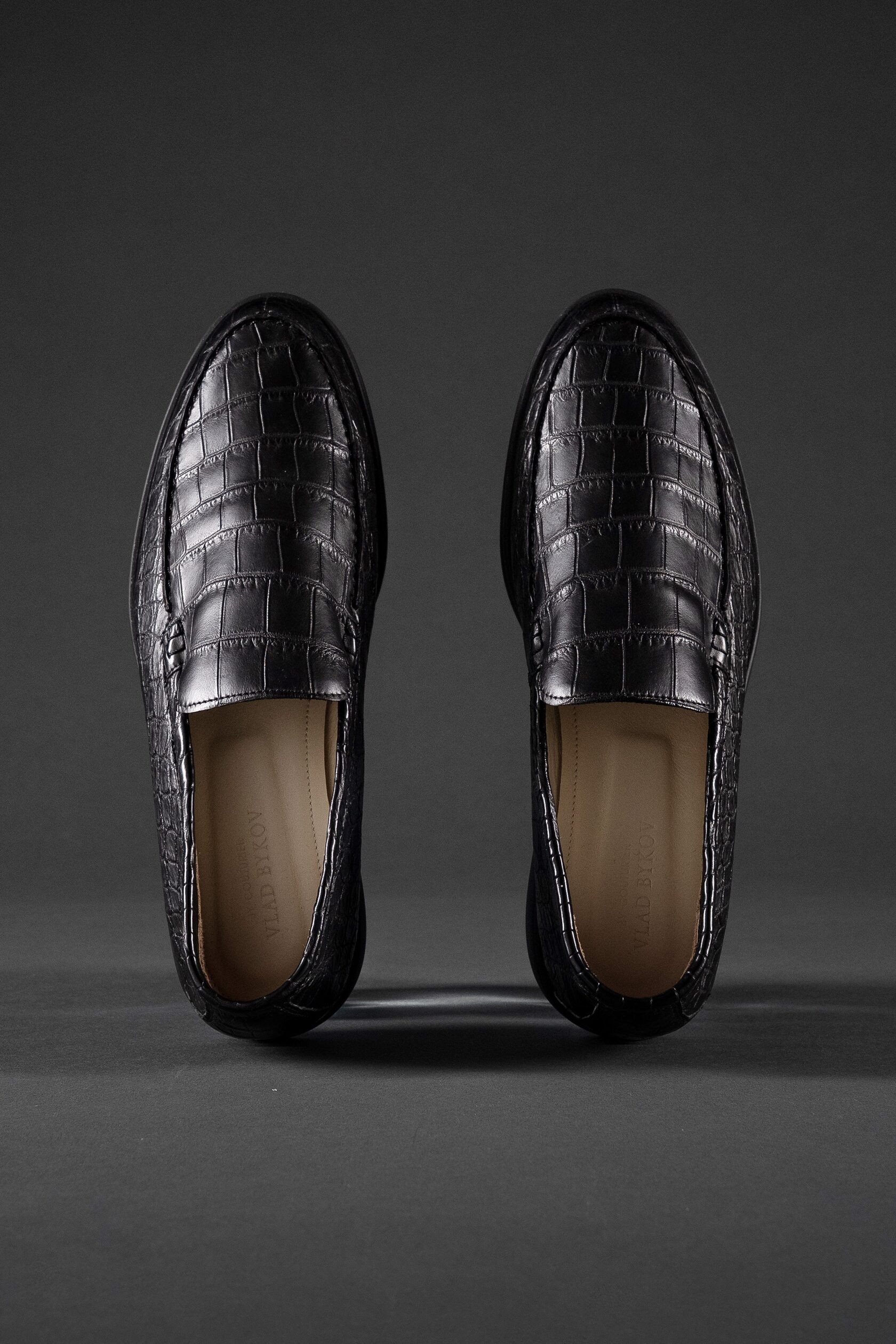
By hand, in Italian suede, crocodile or both, with a natural calfskin lining, a natural leather insole and a lightweight caoutchouc sole. Pairs are made in EU 40 to 45, with EU 47 to 49 on request, or built to your measurements as Bespoke. Most pieces are made by artisans with decades of experience in fine leathers.
For specific pieces, production is placed with European factories working strictly to the House's requirements, and soles are developed with leading European manufacturers.
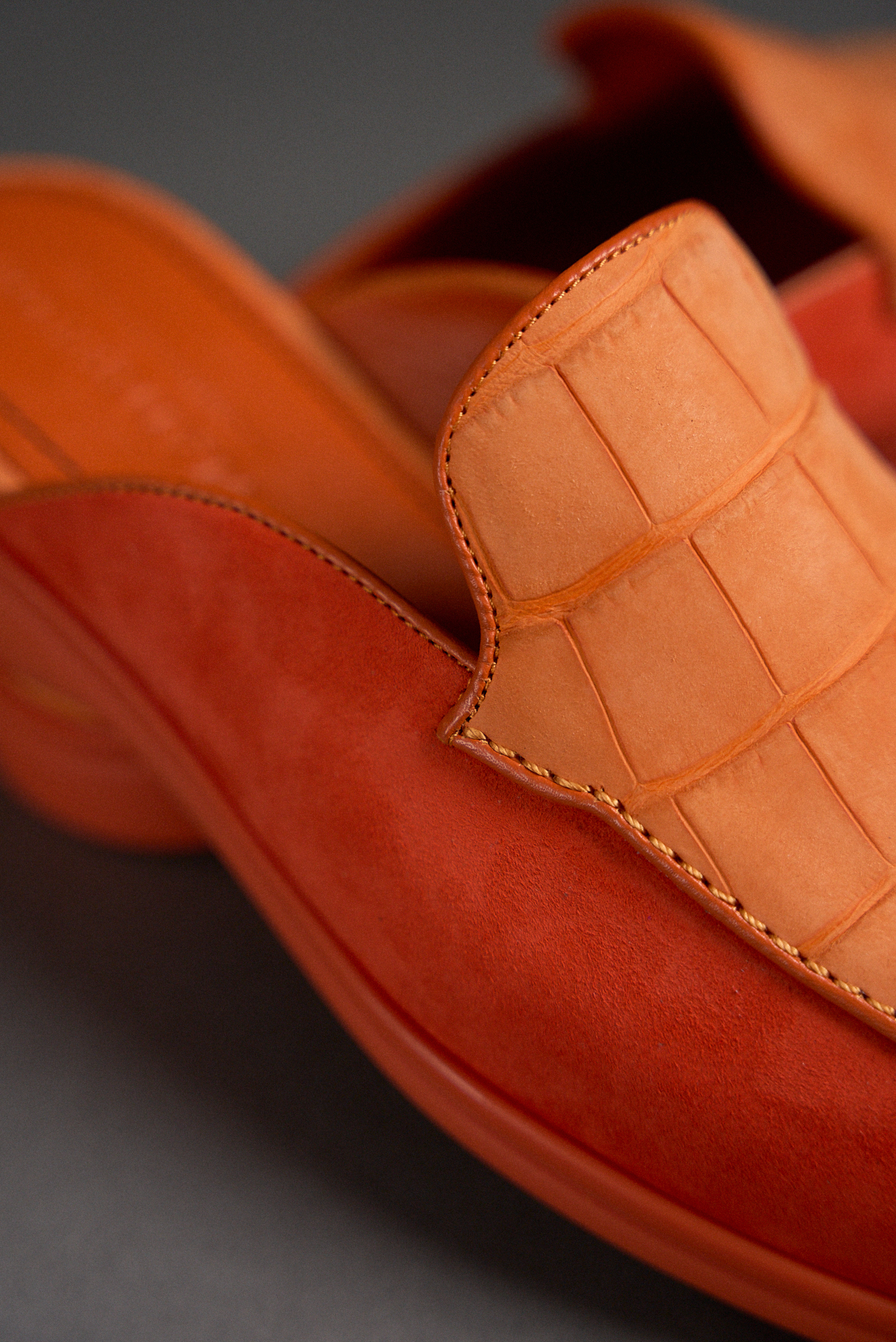
The loafers on vladbykov.ae come in Italian suede in six colours, in nubuck crocodile against cognac suede, and in black matte or glazed crocodile. The pairing of the two materials is a House signature, and I explain it in why crocodile and suede are combined. Every pair is priced on request through Contact.
In my work the visible hand of the maker is part of the design. In the same essay I listed it as "Contrasting hand stitching, slim leather piping along the edge, the owner's name embroidered by hand." Those details are noticed up close, and they say the pair was made for one person.
What should you ask before buying handmade loafers?
Five questions: which seams are sewn by hand, how the sole is attached, whether and where the pair can be resoled, what the insole, heel counter and lining are made of, and which last the pair is built on. A maker who works by hand answers each one at once.
Ask for the construction by name. "Hand-finished" can mean anything from a hand-sewn apron to a polished edge on a glued shoe, while "Blake Rapid" or "Goodyear welt" means one thing only. Ask, too, what the maker does when the sole wears through: whether the pair comes back to them, or goes to any good cobbler.
If you are ordering from another country, the practical side, sizes, delivery and duties, is in where to get custom-made loafers shipped internationally. Wherever you buy, choose the construction for how the pair will be worn, and the stitching for where the shoe bends.
Frequently Asked Questions
What does hand-lasted mean?
The upper is pulled over the last and fixed to the insole by hand, with pincers and tacks or stitches, rather than by a lasting machine. Hand lasting lets the maker work the leather into the shape of the last gradually, which matters most at the toe and heel of a slip-on.
What is a saddle stitch?
A hand stitch sewn with two needles on one thread, passed through each hole from opposite sides. Each stitch locks on itself, so one broken stitch does not run along the seam. It is the classic stitch of leatherwork and of hand-sewn loafer aprons.
What is a heel counter in a loafer?
The stiffener built into the back of the upper, between the outer leather and the lining. It holds the shape of the heel and keeps a slip-on on the foot. A leather counter moulds to the heel with wear; leather board or plastic is cheaper and conforms less.
Is a rubber sole a sign of a cheaper loafer?
No. The material of the sole and the way it is attached are separate choices. Rubber grips better and copes with water; leather looks more formal. VLAD BYKOV loafers have a lightweight caoutchouc sole, a natural rubber, under a natural leather insole.
Does "handmade" on the insole prove a shoe is handmade?
Not on its own. The word is used loosely across footwear, so the construction proves more than the label: hand-sewn seams, a stitched sole, leather insole, counter and lining, and a maker who can say which operations were done by hand.
Are Goodyear-welted loafers stiff at first?
Often, yes. A welted shoe carries a welt, a cork filling and a stitched outsole, so it is heavier and bends less in the first weeks while the cork settles under the foot. A Blake or moccasin loafer is usually supple from the first day.
Why do handmade shoes cost more?
Because the cost is time and skill as much as material. Crockett & Jones describes up to eight weeks and over 200 operations for one welted pair; hand-sewn seams, leather insoles and counters and stitched soles add work that a cemented shoe never needs.
What is the difference between a loafer and a moccasin?
A moccasin is a soft shoe whose sole and sides are one piece of leather, stitched together at the top. A loafer keeps the moccasin's wrapped vamp and apron seam but adds an outsole and a heel, which makes it a shoe for city streets rather than soft ground.
Do VLAD BYKOV loafers have a leather lining?
Yes. Every pair is lined in natural calfskin and has a natural leather insole, whether the upper is Italian suede, crocodile, or crocodile combined with suede. A lining in a contrasting colour can be chosen as part of a Private Order.
How much do VLAD BYKOV loafers cost?
The price is given on request. Send the model, the material and your size to your advisor through Contact, and the quote comes back for your pair; Bespoke sizes and Private Order details are priced individually and confirmed before payment.
Written at VLAD BYKOV Couturier House, Dubai. About the House · Ready-to-Wear · Commission a bespoke piece · Contact · Privacy Policy
Crockett & Jones, G.H. Bass, Weejuns, Quoddy and other names mentioned in this article belong to their respective owners and are referenced for context only. Mention does not imply partnership, licence or endorsement.