11.11.2026
Full Grain, Top Grain and Genuine Leather: What the Words Actually Mean
Full Grain, Top Grain and Genuine Leather: What the Words Actually Mean
By Vlad Bykov, Founder and Couturier, VLAD BYKOV Couturier House, Dubai · Published 11 November 2026
Full grain leather keeps the entire grain surface of the hide, with nothing sanded away. Top grain is the grain layer split from the hide, usually sanded and refinished. Genuine leather is not a grade: it only says the material is leather, often corrected grain or split. Read the label, the surface and the edge.
What is the difference between full grain, top grain and genuine leather?
The difference is how much of the original surface survives. Full grain keeps all of it, pores and natural marks included. Top grain keeps the grain layer but usually has its surface lightly sanded. Corrected grain is sanded further and coated. Genuine leather names no layer at all, and bonded leather is not leather.
Most leather comes from cattle, and a thick hide is split horizontally into layers before or after tanning. The top layer carries the grain: the outer surface with the pattern of hair follicles, or of scales on a reptile. Everything below it is split. The grade words on a label describe which layer you are holding and what was done to its surface.
Below, each line in turn: what the standards and the US Federal Trade Commission say, how to check a piece by hand, which grade lasts and where crocodile sits.
What do the leather standards say?
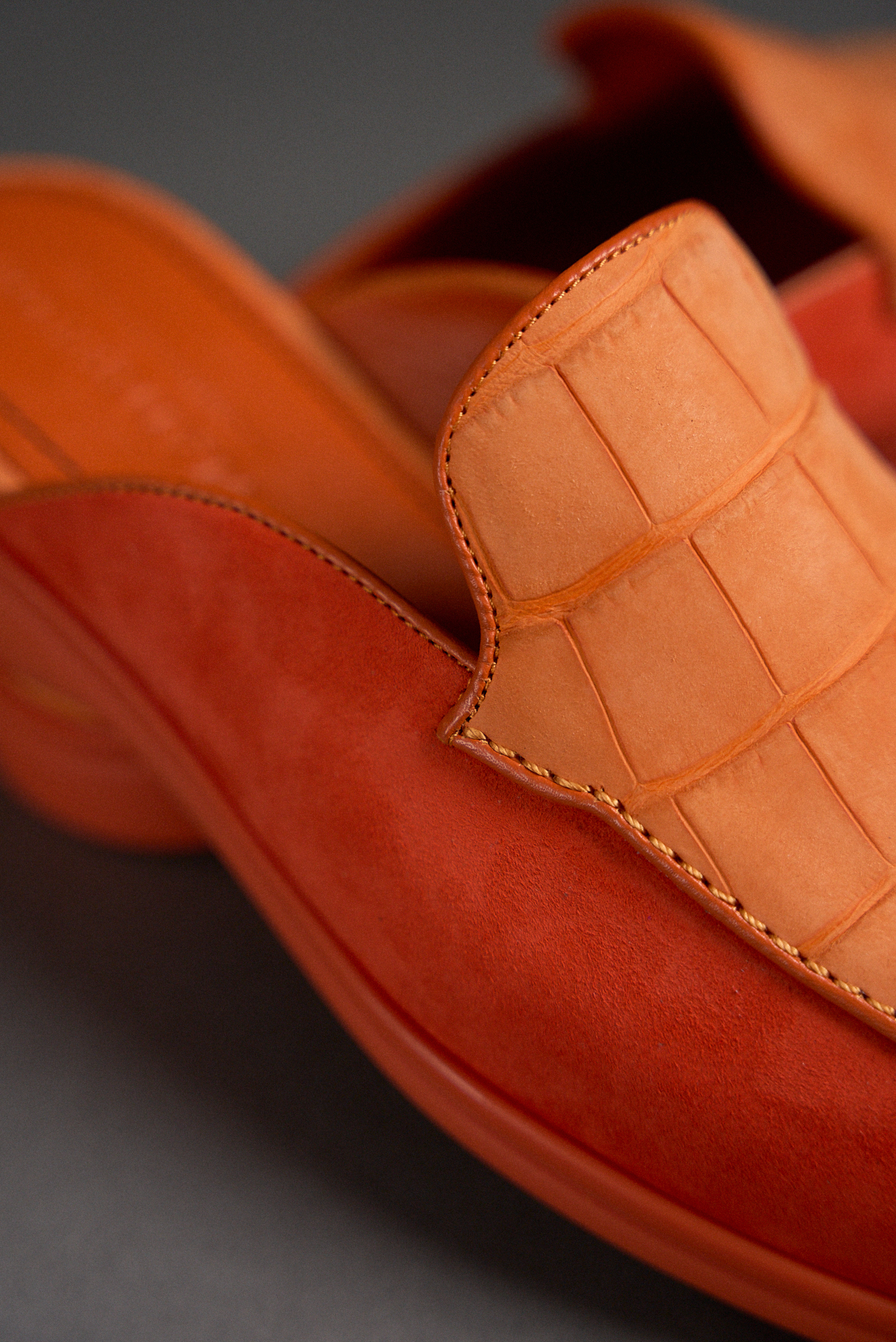
Three texts set the vocabulary. The European standard EN 15987 and the international ISO 15115 define leather as hide or skin with its fibrous structure more or less intact, tanned so that it does not rot, with any surface coating no thicker than 0.15 mm. The US Federal Trade Commission adds guidelines for bags, belts and shoes.
EN 15987:2022, from the European Committee for Standardization, says leather is exclusively of animal origin and adds two notes that matter to a buyer. If the tanned hide is broken down into fibres or powder and pressed into sheets, "such sheets or forms are not leather". And if the grain layer has been completely removed, the word leather should not stand alone: it becomes split leather or suede leather.
ISO 15115:2019, the international vocabulary of the leather trade, defines the grades themselves. Full grain leather has "kept its entire grain, with none of the surface removed by any corrective mechanical treatment". Corrected grain leather has had its grain "partially removed by buffing" and then enhanced by a finish. Genuine leather, the phrase buyers see most often, is not among the terms it defines.
In the United States the FTC's Guides for Select Leather and Imitation Leather Products, 16 CFR Part 24, cover handbags, wallets, belts and footwear. They allow the unqualified word leather only for a product "composed in all substantial parts of leather", and they ask for disclosure whenever leather is embossed to imitate another leather or contains ground or bonded fibres.
What is full grain leather?
Full grain leather is leather with its entire grain intact: the hair and the epidermis are removed, and nothing more. No sanding, buffing or splitting touches the surface, so the pores, fine creases and small natural marks of the animal stay visible. It is the most honest form of a hide, and it ages instead of wearing out.
The European footwear labelling directive gives the most exact wording of all. If a label uses the term, the leather must bear "the original grain surface as exposed by removal of the epidermis and with none of the surface removed by buffing, snuffing or splitting", in the words of Directive 94/11/EC.
Because the grain is left whole, full grain can only be made from the cleanest hides: a scar cannot be sanded away. That is why it costs more and why two pieces never look identical. Its finish is usually light, aniline or semi-aniline, and over years of wear it darkens and softens into a patina.
You meet it in fine shoes and their linings, in belts and inside a well-made bag. Nappa, in the ISO vocabulary, is simply soft full grain leather, dyed through and lightly finished.
What is top grain leather, and is it real leather?
Yes, top grain is real leather. Technically it is the top layer split from a thick hide, the layer that carries the grain; the European standard calls it a top-grain split. In retail, especially in the United States, top grain usually means grain leather whose surface has been lightly sanded and refinished to look even.
So every full grain hide is, literally, top grain, but not every top grain is full grain. The word on its own does not tell you whether the surface was sanded. The FTC Guides use Top Grain Cowhide as their example of naming the kind and type of leather, and that is the right instinct: a precise label names the animal and the layer.
Sanded grain looks uniform and resists stains better at first. What it loses is the very top of the grain, the part that ages most beautifully, so it develops less patina. When a seller says top grain, ask one question: has the surface been sanded?
What is corrected grain leather?
Corrected grain leather is leather whose grain has been partly buffed away to remove defects, then covered with a finish, often pigmented and embossed with an artificial grain. ISO 15115 defines it by those two steps, buffing and finishing. It is real leather and very uniform, though its look is the work of the finish.
The ISO definition carries a telling note: the original pattern is generally identifiable "except for heavily corrected grains". The more correction, the less of the animal you see. Correction is how hides with scars become saleable.
Two terms sit beyond it. Coated leather carries a coating thicker than 0.15 mm, up to a third of the total thickness; patent leather carries a mirror-like varnish within the same limit. Both are leather, named in full.
Embossing is not a fault in itself. It becomes one when it imitates another leather and the label stays silent. Under the FTC Guides, cowhide pressed to look like pigskin may be sold as "Top Grain Cowhide"; if the seller mentions the pigskin look, the label reads "Top Grain Cowhide With Simulated Pigskin Grain". The same logic applies to calf embossed with a crocodile pattern.
What is split leather, and is suede real leather?
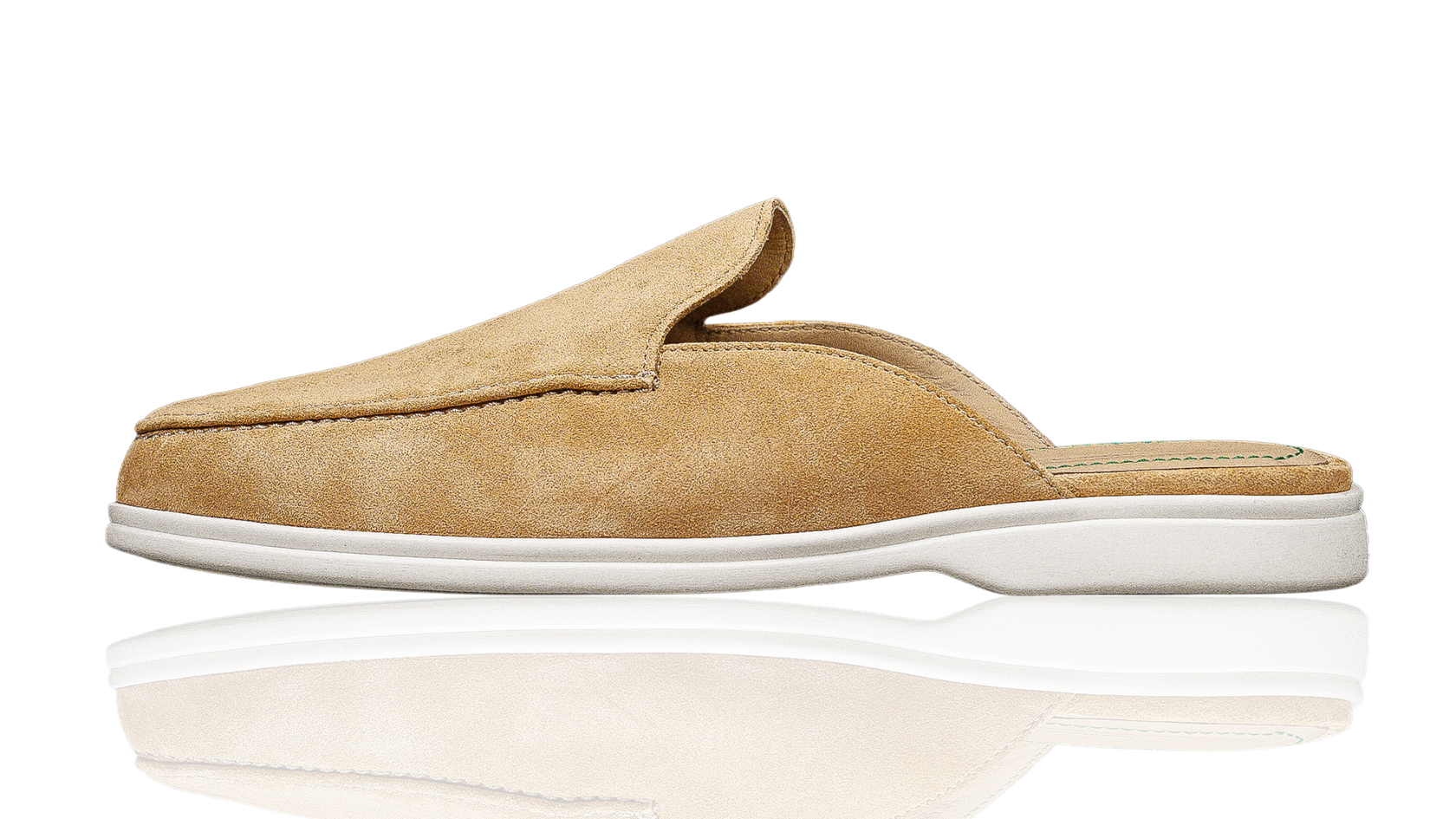
Split leather is a lower layer of the hide, cut away from the grain. It is real leather, but looser and weaker than grain leather, and the European standard says it must be named as split. Suede is a finish: a surface brushed to a velvety nap, made from split or leather.
EN 15987 defines split leather as a layer "without any grain structure", taken from the flesh side or, in heavy hides, from the middle. A split can be napped into suede, or coated and embossed to look like grain leather. The second is where buyers are misled: a pigmented film on a split passes for smooth leather on a shelf, then cracks where grain would crease.
In the ISO vocabulary, nubuck is grain leather buffed to a velvety effect with the grain pattern still visible, while suede is leather or split finished to a nap. Fine suede is judged by the density of that nap; our guide to Italian suede explains how to read it by hand.
Is genuine leather real leather?
Genuine leather is real leather, but it is not a grade. The phrase says the material comes from an animal hide, not which layer or how much of the surface survives. Neither ISO 15115 nor the FTC Guides define it as a level of quality, and it often appears where a maker prefers not to name the layer.
If the label is honest, the answer is yes. Under the FTC Guides, unqualified leather has to be leather in all substantial parts, so a genuine leather belt should be leather throughout, not leather glued to vinyl. What the phrase does not promise is full grain, top grain or any grain at all: corrected grain and coated split both qualify.
That is why genuine leather is often called a low grade; it is fairer to call it a silence. A maker who uses full grain says full grain. Next to a species, as in genuine crocodile, the word confirms a real skin; on its own it names nothing.
In an essay on people who build history I wrote about respect for material: "I often see the absence of that respect in finished pieces — where a material has been used against its nature, simply because it was faster or more profitable that way."
Is bonded leather real leather?
No. Bonded leather is made from leather scraps ground into fibres and glued into a sheet, often finished with a polyurethane film. EN 15987 states that such sheets are not leather, and the FTC Guides ask that a material sold as bonded leather disclose its percentage of leather fibres and of other substances.
The FTC's own example reads: "Bonded Leather Containing 60% Leather Fibers and 40% Non-leather Substances." If a material only looks like leather, such as polyurethane or vinyl, the Guides ask for a plain disclosure: Not leather, Imitation leather, Simulated leather, Vinyl or Plastic.
Bonded leather tends to fail where it bends, as the film separates at edges and creases: fine for a book cover, poor for a shoe or a strap. The same European definition rules out vegan leather, since the word is reserved for hide or skin exclusively of animal origin.
How do you read the leather label on shoes and bags?
Read it part by part. In the European Union, footwear is labelled for three parts, the upper, the lining and sock, and the outer sole, each with one of four materials: leather, coated leather, textile or other. The label names the material that makes up at least 80 percent of each part.
Directive 94/11/EC allows the information as pictograms or as written words, affixed to at least one shoe of each pair. It is worth reading all three parts, because a pair can carry a leather upper and a synthetic lining, and the lining is the part that touches the foot.
The FTC Guides use the same three parts for shoes and accept a disclosure such as "Upper of manmade materials and leather" when synthetics dominate. For bags and belts, any non-leather part that looks like leather, a gusset or a backing, should be disclosed on an attached tag or stamp.
A genuine leather stamp on an insole speaks for the insole alone. When a description says leather without naming the part, ask which parts: upper, lining, insole, sole, strap.
How can you tell real leather and full grain in your hands?
Look at the surface, bend it, then look at the edge and the back. Full grain shows irregular pores and small marks, creases finely when bent and has a dense, fibrous edge. Corrected grain looks uniform and slightly plastic, embossed patterns repeat, and imitation leather shows a fabric or foam layer at the cut edge.
1. Pores and marks. In daylight, full grain shows irregular pores and the occasional small scar. A perfectly regular pattern, identical on both shoes, has been pressed in. 2. The break. Bend the leather with the grain inward. ISO 15115 calls the wrinkles that form the break of leather and notes that, generally, the finer the wrinkles, the better the leather. A finish that whitens or cracks at the fold points to a heavy coating. 3. The edge. Leather is a dense mass of fibres through its whole thickness; imitation shows layers, a plastic film over fabric. 4. The back. The flesh side of leather is fibrous, like coarse suede. A fabric back means the material is not leather, whatever its face says. 5. The finish. If the surface feels like a film and the pores have disappeared beneath it, the coating is heavy; beyond 0.15 mm the leather must be called coated. 6. The maker. Ask which hide, which layer and which finish. A maker who works with the material answers precisely.
Smell and the flame test prove little: one fades, the other damages the piece.
Which leather grade lasts the longest?
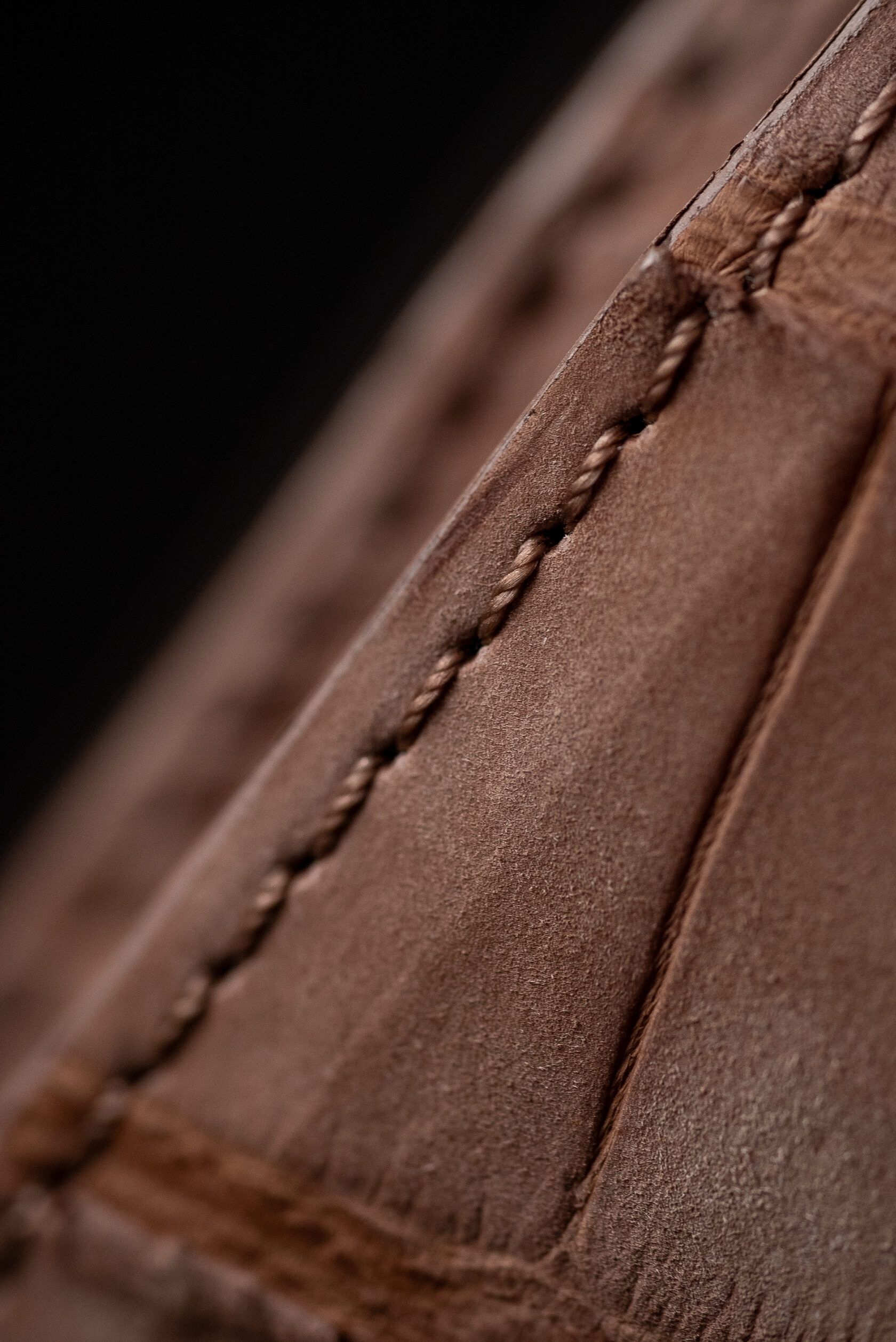
Full grain, provided it is well tanned and cared for. The intact grain is the densest part of the hide, so it resists tearing and abrasion best, and because nothing covers it, it ages into a patina rather than cracking. Corrected grain lasts until its finish fails; split and bonded leather wear out fastest.
Tannage, thickness, construction and care count too: a full grain shoe never conditioned will dry and crack. Given equal care, though, the grade sets the ceiling.
A light, transparent finish lets leather darken and soften where it is handled. A thick pigmented finish stays even for a while, then shows wear as cracks in the film itself. For shoes, the lining and insole matter as much as the upper: they take the warmth and the friction.
Where does crocodile leather sit on this scale?
Crocodile sits outside the cowhide vocabulary. Its grain is its scales, and fine crocodile is used with that grain intact: glazed, matte or buffed to nubuck. The questions that matter are different: which part of the skin, how the scales are matched, which finish, and whether it is crocodile at all.
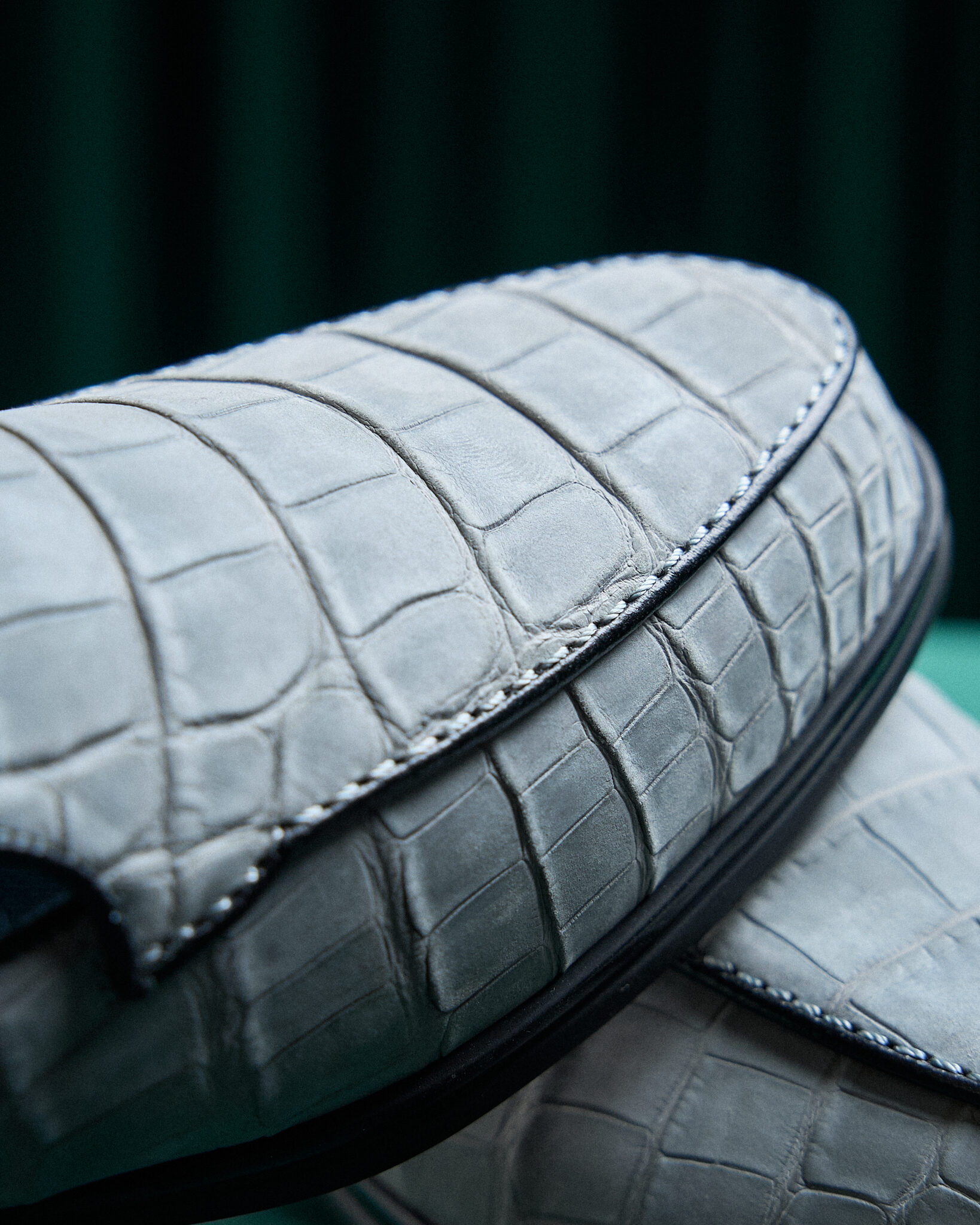
The ISO vocabulary defines grain as the outer side of the leather, characterised by hair follicles, feather follicles "or scales, specific to each animal species". On crocodile, the belly scales are that surface. Glazing polishes them to a glass-like shine, a matte finish leaves them textural, and nubuck crocodile is buffed to a nap while the pattern stays visible.
Because the pattern is the value, imitation copies it: calf embossed with crocodile scales. The tests are specific to reptile skin, from the sensory dot on each belly scale to the way the pattern behaves at a fold, and I set them out in the guide to choosing a crocodile leather bag. How crocodile compares with ostrich, python, lizard and calfskin is covered in our comparison of exotic leathers.
What leather does VLAD BYKOV use?
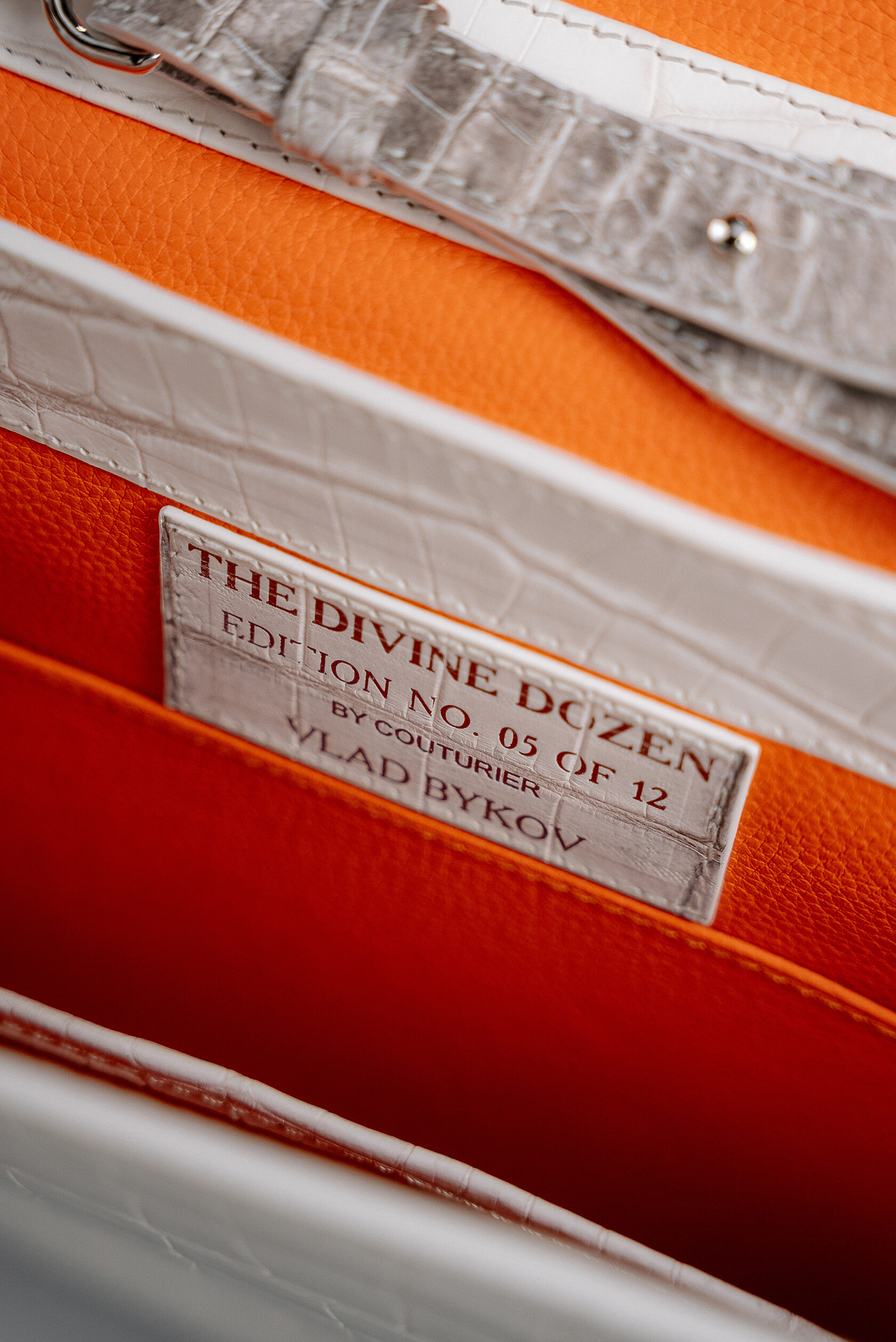
Three leathers above all: crocodile, Italian suede and calf. Our mules and loafers are cut from Italian suede, crocodile or both, lined in natural calfskin, with a natural leather insole and a light caoutchouc sole. Crocodile belts carry an Italian leather lining, and the cross-body bag in glazed black crocodile is lined in natural orange leather.
Describing Modern Sprezzatura, I put the materials in one line: "Material is crocodile leather, Italian suede and calf". Each has its own role. Crocodile, glazed, matte or nubuck, gives the surface its character; Italian suede gives softness and colour; calf is the leather you never see and feel every time you put the shoe on.
Combining them is a signature of the House, explained in why crocodile and suede are combined. On the Black & Orange mules, black nubuck crocodile and black Italian suede are joined by orange piping hand-stitched from soft suede.
The lining is where the grade matters most to the wearer: the calfskin against the foot is what lets a mule be worn without a sock.

Which leather should you choose?
Choose by use, then by grade. For shoes, belts and bags you will wear for years, choose full grain or fine crocodile with a leather lining. For softness and colour, choose suede. Corrected grain suits a uniform look at a lower price. Avoid bonded leather for anything that bends, and always ask the maker to name the layer.
Price follows the grade, but grade is not the purpose: nubuck crocodile suits a pair for evenings, Italian suede warm days without socks. The best material is the one whose properties suit the piece and the person.
Buying at a distance changes nothing: ask for the grade, lining and construction in writing, and for daylight photographs of the surface and the edge, as I describe for crocodile in where to buy crocodile leather shoes online.
The words on a label are the first reading: they tell you which layer you are paying for, and the hand tells you how well it was chosen and made.
Frequently Asked Questions
What is the highest grade of leather?
Full grain is the highest grade: the entire grain surface is kept and nothing is sanded away. Within full grain, quality still varies with the animal, the part of the hide and the tannage, so the finest full grain comes from the cleanest hides and the most careful finishing.
What is the lowest grade of leather?
Among materials that may be called leather, coated split is usually the lowest: a layer with no grain of its own under a heavy film. Bonded leather sits lower still, but under the European standard it is not leather at all.
Is PU leather real leather?
No. PU leather is a polyurethane coating on a fabric backing, with no hide in it. When it looks like leather, the FTC Guides ask that it be disclosed plainly, for example as not leather, imitation leather or simulated leather.
Is nubuck full grain leather?
Not strictly. Nubuck is grain leather buffed to a velvety nap, so a little of the surface is removed, but the original grain pattern stays visible. It is grain leather, not split, and nubuck crocodile keeps its whole scale pattern under the nap.
Does full grain leather crack?
It can, if it dries out. A light finish lets full grain breathe and age well, but heat, strong sun and neglect will dry any leather. Clean it gently, condition it regularly and let shoes rest a day between wearings.
What does 100% genuine leather mean?
That the material is leather in all its substantial parts, with no vinyl or bonded fibres passed off as leather. It says nothing about the layer: a product sold as 100% genuine leather can be full grain, corrected grain or coated split.
Does Italian leather mean full grain?
No. Italian describes where the leather was tanned or finished, not which layer of the hide it comes from. Tanneries anywhere can produce every grade, so ask for the grade and the finish as well as the origin.
Is calfskin better than cowhide?
Calfskin comes from younger animals, so its grain is finer and tighter and the leather lighter, which suits fine shoes and linings. Cowhide is thicker and tougher, suited to heavy goods. Either can be full grain or corrected.
Is embossed leather real leather?
Yes, if the base is leather: embossing presses a pattern into the surface. It should be disclosed when it imitates another leather, so calf embossed with crocodile scales is sold as calf. Embossed patterns repeat exactly, which is how you recognise them.
How much does a VLAD BYKOV piece in crocodile cost?
Every crocodile piece is priced on request, because each is quoted against the skin it will be cut from. Send the model, leather and size to an advisor through Contact or on WhatsApp, and the price comes back individually, confirmed before payment.
Written at VLAD BYKOV Couturier House, Dubai. About the House · Ready-to-Wear · Commission a bespoke piece · Contact · Privacy Policy
ISO, CEN, the Federal Trade Commission and other names mentioned in this article belong to their respective owners and are referenced for context only. Mention does not imply partnership, licence or endorsement.