10.11.2026
Why Crocodile and Suede Are Combined: A House Signature Explained
Why Crocodile and Suede Are Combined: A House Signature Explained
By Vlad Bykov, Founder and Couturier, VLAD BYKOV Couturier House, Dubai · Published 10 November 2026
Crocodile and suede are combined because each does what the other cannot. At VLAD BYKOV, nubuck crocodile forms the apron on top of the foot, where the eye falls and the shape must stay crisp; soft Italian suede forms the body of the shoe, where the foot bends and breathes. One pair carries crocodile's presence and suede's ease.
Why are crocodile and suede combined in one shoe?
Because a shoe has two jobs that one material does not do equally well. It has to hold a clean, recognisable shape where it is seen, and it has to give, breathe and move where the foot works. Crocodile does the first, suede the second. Together they balance look, comfort and the life of the pair.
The two materials come from opposite sides of the same idea. Crocodile is a grain leather whose tiles differ from skin to skin: the animal has smooth skin on its belly and sides, while its back is armoured with bony osteoderms, and the tiles of a fine shoe come from the smooth parts. Suede is the other face of a hide, cut from its underside: it bends more easily and feels softer than the grain, and it wears out sooner.
In a VLAD BYKOV pair each material goes where its nature is an advantage. Crocodile goes where the shoe is looked at; suede goes where it has to move with the foot at every step. Call it a division of labour.
I described the principle behind it in my essay on Modern Sprezzatura: "Crocodile, nubuck crocodile, suede and silk work not as decoration but as texture. The costlier the material, the simpler the silhouette: that is the whole difference between luxury and its display." A combined shoe is that sentence in leather: two textures, one quiet silhouette.
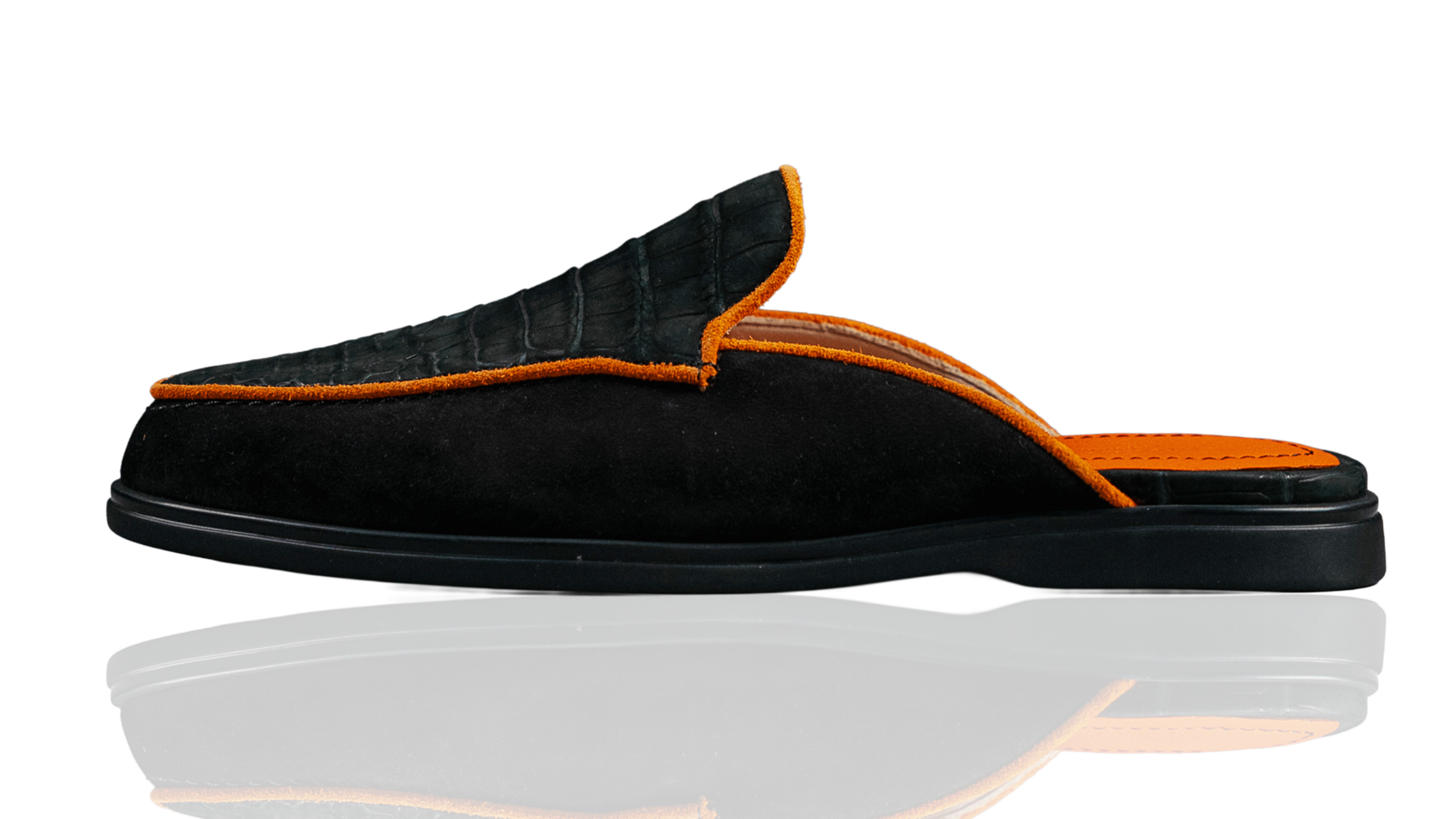
What are combined mules?
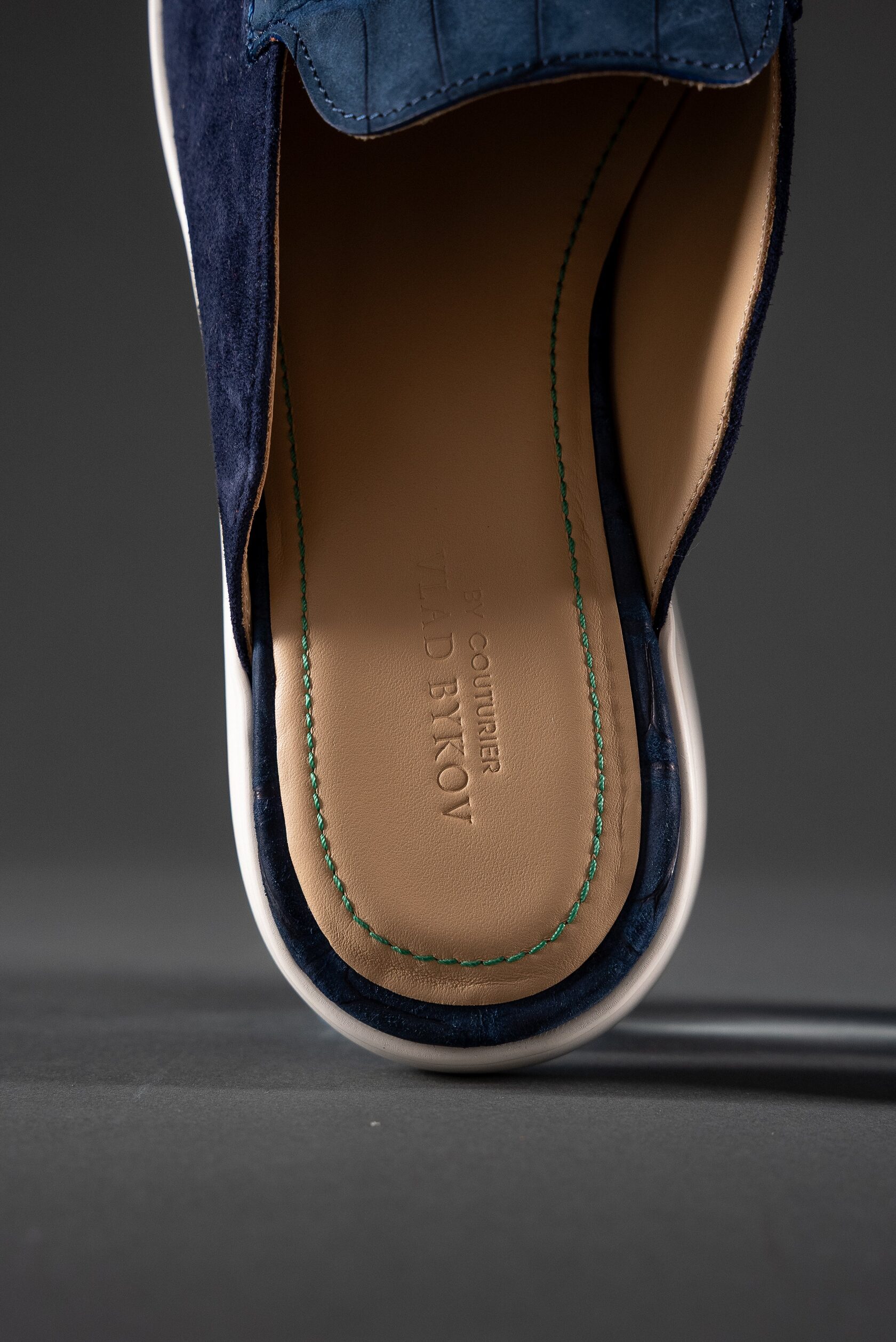
Combined mules are backless slip-on shoes whose upper joins two materials. At VLAD BYKOV the two are nubuck crocodile and Italian suede, built on a natural calfskin lining, a natural leather insole and a light rubber sole. The navy model carries the name itself: Combined Mules, nubuck crocodile and Italian suede.
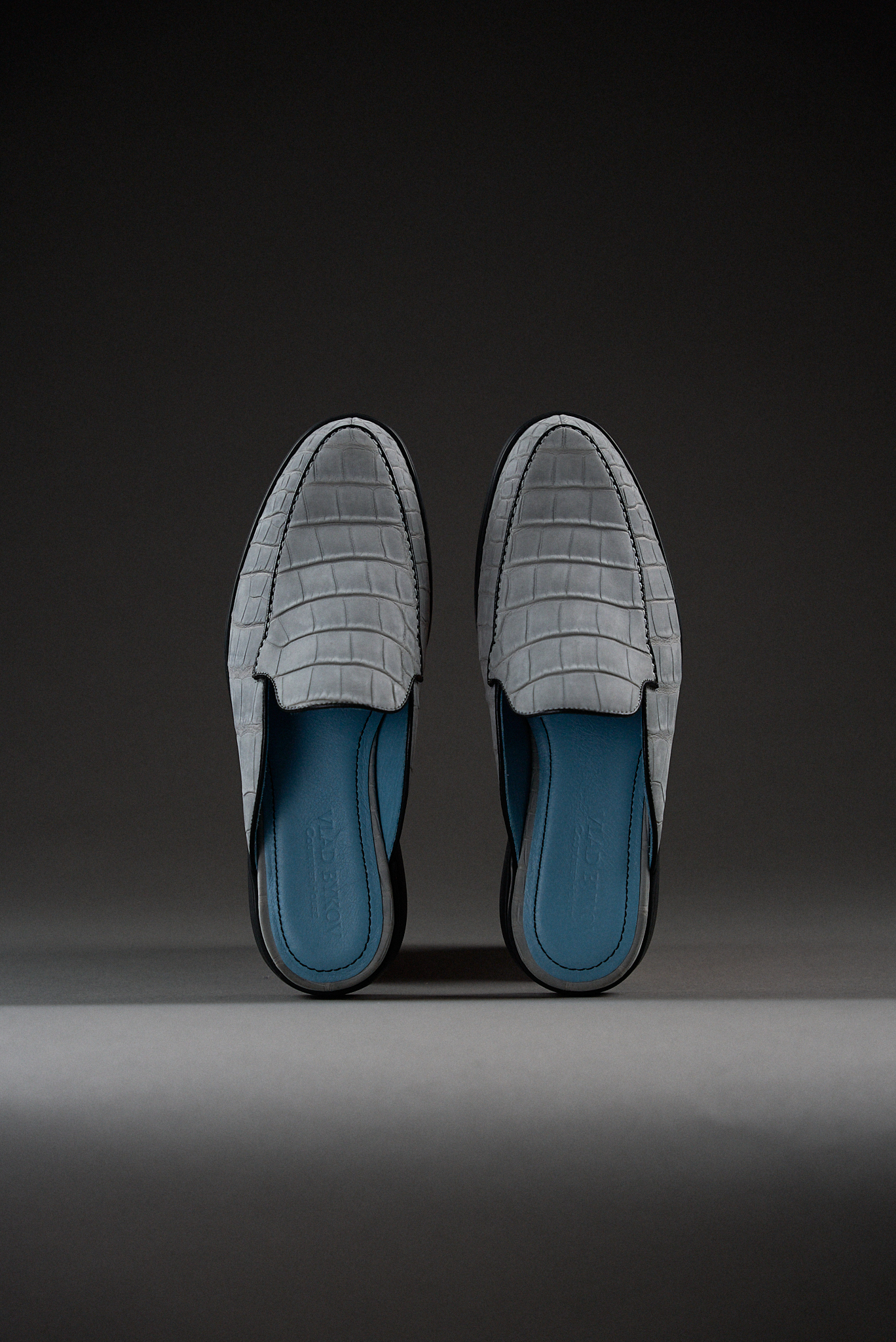
A mule is a shoe with no back or fastening around the heel, so every panel of its upper is on show at once. That is why the choice of materials matters more on a mule than on almost any other shoe: the eye reads the whole upper in one glance, and the two materials have to agree.
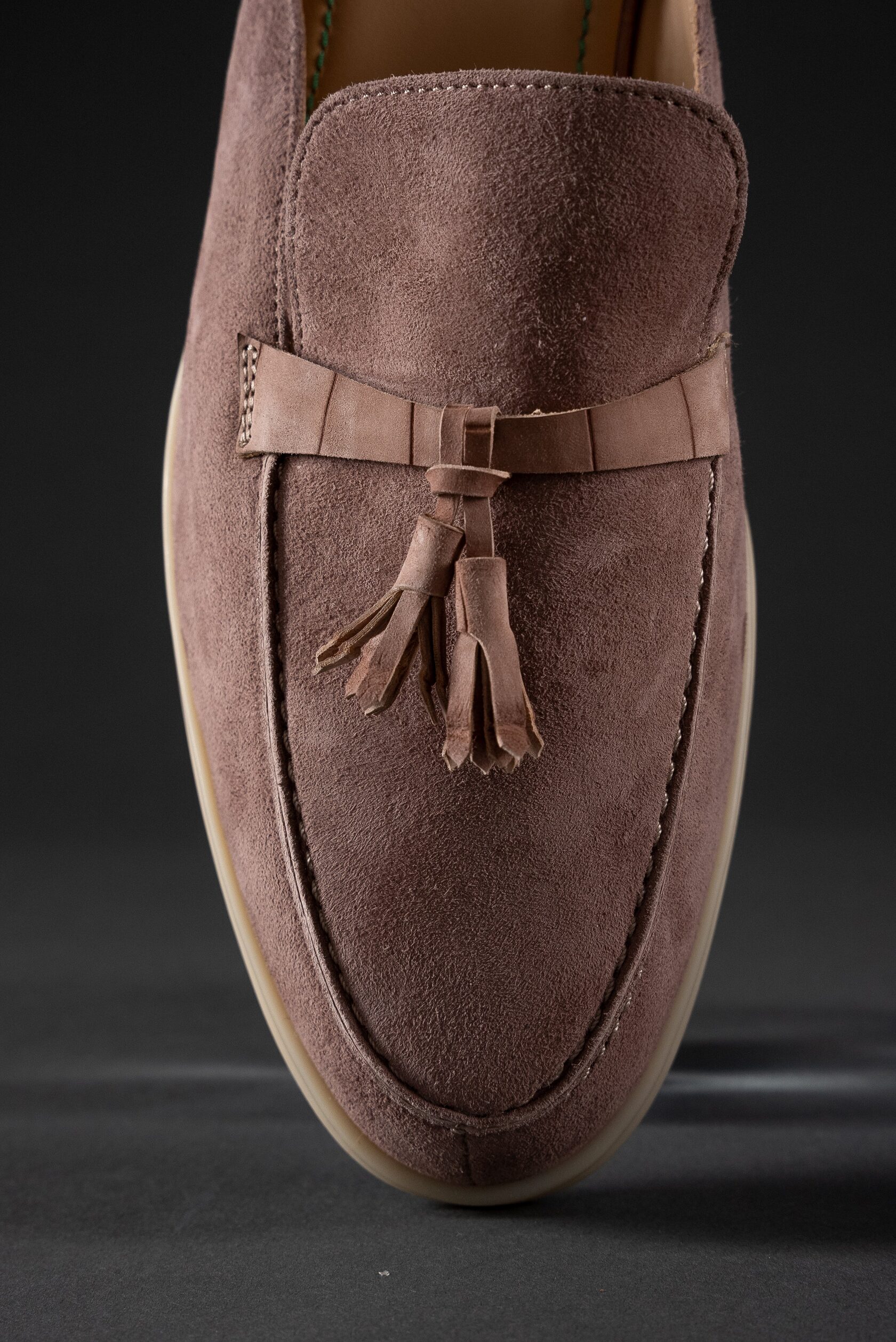
Combined is not the same as two-tone. A two-tone shoe contrasts two colours; a combined shoe contrasts two materials, often in a single colour. The navy pair is combined but tonal, navy crocodile on navy suede. The terracotta and cognac loafers are both: two materials and two neighbouring colours.
Four of the House's five combined models are mules. Standard men's sizes are EU 40–45, and every model can be made to measure. Loafers follow the same logic with a closed heel.
Which part of the shoe is crocodile, and which is suede?
On most House pairs, nubuck crocodile forms the apron, the panel on top of the foot from the toe to the opening, and sometimes the trims around the topline and heel. Italian suede forms the body: the toe surround, the sides and the back. On some models the roles reverse, and crocodile becomes the accent.
The apron is the part of a shoe seen from standing height, framed by its stitched seam. It is the face of the pair and carries its identity. Put crocodile there and the shoe reads as crocodile from across a room, even when most of its surface is suede.
The sides and the back are where a shoe works. They flex with every step and follow the shape of the foot, and that is where pliable suede earns its place. On the Terracotta & Cognac Mixed-Media Loafers, terracotta crocodile also binds the topline and covers a strip at the back of the heel, so the crocodile frames the suede as well as covering it.
The reverse arrangement appears where suede is meant to lead. On the mules in soft Italian suede with nubuck crocodile tassels, the whole upper is cappuccino suede and crocodile appears only in the tassels and the strap that carries them. On the Black & Orange Mules — Bespoke Edition, a hand-stitched piping of orange suede outlines the black crocodile apron.
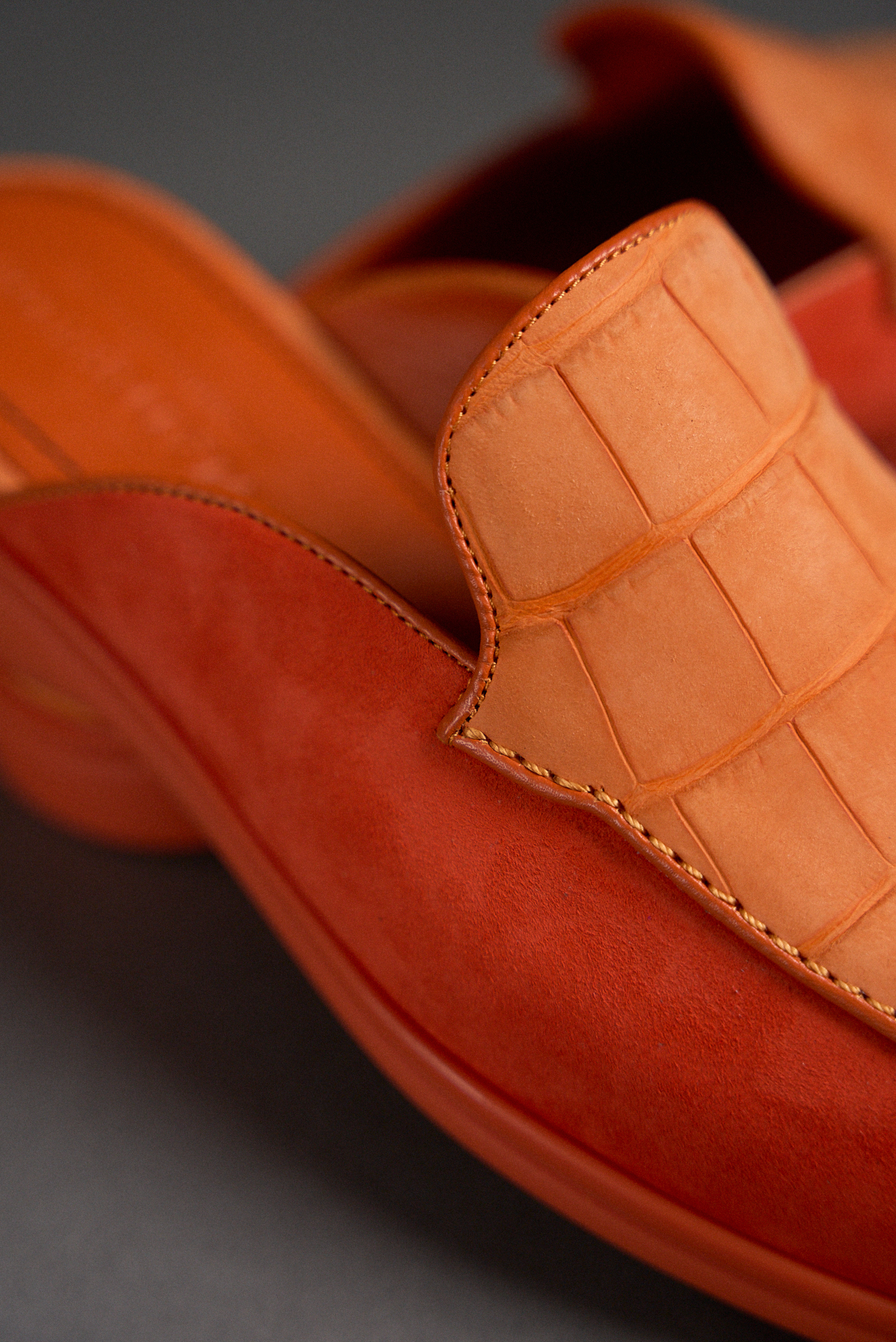
Which VLAD BYKOV models combine crocodile and suede?
Five models on vladbykov.ae: the navy Combined Mules, the Crocodile & Suede Mules in cappuccino, the Terracotta & Cognac Mixed-Media Loafers, the suede mules with nubuck crocodile tassels and the Black & Orange Mules — Bespoke Edition. Each pair is made by hand and priced on request.
What the five share is the construction under the surface: a natural calfskin lining, a natural leather insole, a rubber sole and the signature VLAD BYKOV silhouette. The Black & Orange model is made individually, with a lining in black, orange and white and black stitching on the insole. The wider choice of full crocodile and combined pairs, and how ordering works, is set out in the guide to buying crocodile shoes online.
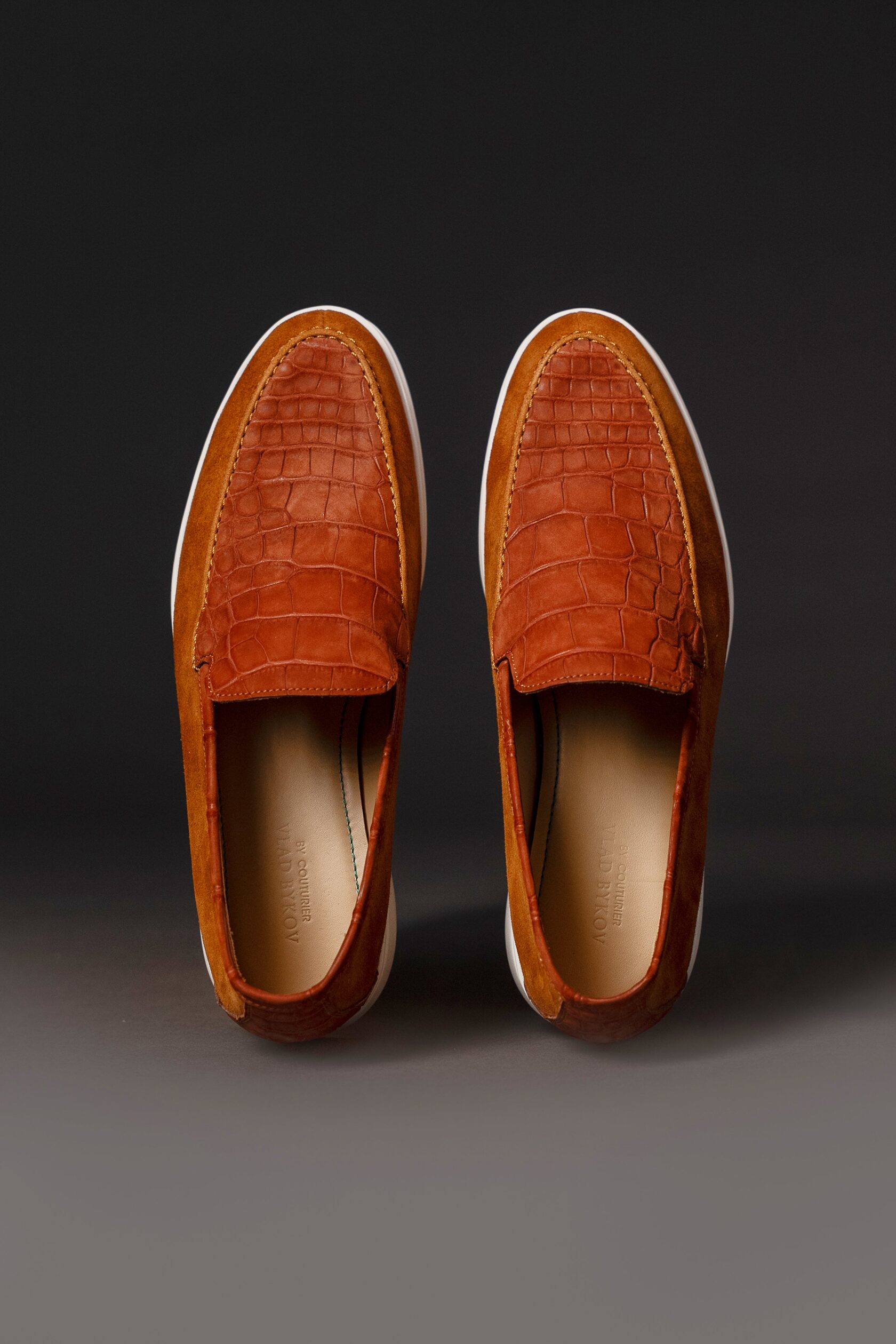
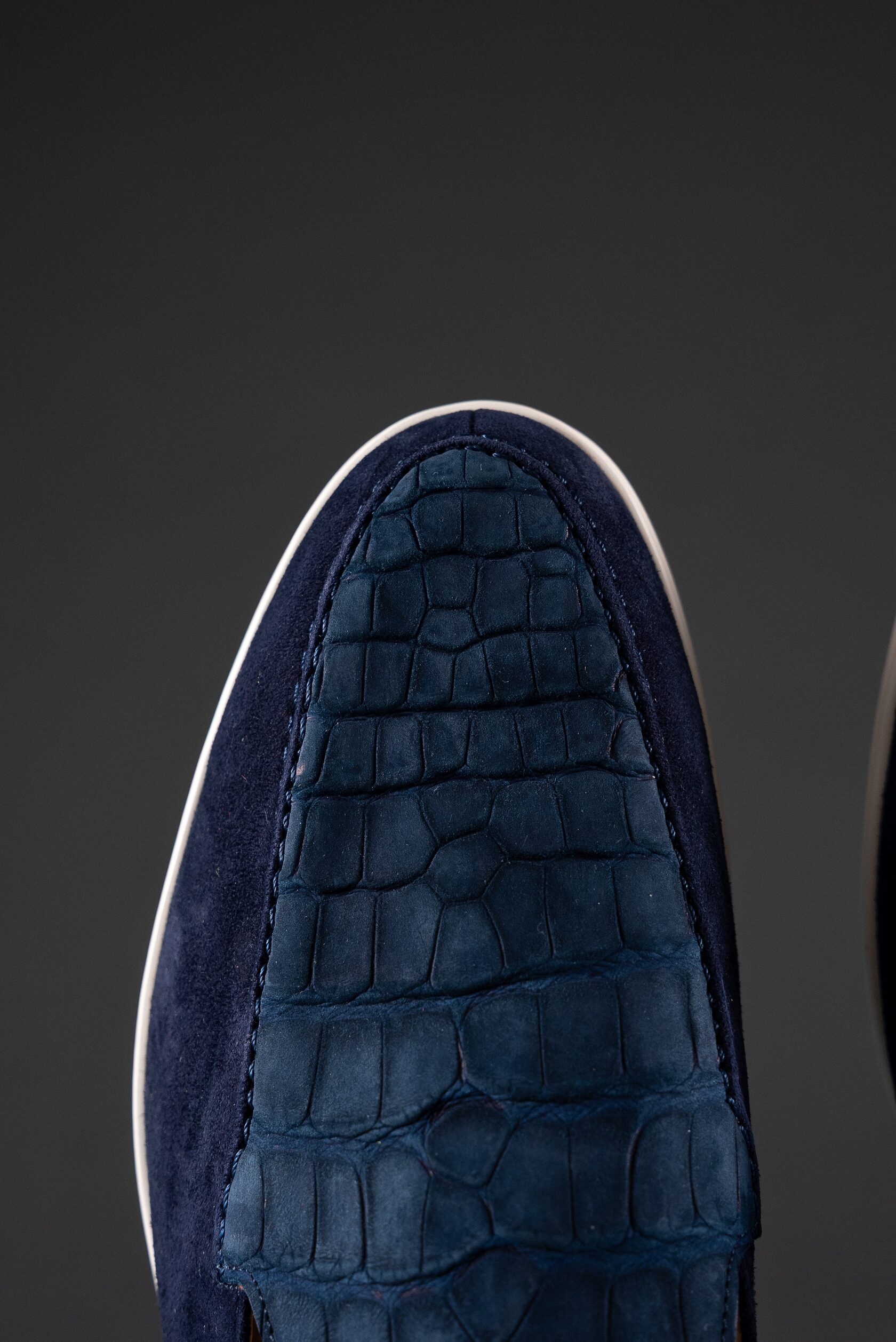
Why does nubuck crocodile work with suede better than glazed crocodile?
Because both are napped surfaces that take light the same way. Nubuck crocodile is buffed on the grain side until the scales carry a fine velvet, and suede has a nap of its own. Side by side they read as one calm surface in two reliefs. Glazed crocodile beside suede reads as two different shoes.
Nubuck is grain leather buffed on its outer face until it feels like velvet. It looks like suede, yet it keeps the outer layer of the hide, so it is thicker and stronger. On crocodile the scale pattern lives on that grain side, so buffing it keeps the tiles and softens their shine. A napped skin also shows colour deeper than a polished one.
Every combined model on vladbykov.ae uses nubuck crocodile, and the terracotta loafers describe theirs as matte crocodile with a nubuck finish. Glazed crocodile, polished to a deep shine, belongs to full crocodile loafers and to the evening, where its reflection is the point. Next to suede it would pull the eye away from the shape of the shoe.
How crocodile compares with ostrich, python and other skins is covered in our exotic leathers compared, and what makes suede Italian, and why it costs more, in the Italian suede guide. Here the point is narrower: the two napped materials agree with each other.
Are crocodile and suede shoes comfortable in hot weather?
Yes, and most of the reason is construction. The upper is largely suede, which is soft, thin and pliable. Add a calfskin lining, a natural leather insole, a light rubber sole and, on a mule, an open heel, and a combined pair suits a Dubai day.
The lining matters as much as the upper. Suede worn against a bare foot darkens with sweat; a calfskin lining takes that contact instead, breathes and grows more comfortable with wear. That is why every combined pair is lined in natural calfskin, and why the pairs can be worn without socks.
The crocodile keeps the authority of the pair from the apron, while the body stays soft from the first wear. Heat changes the routine more than the choice: in Dubai, where outdoor humidity meets dry air-conditioned rooms, rotate two pairs and rest each for a day.
When should you wear crocodile and suede instead of full crocodile?
When full crocodile would say too much and full suede too little. A combined pair sits between them: dressier than suede, easier than crocodile. It suits business casual, smart casual, daytime weddings in summer, travel and dinners without a dress code, and in Dubai it is often the more natural office choice.
Full crocodile is a statement. Worn every day, it can feel like an evening shoe that has wandered into the morning. Full suede is the opposite: relaxed and soft, sometimes too relaxed for a meeting or a dinner where the rest of the outfit is sharp. Crocodile on the apron gives a suede shoe the polish it lacks, and suede on the body takes the edge off crocodile.
The tonal pairs are the easiest to place. Navy combined mules sit naturally with navy, grey and stone; the cappuccino pair with beige, sand and ivory; the terracotta and cognac loafers with brown, olive and navy. Black & Orange belongs to the evening.
How each of these works with tailoring, by suit colour, finish and dress code, is in the guide to how to wear crocodile shoes with a suit.
Is combining two materials in one shoe a new idea?
No. Men's shoes have mixed materials since the nineteenth century. The spectator, or co-respondent shoe, comes from that century: darker calf caps at the toe and heel, set against a body of white buckskin or reverse-calf suede.
Its popularity peaked in the 1920s and 1930s. In England the style was thought too flamboyant for a gentleman, and its nickname came from divorce courts, where the co-respondent was the third party in a case.
Museums keep the evidence. The Victoria and Albert Museum holds a pair of man's correspondent shoes in white and brown leather, made in Britain around 1925 to 1935.
Where the spectator spoke with colour, the House speaks with texture. Navy crocodile on navy suede, black on black, two shades of orange: the contrast lives in the surface, so the shoe reads as one piece from a distance and as two materials only when you come close.
How do you choose the colours of a crocodile and suede pair?
Start with the suede, because it covers most of the shoe and decides how it sits with your clothes. Then choose the crocodile in one of three relationships: the same colour for a tonal pair, a neighbouring tone for warmth, or one clear accent. Decide the sole and the lining last.
A few rules hold across all four. Choose the suede against the trousers you wear most, because it is the larger surface. Keep the crocodile within one step of the suede in depth if the pair is for every day; a strong contrast belongs to a pair you plan to wear for effect. Look at both materials in daylight, where nap and scale show their true colour.
Carry the same logic to the belt: a belt that agrees with the shoes in tone looks considered, one that copies their leather looks planned too hard. The House's nubuck crocodile belts come in burgundy, cappuccino, sand, turquoise and white, so a belt can echo the crocodile of a pair without repeating it.
Can you commission your own crocodile and suede combination?
Yes. A bespoke or Private Order pair lets you choose the colour of the crocodile and of the suede, which parts each one takes, the piping, the lining, the sole and the fit. At the House, Made-to-Order footwear takes about two and a half to three weeks, and measurement-based footwear three and a half to five.
People come to a combination from different places. As I wrote about our personal pairs of mules: "I enjoy making shoes for people of different characters. One chooses calm suede, another bright crocodile leather, a third wants a combination tied to a particular piece in his wardrobe."
Sometimes that piece is a car. Automotive Color Bespoke translates the colours of a guest's car into a pair of shoes, and most of its commissions are custom mules or loafers in Italian suede, in crocodile, or in the two combined. A watch, a suit or a single tie can be the reference just as well.
Send the model, the two colours and your size to an advisor through Contact or WhatsApp, and the quote comes back individually, confirmed before payment. Consultations take place in person in Dubai or by video call; standard sizes are EU 40–45, and EU 47 to 49 are made on request.
How do you care for shoes made of crocodile and suede?
Care for the pair dry, by the stricter of its two materials: a suede brush for the suede, a soft brush along the scales for the nubuck crocodile, no cream or polish on either nap, protection before first wear, no rain, and a day's rest on cedar shoe trees.
Both surfaces are napped, so one principle covers the whole shoe: dirt is lifted dry, never washed. Suede is stained or worn by salt, dirt, water, oils and moisture and should not be cleaned with soap and water. A drop of water darkens nubuck for a while, but rain mats the nap of nubuck crocodile, and the mark is hard to lift.
- Brushes. A suede brush for the suede, its brass side only for a matted nap and never near the crocodile; a soft nubuck brush for the apron, worked along the scales.
- Protection. A colourless protector for suede and nubuck before first wear and every few weeks after, tested first on a hidden spot.
- Water. Keep the whole pair out of the rain. If suede is caught in a shower, blot it, dry it slowly at room temperature and brush the nap up; keep it away from heat.
- Rest. Cedar shoe trees after every wear and a full day off, so the lining dries completely.
- Seams. Brush towards the seam, not across it, so the brass never touches the crocodile.
The full routines are in our suede care guide and our guide to crocodile leather care. A combined pair needs both, applied with a little more patience at the line where the two materials meet.
Frequently Asked Questions
Is there such a thing as suede crocodile leather?
Not in the sense the name suggests. Suede comes from the underside of a hide, while the scale pattern of crocodile exists only on the grain side. The velvet-surfaced crocodile people mean is nubuck crocodile: the grain side buffed to a fine nap, with the tiles still visible.
How can you tell real nubuck crocodile from embossed leather?
Look at the scales. On real crocodile the tiles vary naturally in size and shape, follow the lines of the skin and never repeat. An embossed calf or suede repeats one pattern, its relief is shallow, and at a bend it stretches flat instead of moving tile by tile.
Can crocodile and suede shoes get wet?
Keep the whole pair out of the rain. If suede is caught in a shower, blot it, dry it slowly at room temperature and brush the nap up; keep it away from heat. Rain mats the nap of nubuck crocodile and leaves a mark that is hard to lift.
Can you wear combined mules without socks?
Yes, that is how most of our guests wear mules. The natural calfskin lining takes contact with the foot and breathes, so the suede outside stays clean. Rest the pair for a day after each wear on cedar shoe trees, so the lining dries completely.
What belt goes with crocodile and suede shoes?
A belt in a neighbouring tone, in a matte or napped finish. A nubuck crocodile belt that echoes the crocodile of the pair looks chosen, while a high shine at the waist fights the soft surface of the shoes below it.
Which crocodile and suede pair goes with the most outfits?
The navy Combined Mules. Navy on navy is tonal, so the pair works with navy, grey and stone, with soft tailoring and with dark denim. If your wardrobe is warm, in beige, sand and brown, the cappuccino pair plays the same role.
What decides the price of a crocodile and suede pair?
How much crocodile the pair uses and which skin it is cut from, the finish, the model, the size and how personal the order is. That is why every pair is priced on request: an advisor confirms the price once the model, colours and size are chosen.
How long does it take to make a crocodile and suede pair?
A Made-to-Order pair takes about two and a half to three weeks. A pair made to your measurements takes three and a half to five weeks. A Private Order receives an individual estimate before payment, because the colours and the skin are chosen for it.
What sizes are VLAD BYKOV combined mules and loafers made in?
The standard men's range is EU 40 to 45, and every model can be made to your measurements. Sizes EU 47, 48 and 49 are made on request. The Black & Orange model is made individually for each guest.
Is a crocodile and suede pair a good gift?
Yes, especially for a man who already owns full suede or full crocodile. A combination is a step outside his habits that still fits his wardrobe. If you do not know his size, an advisor can help, or a gift certificate leaves the choice to him.
Written at VLAD BYKOV Couturier House, Dubai. About the House · Ready-to-Wear · Commission a bespoke piece · Contact · Privacy Policy
The Victoria and Albert Museum and other names mentioned in this article belong to their respective owners and are referenced for context only. Mention does not imply partnership, licence or endorsement.