27.10.2026
Couture House vs Fashion Brand: What Is the Difference?
Couture House vs Fashion Brand: What Is the Difference?
By Vlad Bykov, Founder and Couturier, VLAD BYKOV Couturier House, Dubai · Published 27 October 2026 · Updated 27 October 2026
A couture house designs and makes for one named person: it starts from their measurements, wardrobe and life, works after the order, in a single piece or a very small number, and measures success by the relationship with each guest. A fashion brand designs seasonal collections in runs of sizes for an anonymous market and measures success in units sold.
What is the difference between a couture house and a fashion brand?
The difference is structural, not a matter of price. A fashion brand designs collections, produces them in advance in runs of sizes and sells them through seasonal cycles. A couture house designs around one person, makes the piece after the order, alone or in a very small number, and measures its value by the relationship with each guest.
This changes what each is optimising for at every level. A fashion brand needs a hit each season. A House needs to be right for a client's tenth commission the same way it was right for the first — consistency over time matters more than any single collection.
This is not a claim that mass production is illegitimate — many respected brands run on it successfully. It is a different business, with a different product at the end of it.
What is a couture house?
A couture house — maison de couture in French, sometimes called a couturier house — is a business that designs and makes original clothing and accessories to order for private clients, under the name and direction of a couturier. Each piece begins with a person and is cut, made and finished for that person alone.
The model took shape in Paris in the nineteenth century. The Fédération de la Haute Couture et de la Mode traces haute couture back to Charles Frederick Worth: in 1858 he opened what the Fédération regards as the first real couture house, at 7, rue de la Paix.
Worth, an Englishman from Bourne in Lincolnshire, changed how fine clothes were sold. Instead of visiting clients at home, he received them in his own salon for a consultation and a fitting. He showed finished designs on live models in place of fashion dolls, and he sewed his own name into every piece: the first brand label on clothing. Over his career the house grew to 1,200 employees.
In 1868 Paris couture founded its first trade chamber. After the 1945 decision that protected the name haute couture, it became the Chambre Syndicale de la Haute Couture, and today its work continues within the Fédération de la Haute Couture et de la Mode, whose events include Paris Fashion Week.
What is a couturier?
A couturier is a person or house that designs, makes and sells fashionable clothing to order for private clients. The word comes from the French couture, meaning sewing; the Cambridge Dictionary defines a couturier as "a person or company that designs, makes, and sells expensive fashionable clothing".
The role changed with Worth. In France the couturières, women dressmakers, had had their own guild rights since 1675, but the maker's job was to execute what the client wanted. Worth raised the status of the maker: the couturier became the arbiter of what the client should wear as well as the hands that sewed it.
Three things define a couturier at once: authorship of the design, responsibility for how it is made, and a direct relationship with the person who will wear it. Remove one and the role changes. Without the making, it is design. Without the person, it is production. Without authorship, it is sewing to instruction.
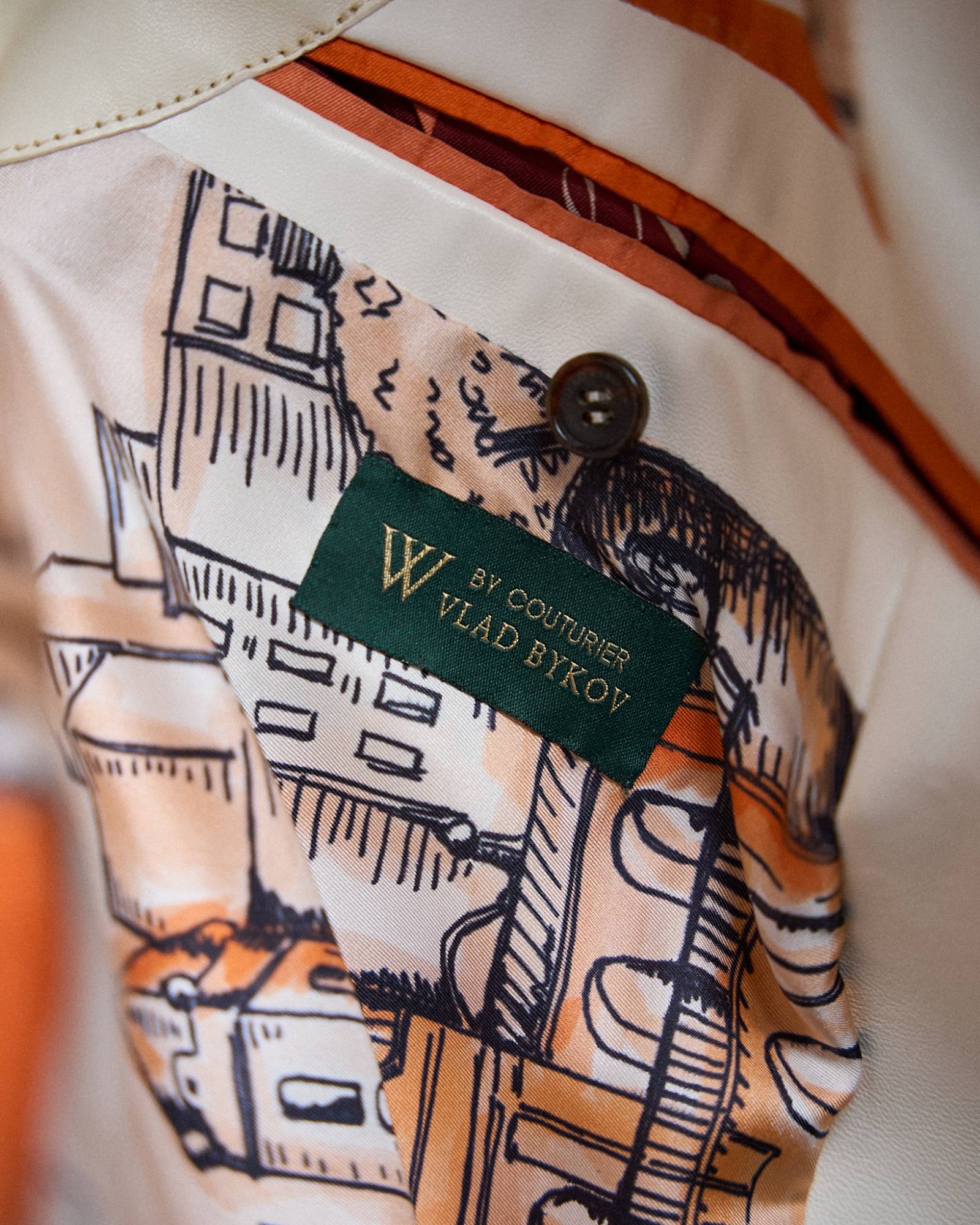
That is why the title belongs in the signature. The House's label reads "By Couturier VLAD BYKOV": the name of the House and the profession of the person who leads it, stitched into the lining.
What is the difference between a couturier and a designer?
A designer works from a brief. A couturier works from the material outward — the leather, the paint reference, the cut of cloth dictate what's possible before any sketch is final. A designer's work can end with the drawing; a couturier also answers for the making, the fit and the person who wears the piece.
"Designer" is the broader word. A fashion designer may create a collection for a brand, inside a team, for production in a run of sizes, and may never meet the person who buys the piece. A couturier designs for someone known by name and stays responsible until that piece fits. Every couturier designs; not every designer is a couturier.
In my essay on Loro Piana fabrics I put the couturier's order of work this way: "This is why the selection of cloth is never a decorative step in my work. It is the beginning of the design." A designer can choose a fabric to illustrate an idea; a couturier lets the fabric decide what the idea can become.
What does haute couture mean, and who can use the term?
Haute couture is a legally protected designation in France. Since a decision of 23 January 1945 the name belongs only to houses that a commission, overseen by the French Ministry for Industry, approves year by year. The Fédération de la Haute Couture et de la Mode runs that process and the Haute Couture Week in Paris every January and July.
The criteria are strict. As reported by AFP via FashionUnited in January 2026, an accredited house must:
- create original designs, made to measure and by hand;
- have them designed by its permanent artistic director and made in France;
- keep two separate workrooms: the tailleur, for structured pieces such as jackets, coats and trousers, and the flou, for soft, fluid pieces such as dresses and blouses;
- employ at least twenty people;
- present collections in Paris in January and July, each with at least 25 looks mixing day and evening.
The label is granted for one year at a time. In January 2026 only 13 houses held it, with seven correspondent members working outside Paris, and in December 2025 haute couture was added to France's list of intangible cultural heritage. The Fédération itself calls haute couture "a French exception".
Couture as a profession is wider than that list. In everyday use the word also covers any high-fashion clothing fitted to the client in the fashion capitals, and houses that design and make to order for private clients work in London, Milan, New York, Dubai and elsewhere. The Paris label names one regulated circle within that world.
How does a couture house work with the person it dresses?
A couture house starts with a conversation. It learns the person's style, lifestyle and wardrobe, selects materials for them and only then designs. The piece is made to their measurements, can carry their name, and is not repeated for anyone else; the relationship then continues from one commission to the next.
At VLAD BYKOV every project begins with a dialogue, the selection of materials and an understanding of the person the piece is for; only then are the details and the construction chosen. Consultations take place in person in Dubai or by video call.
The House calls the people it works for guests, not customers. The word sets a standard: a guest's sizing, past commissions and preferences are remembered, so the next conversation starts where the last one left off.
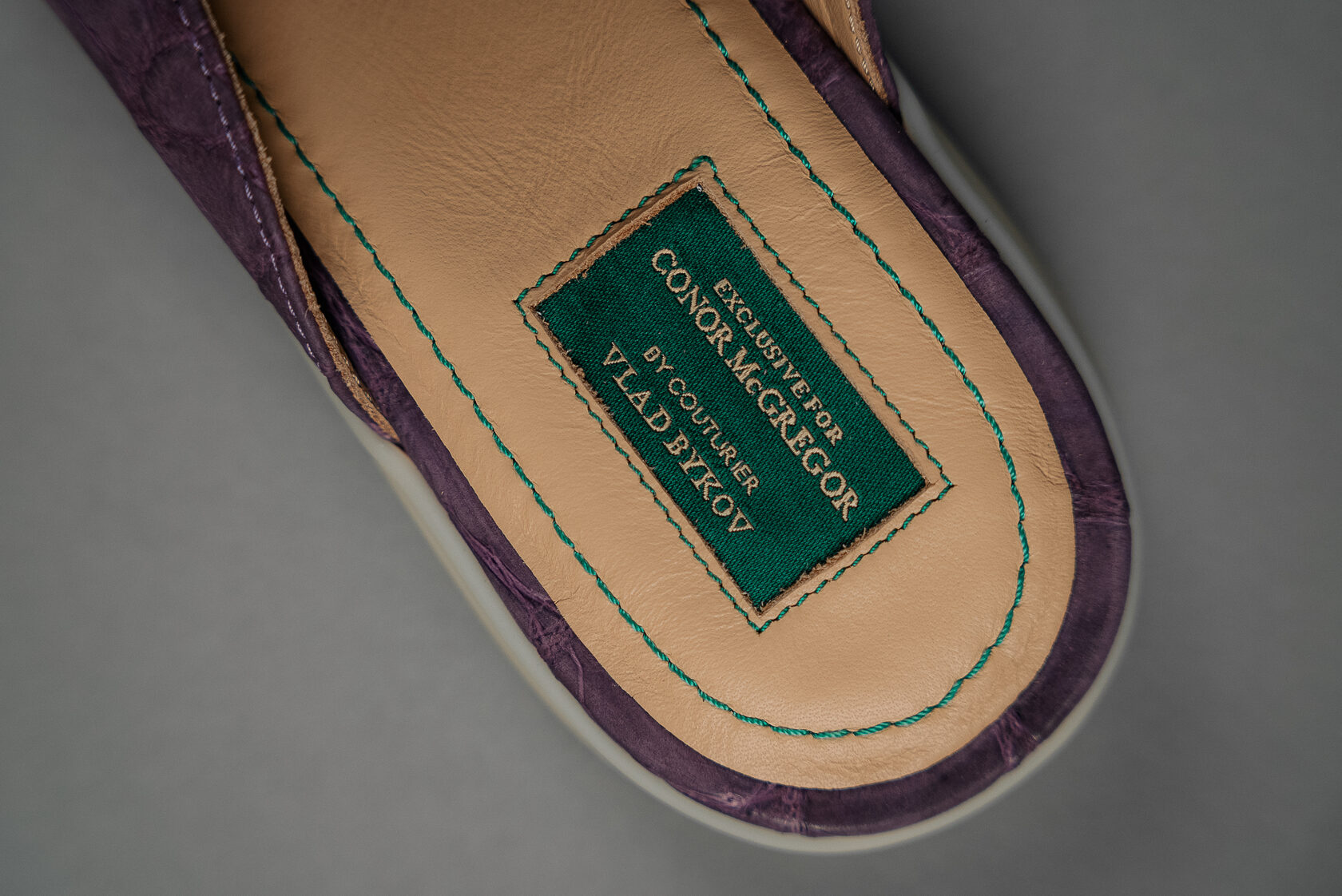
Personalisation is where the difference becomes visible. A pair can carry its owner's name, embroidered on the piece or set inside it, and a piece that carries somebody's name is made for that person alone. The House has made several personal pairs of mules for Conor McGregor, former UFC champion in two weight divisions, each different in materials, colour and embroidery.
How do production and lead times differ?
A fashion brand produces before it sells: pieces are made in runs, held in stock and cleared through seasonal sales. A couture house produces after the order, for one person, so the piece takes weeks rather than arriving from a warehouse. At VLAD BYKOV footwear takes about 2.5 to 5 weeks, clothing three to four and bags four to five.
The range depends on how personal the piece is. Made-to-Order footwear, with material already in stock, takes about two and a half to three weeks; footwear built on the guest's measurements takes three and a half to five. Personalisation — initials, a special lining, a thread colour — adds roughly a week, and a Private Order receives its own estimate before payment. What separates these formats is set out in the House's guide to Made-to-Order, Made-to-Measure, Bespoke, Private Order and One of One.
The practical consequence is the absence of sales and dead stock. A piece made for one owner cannot go unsold, because it had an addressee from the start.
The money works differently too. The large Paris houses earn their returns from ready-to-wear, shoes, perfume and licensing; couture itself often costs them far more than it sells for, and its role is to lend those lines its glamour. In a house built around commissions, the individual piece is not a showcase for other products. It is the work itself.
How does a couturier think about craft?
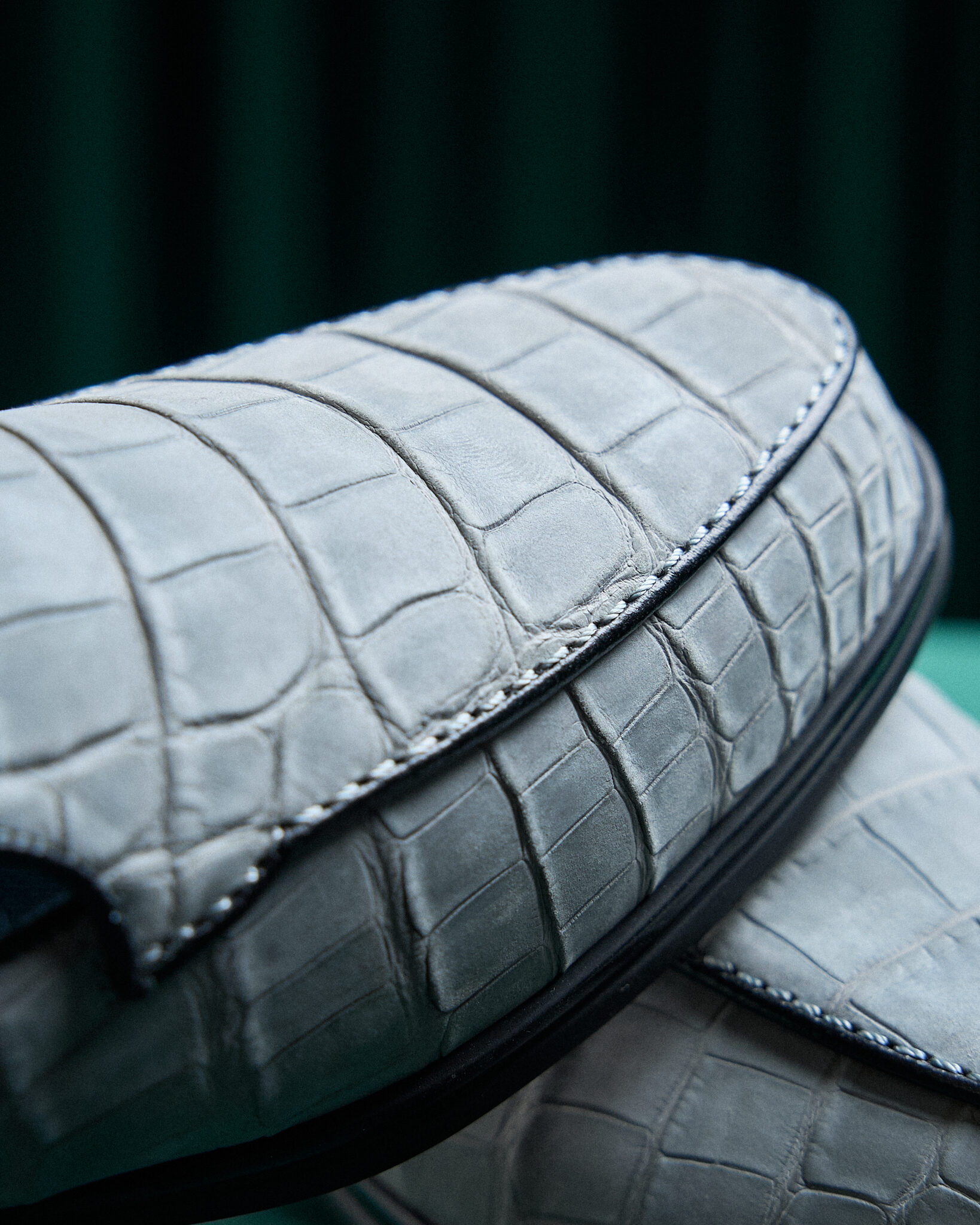
A couturier treats craft as a working method: understand the material's limits first, then design inside them, rather than designing something and forcing the material to comply. A python skin behaves differently from smooth calf; a bespoke shoe built around that behaviour looks and wears better than one that ignores it.
This is also why the House resists the instinct to standardise. A couturier's eye adjusts per commission — per client, per skin, per proportion — in a way a purely industrial process cannot. Efficiency is not the primary value; getting the piece right is.
The result is a slower, more deliberate process than most of the market runs on — and that's a deliberate trade the House makes, every time, in favour of the finished piece over the production timeline.
How does VLAD BYKOV define craftsmanship?
Craftsmanship is not the same as "handmade". A piece can be made by hand and still be poorly made. The House's definition centres on outcome: does the construction hold up under real wear, does the fit respect the guest's actual body, does the material choice serve the piece rather than just looking expensive in a photo.
It also includes the willingness to say no. A skin with a flaw, a proportion that won't work for a guest's frame, a request that would compromise the finished piece — craftsmanship includes the discipline to flag these rather than proceed anyway to close the sale.
Consistency matters as much as any single detail. One excellent pair proves a maker can do good work once. Craftsmanship, in the House's definition, is doing it the same way on the fiftieth commission as the first — repeatable standards, not a lucky outcome.
This is a standard the House holds itself to internally, not just a description for guests, because the House's name is only as strong as its worst piece in circulation.
Is VLAD BYKOV a couture house or a fashion brand?
VLAD BYKOV operates as a House, not a fashion brand. Its founder, Vlad Bykov, works as a couturier rather than a seasonal designer and builds toward the individual guest and the long relationship instead of a runway calendar or a retail footprint. That is a deliberate structural choice.
VLAD BYKOV Couturier House makes footwear, clothing, bags and accessories, and assembles complete looks for its guests, in three formats: bespoke, made-to-measure and ready-to-wear. Cloth comes from Loro Piana, Dormeuil, Ermenegildo Zegna, Scabal, Cerruti and Holland & Sherry; leathers include Italian suede and crocodile. Most pieces are made by hand by artisans with decades of experience in fine leathers and textiles. For specific pieces, production is placed with European factories working strictly to the House's requirements, and hardware and soles are developed with leading European manufacturers.
The House's own ready-to-wear models are gathered at vladbykov.ae, and even there the catalogue is an entry point into a conversation rather than a final assortment: almost any item can become the basis for a personal project. The House works without seasons. Its direction, Modern Sprezzatura, does not change with the runway calendar, and a project starts when a guest needs it, not when a selling window opens.
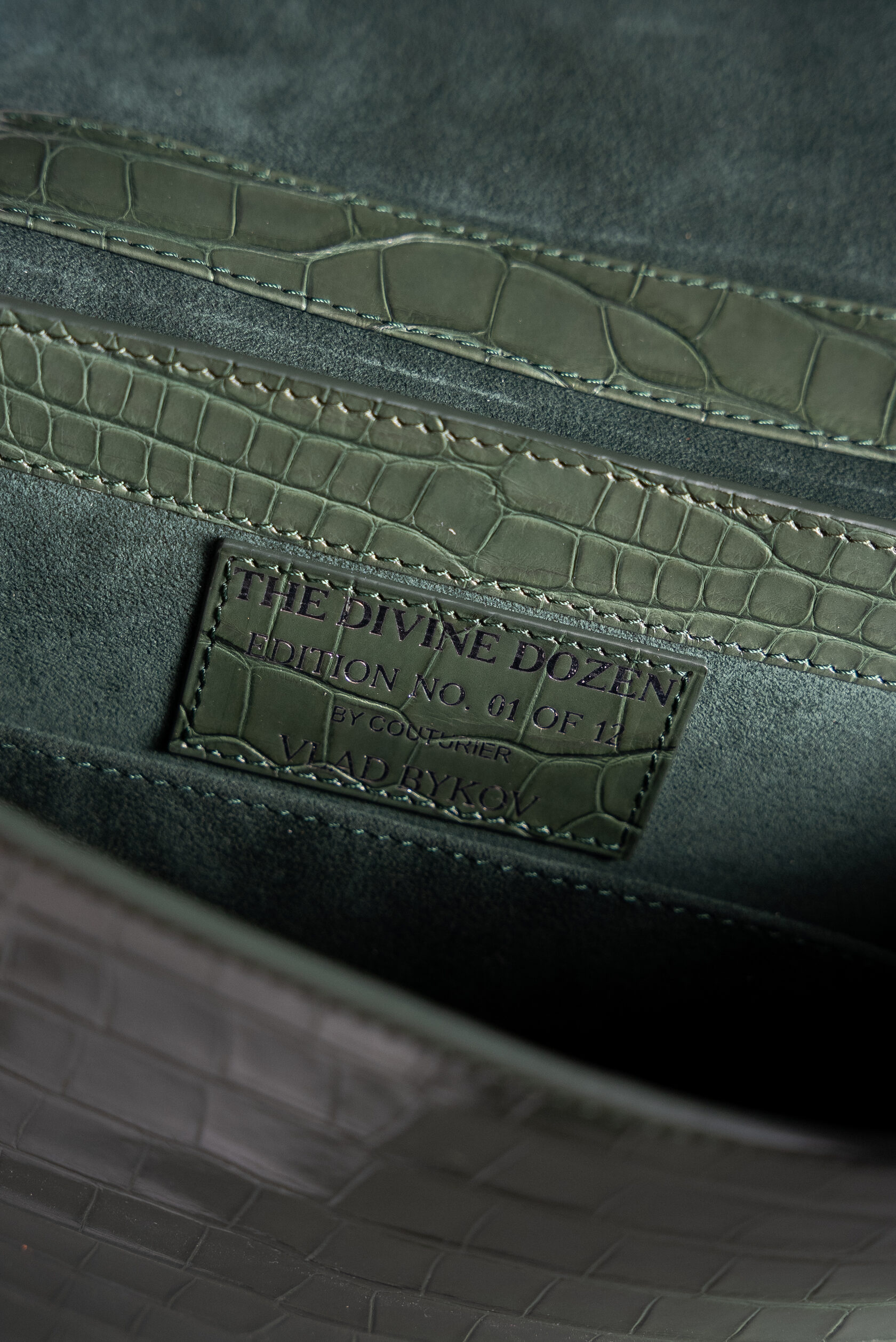
The clearest expression of the model is One of One: a piece conceived for one owner and never offered again. The House's first collectible series, The Divine Dozen, applies it to twelve crocodile bags, each in its own colour, signed, numbered and documented, with no repeats.
Are there couture houses in Dubai and the Middle East?
Yes. The region is already part of the Paris couture circle: a Lebanese house sits among the Fédération's seven correspondent members, and a Syrian designer showed as an invited guest in January 2026. In Dubai, VLAD BYKOV Couturier House designs and makes clothing, footwear, bags and accessories to order for private guests.
Dubai suits the format. The city is home, for long stretches of the year, to people used to commissioning a piece and willing to give time to fittings; here bespoke is not a rare service but a normal way to buy.
The climate shapes the work as much as the clientele. Among the House's pieces most asked for in Dubai are mules, loafers and slippers in crocodile leather and Italian suede, and suits in linen and silk.
Distance is not a barrier. Guests who live elsewhere begin with a consultation by video call, approve the project remotely and receive the finished piece wherever they are.
How can you tell whether a house really works as a couture house?
Ask who the piece is designed for and when it is made. A couture house can name the person, begins with a consultation, takes measurements, makes the piece after the order, signs it and, where it is unique, documents it. If the answer for the piece in front of you is a run of sizes produced in advance, that piece is ready-to-wear, whatever the label on the house says.
- The design starts with a consultation, in person or by video call, not with a size chart.
- Measurements are taken for you and kept for the next commission.
- Materials are selected for your piece: the skin, the cloth, the lining, the thread.
- Production starts after your order, with a stated lead time.
- The piece is signed by the house; a unique piece is numbered or carries its owner's name.
- The house will say no to a flawed skin or a proportion that will not work for you.
- The person who leads the house answers for the result.
The cutting, fittings and hand construction behind a single tailored garment are a separate subject, covered step by step in the House's guide to what bespoke really means.
Frequently Asked Questions
What is the difference between couture and ready-to-wear?
Couture is designed and made to order for one person, after the order, and fitted to them. Ready-to-wear, or prêt-à-porter, is designed as a collection and produced in advance in standard sizes. In Paris, ready-to-wear designers formed their own chamber only in 1973, more than a century after Worth.
Is a couturier the same as a tailor?
Not quite. A tailor cuts and sews garments, traditionally structured menswear, often to the client's instructions. A couturier is the author of the design and answers for its making and fit. In a couture house tailors work alongside the couturier, and the haute couture rules even name a separate tailleur workroom.
What does "maison" mean in fashion?
Maison is French for house. A maison de couture is a couture house: a business led by a couturier that designs and makes clothing to order for private clients. Several Paris houses still carry the word in their names, such as Maison Margiela, one of the current haute couture houses.
Who was the first couturier?
Charles Frederick Worth, an English designer who worked in Paris, is widely considered the father of haute couture. The Fédération de la Haute Couture et de la Mode traces haute couture back to him and dates his first couture house to 1858, at 7, rue de la Paix.
How many haute couture houses are there?
Very few. In January 2026 only 13 houses held the official haute couture accreditation, including Dior, Chanel, Givenchy and Schiaparelli, with seven correspondent members outside Paris. The label is granted by decision of the French Ministry for Industry for one year and must then be renewed.
Can a fashion brand also be a couture house?
Yes. Most Paris couture houses also run ready-to-wear, accessories and fragrance, and it is those lines that now earn most of their money. What makes a business a couture house is that it still designs and makes individual pieces to order for private clients.
Is couture always handmade?
Haute couture must be: the Paris rules require original designs made to measure and by hand. But handmade alone does not make a piece couture. A couture piece is designed for a named person, made after the order and fitted to them, and a piece can be handmade and still be poorly made.
Do you need to be in Dubai to commission a piece from VLAD BYKOV?
No. Consultations and the approval of a project can take place in person in Dubai or by video call, and finished pieces are delivered to guests worldwide. Each commission starts from the same conversation about the person, their wardrobe and the life the piece will be worn in.
Why does VLAD BYKOV call its clients guests?
A customer completes a transaction. A guest is welcomed, remembered, and looked after beyond the moment of purchase. The House keeps each guest's sizing, past commissions and preferences, so the next conversation starts from where the last one left off rather than from zero.
What does "private" mean in a private couture house?
At VLAD BYKOV it means the House answers to its own standards. That independence lets it turn down work that does not fit its direction and keep made-to-order production made to order as it grows.
VLAD BYKOV Couturier House, Dubai. About the House · Ready-to-Wear · Commission a bespoke piece · Contact · Privacy Policy
Loro Piana, Dormeuil, Ermenegildo Zegna, Scabal, Cerruti, Holland & Sherry, Dior, Chanel, Givenchy, Schiaparelli, Maison Margiela and other names mentioned in this article belong to their respective owners and are referenced for context only. Mention does not imply partnership, licence or endorsement.