01.09.2026
Who Is Vlad Bykov: The Couturier Behind VLAD BYKOV Couturier House
Who Is Vlad Bykov: The Couturier Behind VLAD BYKOV Couturier House
The editors of VLAD BYKOV Couturier House, Dubai · Published 1 September 2026 · Updated 1 September 2026
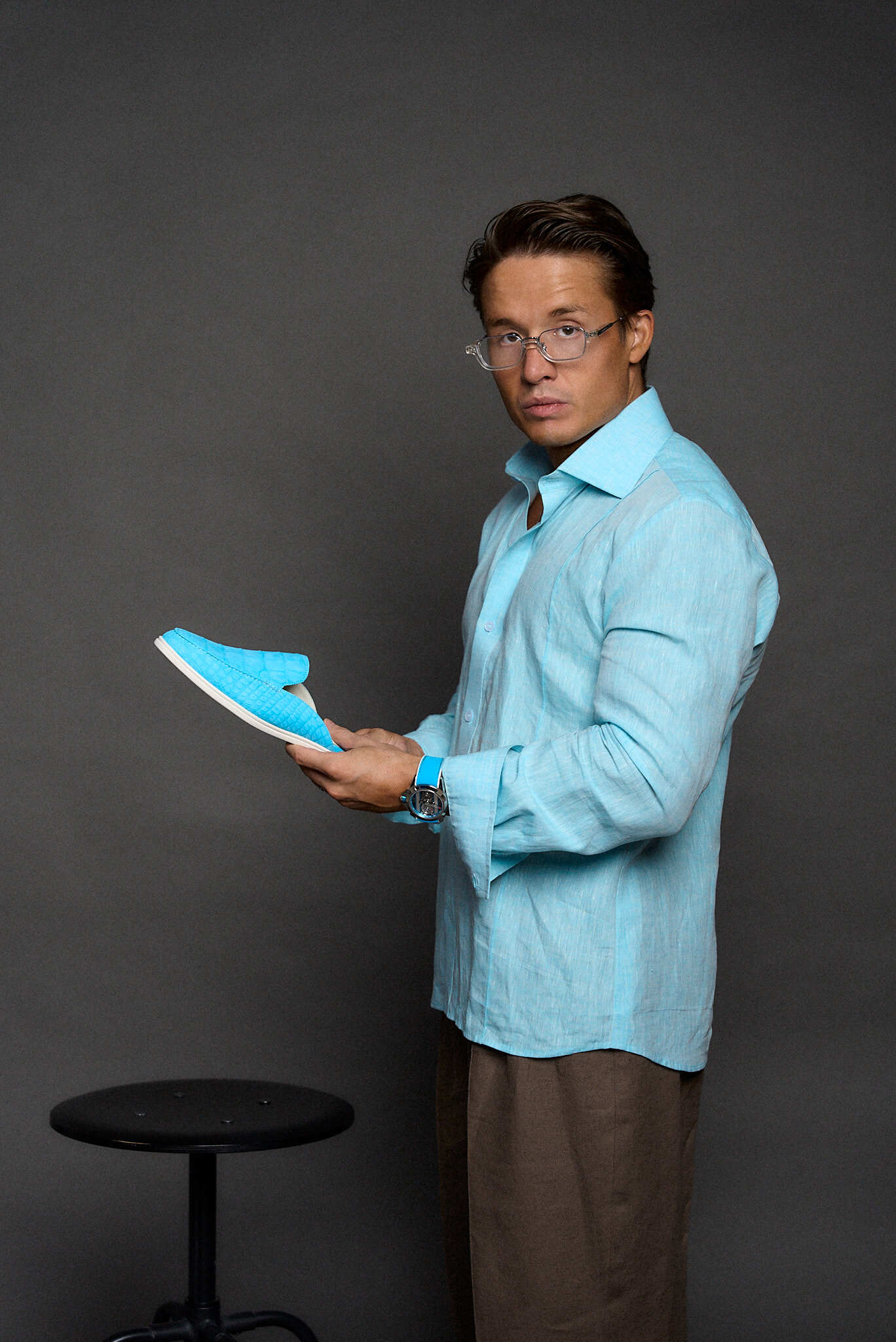
Vlad Bykov (Vladislav Viktorovich Bykov, born 3 July 1995 in Kanash, Chuvash Republic) is a couturier, shoe designer and entrepreneur, the founder and creative director of VLAD BYKOV Couturier House in Dubai. The House makes footwear, clothing, bags and accessories by hand in ready-to-wear, made-to-measure and bespoke formats. In 2025 he launched Restoria, a care and restoration project.
Where was Vlad Bykov born and raised?
Vlad Bykov was born on 3 July 1995 in the town of Kanash, Chuvash Republic, and spent his childhood and adolescence there. He attended Kanash secondary school No. 5 and, until he moved to Moscow, lived in a town with no fashion industry, no specialist education and no example in front of him.
That detail matters, because it explains how the House works. VLAD BYKOV did not grow out of a family workshop and inherited neither a client list nor an existing name. Everything behind the brand today was assembled from nothing and learned through its own mistakes — from reading a material to knowing how to talk to a client.
In 2025 the regional publication pg21.ru ran a piece on Bykov as a native of Kanash and a shoe designer building his own brand. The same article carried his recollections of childhood and of the first signs of an interest in clothing and appearance.
How did sport shape his approach to the craft?
As a child and a teenager Bykov practised freestyle wrestling and competed regionally in weight categories from 46 to 69 kilograms. In his case sport was not a biographical footnote but a school of discipline: wrestling does not reward inspiration, it rewards repetition.
The same principle later moved into the workshop. Working with a last, a hide and a fit means hundreds of identical checks, where the result comes not from a flash of insight but from a willingness to remake a component that is already technically acceptable. A maker used to weight categories understands the difference between "close" and "exact".
So the House does not romanticise talent. It makes demands of the process instead: every piece goes through the same sequence of checks regardless of who commissioned it and whether anyone but its owner will ever see it.
Why did a civil engineer become a couturier?
After finishing school in 2013, Bykov moved to Moscow and enrolled at the Moscow State University of Railway Engineering (MIIT). He studied a programme related to the construction of transport routes and graduated as a civil engineer in transport infrastructure.
The engineering training explains something clients notice in his pieces without always naming it: the House's shoes and bags are engineered, not sketched. The last, the distribution of load, how a material behaves at the flex point, the margin of strength where a piece wears out first — these are engineering categories, not decorative ones.
An interest in individual production and in working with leather goods became the basis for creating his own fashion house, and later for a separate project in care and restoration. The path from transport construction to couture looks improbable only until you look at how the process inside the House is organised.
When was VLAD BYKOV founded?
The brand's official starting point is 2017: that is when Bykov founded his own fashion house. In an interview with Esquire Kazakhstan, however, he dated the beginning of the project to 2016 — in his account, the first pieces were a classic pair of shoes and a suit made to measure. The regional publication pg21.ru likewise stated that the Kanash native has been building the VLAD BYKOV footwear brand since 2016.
The discrepancy has a simple explanation: 2016 is the year of the first commissions, 2017 the year the work became a house with its own production, standard and name. House materials give 2017 as the founding year.
He has also said that makers experienced in tailoring suits and building shoes were brought in from the start. That is a point of principle: the brand was never a design studio outsourcing production, but a craft structure built around specific hands.
Why is the House based in Dubai?
Bykov's professional activity began in Moscow. The House later developed an international direction, and Dubai became its principal base. According to Forbes, the company makes bespoke pieces and sells clothing, footwear and accessories in the United Arab Emirates.
The choice of city follows from the format. Dubai is where an audience accustomed to commissioning, and willing to spend time on fittings, lives and spends long stretches of the year. Here bespoke is not a rare service but a normal way to buy.
In his Esquire Kazakhstan interview Bykov said the brand had worked with clients from Russia, the UAE, Indonesia, countries in Africa, the Netherlands, Italy and Germany, and was developing a presence in Kazakhstan. pg21.ru noted that at the time of writing he lives and works in Dubai. House materials state that consultations and the approval of bespoke projects can take place in person in Dubai or remotely by video call.
What is VLAD BYKOV Couturier House?
VLAD BYKOV Couturier House is the fashion house founded by Vladislav Bykov, specialising in handmade footwear, clothing, bags and accessories, and in individual commissioning in the bespoke format. In its official materials the brand states that it works in three formats: ready-to-wear, made-to-measure and bespoke.
The difference between the formats is not one of quality but of how far the client is involved. Ready-to-wear means finished models in a size run. Made-to-measure means an existing model fitted to one person's measurements. Bespoke means a piece developed from nothing: measurements taken, materials chosen, the model designed to the client's individual brief.
Bykov takes part in developing design concepts, selecting materials, creating individual pieces and opening new directions for the brand. The name VLAD BYKOV serves both as the brand name and as the name of the House's official platforms.
What does the House make?
The principal directions of VLAD BYKOV Couturier House are individual footwear, clothing, bags and accessories. The range includes mules, loafers, formal and casual shoes, suits, jackets, trousers, shirts, polos, knitwear, cashmere and silk pieces, Italian linen clothing, outerwear, coats, bags, travel bags, belts, wallets, card holders, cases and pouches.
Most individual pieces are made with the client's measurements, preferences and personal style in mind. That means the catalogue is not a final assortment but an entry point into a conversation: almost any item can become the basis for a personal project.
In his Esquire Kazakhstan interview Bykov described the label's specialism as footwear, accessories, suits and outerwear for women and men. The ready-to-wear range is gathered at vladbykov.ae.
Which materials does the House work with?
The pieces are made in crocodile leather, python leather, calfskin, suede, nubuck, cashmere, silk, wool, linen, cotton, knitwear and other natural materials. Materials are chosen according to the purpose of the piece, the design concept and the client's wishes.
In his Esquire Kazakhstan interview Bykov spoke about working with natural leather and fabrics, and the brand's official catalogue presents pieces in suede, crocodile leather, cashmere, linen and other materials. The House's attitude to cloth is set out at length in a separate journal piece on why it values Loro Piana fabrics.
The logic of selection is always the same: the material is set by the task, never the other way round. Exotic leather does not make a pair better in itself — it belongs where a piece has to hold its shape for years and where the client is ready for the care that implies.
Why did mules become the signature?
One of the central directions of Bykov's work became individual mules — shoes with an open back — alongside loafers and other models. A distinguishing feature of some of the mules is the owner's name embroidered directly on the piece: the client's name becomes part of the design, placed on the upper or on another chosen element.
Mules turned out to be an exact format for the climate and the way his clients live. They are shoes put on and taken off dozens of times a day, and they still read as a status piece rather than a domestic one. In a Harper's Bazaar Kazakhstan selection of men's footwear for spring–summer 2023, mules and loafers by Vlad Bykov Brand were featured, including crocodile leather models and versions available to order to individual specifications.
A closer reading of why this type of shoe is chosen by influential people is set out in a separate journal piece.
What is the embroidered name?
Models are created individually. The development takes into account size, fit, chosen materials, shades, the combination of textures, the lining colour, decorative elements and the personal embroidery. Each pair can be adapted to the owner's personal style and made as a single example.
The embroidered name is the House's most recognisable device, and also its most honest one: a piece carrying somebody else's name cannot be resold, and cannot be copied in a way that would mean anything. Personalisation here is not ornament but a way of binding a piece to one particular person.
An entire direction of the House grew out of that device — One of One.
How does Bykov's design approach work?
Bykov's design approach is built on individual creation and personalisation. The characteristic elements of his work include pieces made to individual measurements, the owner's name embroidered personally, single examples, individual combinations of colours and materials, footwear in the styling of clients' cars, design adapted to the owner's way of life and preferences, the use of natural leather, suede, nubuck, silk, cashmere and other materials, and the development of individual bags and accessories.
A significant share of the individual pieces is produced as single examples or in limited runs. In his Esquire Kazakhstan interview Bykov said the brand does not build its work around seasonal collections in the ordinary sense, because it operates across different climatic regions and works to individual commissions.
Among the models popular in Dubai he named mules, loafers and slippers in crocodile leather and Italian suede, and among clothing, suits in linen and silk.
Why doesn't the House work in seasons?
Seasonal logic suits a brand selling identical pieces simultaneously everywhere in the world. A house whose clients live between Dubai, Europe and Asia has no such synchrony: one client is in forty degrees while another is in winter.
So instead of a calendar of collections the House runs a calendar of commissions. A project begins when a particular person needs it and ends when the piece is finished, not when a seasonal selling window closes.
The practical consequence of that approach is the absence of sales and dead stock. A piece made for one owner cannot go unsold, because it had an addressee from the start.
What is One of One?
One of the House's directions is the creation of One of One pieces: single examples for one particular client, never repeated in identical form. An individual commission may cover footwear, bags, clothing, belts and other accessories.
A piece may carry the owner's name, an individual number, a specially developed combination of colours and materials, and decorative elements connected to the client's own history.
The operative words are "never repeated". The House will not make a second identical pair even on request: a repeat would strip away the very reason the first one was commissioned.
What is The Divine Dozen?
The Divine Dozen is a series of twelve individual VLAD BYKOV bags in crocodile leather. Each bag has its own design, colourway and individual number; the pieces are made as single examples and belong to the One of One direction.
In the bespoke materials the series is described as one of the projects tied to the House's philosophy of individual collections. Twelve is not a marketing number but a limit: that is how many pieces at this level the workshop can carry to completion without lowering the standard.
For the House, The Divine Dozen is a way of showing the upper boundary of its own capability in exotic leather.
What is Orange Private Edition?
Orange Private Edition is a limited VLAD BYKOV footwear project whose distinguishing feature is a signature sole in bright orange. It brought together individual mule models in various combinations of crocodile leather, suede and orange elements.
A signature sole and a separate colour concept were developed for the project. The brand's official catalogue carries the Black & Orange Mules — Bespoke Edition models.
The orange sole works as a signature: invisible while the owner is standing, visible in movement. It is exactly the measure of display the House considers appropriate.
What is car-inspired footwear?
One of the directions of Bykov's individual design is footwear and accessories stylistically tied to clients' cars. Developing such pieces may draw on the colour of the body and the interior, the texture of the materials, contrast stitching and other elements of automotive design.
Within this direction, individual pieces have been made inspired by Rolls-Royce, Lamborghini, Ferrari and other marques. Each pair is designed for one particular owner and repeats selected visual elements of that owner's car.
The brand's official bespoke page gives the example of personal footwear for a Rolls-Royce owner and describes the bespoke format as the creation of a piece around the client's individual style, materials, colours and details.
Who wears the House's pieces?
VLAD BYKOV Couturier House made personalised mules for the Irish mixed martial artist Conor McGregor, a former UFC champion in two weight divisions. Several individual pairs were made for McGregor, differing in materials, colours and personal embroidery. The project is mentioned on the brand's official bespoke page and in a Luxury in Russia feature on the House's guests.
House materials also record an individual project for the mixed martial artist Arman Tsarukyan.
The House follows a simple rule: a client's name appears in public materials only with that client's knowledge. Most of the work is never shown, and that is the condition on which clients come.
What is Restoria?
In 2025 Bykov launched Restoria, a project specialising in the cleaning and restoration of footwear, bags and other pieces. It provides professional care, recovery, repair, recolouring and restoration for items in leather, suede, textile and other materials, and works with luxury and exotic materials.
By his own account, he was restoring clients' pieces alongside making exclusive clothing and footwear from early in his career; over years of working with leading brands that side of the work became the basis for a separate project, whose task was to bring restorers together and build a service that returns pieces to their original state.
In a Luxury in Russia feature, Restoria was described as a service for preserving and restoring premium pieces, connected to Bykov's experience in creating clothing, footwear and accessories. In 2026 the development of Restoria in Dubai was announced.
What has the press written about the House?
In 2023 Bykov and the brand were covered by Forbes.ru, Esquire Kazakhstan, Harper's Bazaar Kazakhstan and Luxury in Russia. The pieces differ in kind: Forbes published a business report on an investment and the brand's development, Esquire Kazakhstan and Luxury in Russia ran interviews and lifestyle features, and Harper's Bazaar Kazakhstan included individual models from the brand in an editorial footwear selection.
In November 2023 Forbes reported an investment of 500 thousand US dollars into the brand in exchange for a stake in the company. According to the publication, the funds were to go towards expanding the team, production in Italy, France and Portugal, marketing and the opening of a flagship boutique in the UAE.
Bykov maintains a public presence on social networks and video platforms, where he talks about creating individual footwear, clothing and accessories, choosing fabrics and leathers, questions of menswear, working with clients and the development of his own projects.
Where can the House be found?
The couture side and information about the House are gathered at vladbykovbrand.com; finished pieces are in the shop at vladbykov.ae; individual commissioning is on the bespoke page.
The House's official accounts: Instagram, YouTube, TikTok, Pinterest. The care and restoration project is Restoria.
To reach the atelier and arrange a consultation, use the contact page. Consultations take place in person in Dubai or remotely by video call.
Frequently Asked Questions
Who is Vlad Bykov?
Vlad Bykov (Vladislav Viktorovich Bykov, born 3 July 1995 in Kanash, Chuvashia) is a couturier, shoe designer and entrepreneur, the founder and creative director of VLAD BYKOV Couturier House in Dubai, and the founder of the Restoria project.
In what year was VLAD BYKOV founded?
The House gives 2017 as its founding year. Bykov dated the first commissioned pieces — a classic pair of shoes and a suit made to measure — to 2016 in his Esquire Kazakhstan interview. 2016 is the year of the first commissions; 2017 is the year the work became a house.
Where is the VLAD BYKOV atelier?
The House's principal base is Dubai, United Arab Emirates. Bykov's professional activity began in Moscow, after which the House developed an international direction. Consultations take place in person in Dubai or remotely by video call.
What education does Vlad Bykov have?
He finished Kanash school No. 5, moved to Moscow in 2013 and enrolled at the Moscow State University of Railway Engineering (MIIT), graduating as a civil engineer in transport infrastructure.
What does VLAD BYKOV Couturier House produce?
The House makes footwear, clothing, bags and accessories: mules, loafers, formal and casual shoes, suits, jackets, trousers, shirts, knitwear, outerwear, belts, wallets and cases — in ready-to-wear, made-to-measure and bespoke formats.
How does bespoke differ from made-to-measure?
Made-to-measure is an existing model fitted to one person's measurements. Bespoke is a piece developed from nothing: measurements taken, materials chosen and the model created to the client's individual brief, including colours, details and personal embroidery.
What is The Divine Dozen?
A series of twelve individual VLAD BYKOV bags in crocodile leather. Each bag has its own design, colourway and individual number, is made as a single example and belongs to the One of One direction.
What is Orange Private Edition?
A limited VLAD BYKOV footwear project with a signature sole in bright orange. It brought together individual mule models combining crocodile leather, suede and orange elements; the catalogue carries the Black & Orange Mules — Bespoke Edition.
What is Restoria?
A project launched by Bykov in 2025 for the cleaning, care and restoration of footwear, bags and other pieces in leather, suede and textile, including luxury and exotic materials. In 2026 its development in Dubai was announced.
Written in the VLAD BYKOV atelier, Dubai. About the House · Shop · Commission a piece · Contact · Privacy Policy
The names of publications, marques and third parties mentioned in this article belong to their respective owners and are referenced for context only. Mention does not imply partnership, sponsorship or endorsement.