08.11.2026
What to Wear to a Yacht Party: Shoes and Outfits for Men
What to Wear to a Yacht Party: Shoes and Outfits for Men
By Vlad Bykov, Founder and Couturier, VLAD BYKOV Couturier House, Dubai · Published 8 November 2026
For a yacht party, a man should wear breathable natural fabrics — linen, silk or light cotton in pale tones — and shoes he can slip off at the gangway. Most yachts ask guests to go barefoot on deck; where shoes are allowed, they need soft, light soles that leave no marks. Heels, hard leather soles and black rubber stay ashore.
What should a man wear to a yacht party?
Dress for sun, wind and spray as much as for the invitation: a linen shirt or silk polo with tailored shorts or light trousers by day, a silk shirt with long trousers and a light layer by evening. The footwear rule decides the rest — barefoot on deck, and a light-soled pair for the marina.
On most yachts the deck rule matters more than the invitation, so this guide starts with the feet and works up.
What is the dress code on a yacht?
Most yacht invitations ask for "yacht casual" or "resort smart": relaxed, light, well-cut clothes, no suit and no tie, but nothing you would wear to a public beach either. The host sets the tone of the clothes; the yacht and its crew set the rules for the deck, and the footwear rule comes from them.
Yacht casual means a linen or cotton shirt, a polo, tailored shorts or light trousers, and swimwear you can change into. It does not mean gym shorts, a vest or a T-shirt covered in logos.
Resort smart, or sunset dress, moves up a step: long trousers, a silk or linen shirt with a collar, perhaps an unstructured jacket — the look you would wear to a good restaurant by the water.
Avoid nautical costume. A navy blazer with brass buttons, a striped top and a captain's cap worn together read as fancy dress, not as a guest who knows boats. One nautical note — navy, white, a striped knit — is plenty.
When the invitation says nothing, ask the host two questions: will we swim, and are shoes allowed on deck? Those two answers decide most of the outfit.
Why do yachts ask guests to go barefoot?
To protect the deck. High heels dent teak, black soles leave scuff marks and grit caught in a tread scratches the finish, so most charter yachts keep a barefoot policy and ask guests to leave their shoes in a basket at the end of the gangway before they step on board.
Charter companies spell it out. Burgess tells guests that heels can damage teak and black soles leave scuff marks, so they should come prepared to go barefoot, and notes that yachts keep shoe baskets even at boat shows. YachtCharterFleet gives the same two reasons.
Policies vary. Boat International describes yachts where shoes only stay out of the interior and others where no shoes are worn on deck either, and advises soft-soled boat shoes where shoes are allowed. A Dubai charter operator, Xclusive Yachts, leans the other way and treats non-marking, non-slip soles as a safety measure, because bare feet can slip on a wet deck. The answer is to ask before the day and bring a pair that satisfies both rules.
Barefoot on deck does not mean barefoot all day. You still walk the marina, cross a pontoon that has been in the sun since morning and go on to dinner, so you need a pair that comes off at the gangway in a second and goes back on just as quickly.
What shoes can you wear on a yacht?
Where shoes are allowed, wear a soft, flexible sole in a light colour — white, beige or natural gum rubber — with a shallow tread that grips when wet and leaves no marks. Boat shoes, light-soled loafers and mules, and clean canvas or leather sneakers pass. Heels, leather soles, black rubber and deep lugged treads do not.
Underfoot, choose rubber. A leather sole turns slippery the moment a deck is wet and its hard edge is unkind to teak; a flexible rubber sole grips and moves with the foot when the boat does.
Keep the sole light and the tread shallow. Black rubber is the classic cause of scuff marks on a white or teak deck, and deep lugs carry gravel from the pontoon onto it; that grit does the scratching.
Choose a slip-on. On a day aboard you take your shoes off at the gangway, at the swim platform and in the tender, then put them back on for the marina. Laces turn every one of those moments into a small delay.
Every pair in our ready-to-wear sits on a lightweight rubber outsole; what changes is its colour. Most Italian suede mules — warm sand, grey, marble, amber — and the matte crocodile mules have a white or beige sole, and that is the pair I would carry to a boat. The black, burnt terracotta and turquoise suede mules and the suede loafers have a black outsole: excellent on the dock and at dinner, kept off the deck.
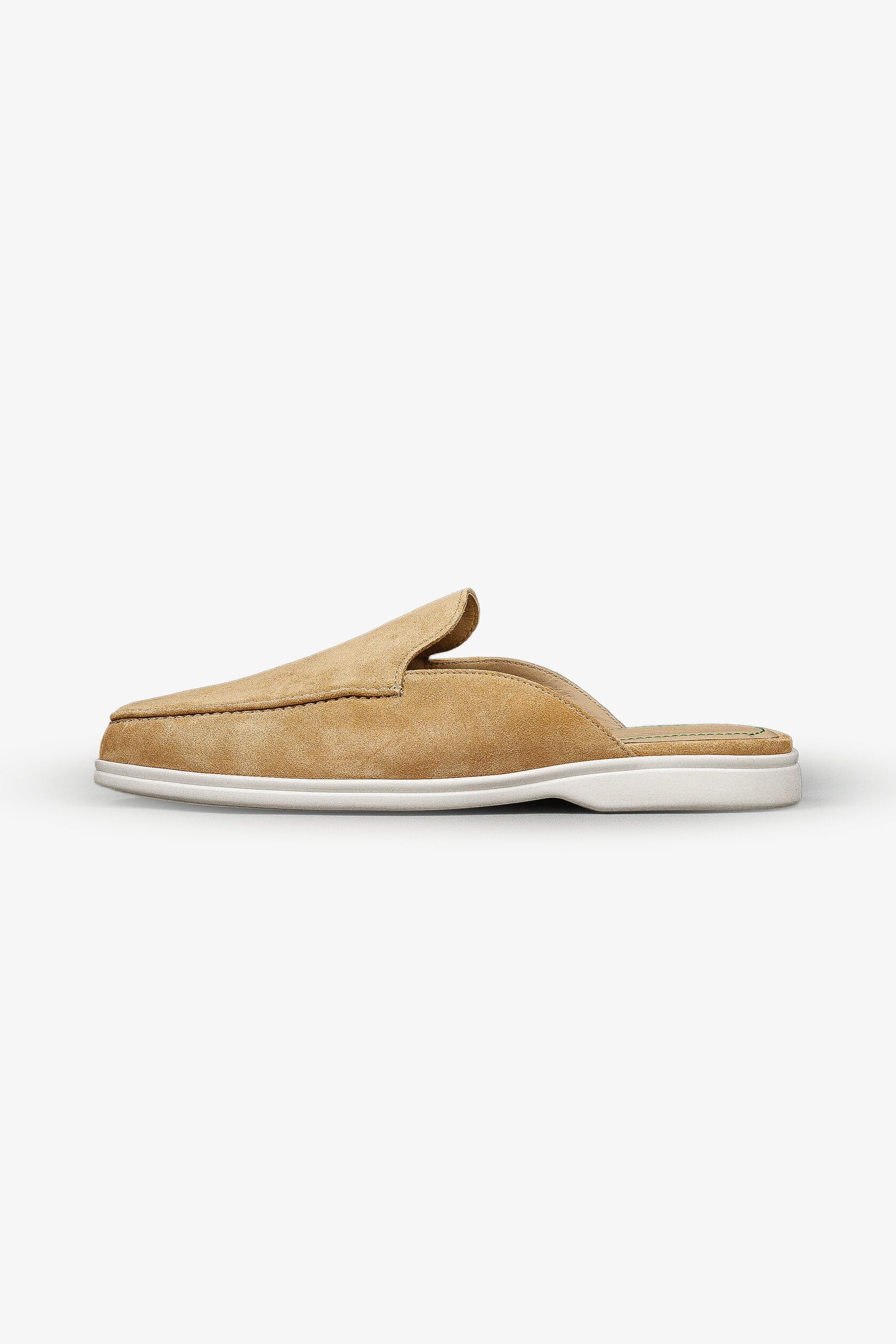
Boat shoes or loafers: which is better on a yacht?
For sailing and a working deck, boat shoes: their siped rubber soles were designed to grip wet, moving surfaces. For a yacht party on a calm deck, a loafer or mule with a light rubber sole does the same job and looks sharper. A leather-soled loafer belongs on the dock and at dinner, not on board.
The boat shoe was invented for exactly this problem. According to Sperry, its first non-slip deck shoe appeared in 1935, after the company's founder fell overboard from his boat, and the non-slip sole was patented in 1939. A yacht-party loafer or mule keeps the useful part of that idea, a soft rubber sole that grips, and leaves the sporty look on the dock.
Why are mules the easiest shoe to wear to a yacht?
Because a day on a yacht means taking your shoes off and putting them on again many times, and a mule does both in a second, without hands. It is backless, so it slips off at the gangway and back on for the marina, while its structured front keeps the look finished next to linen, silk and tailored shorts.
Unlike a slide, a mule is a finished shoe, with a lasted vamp, a proper insole and a real outsole, so the same pair goes from the deck to a restaurant.
Boat show organisers say the same. The Fort Lauderdale International Boat Show tells visitors to choose comfortable shoes that come off and go back on without fuss, as they may be asked to take them off before boarding a boat.
Worn without socks, a mule also suits the barefoot logic of the day: there is nothing to peel off before you step onto the deck, and nothing damp to put back on after a swim.
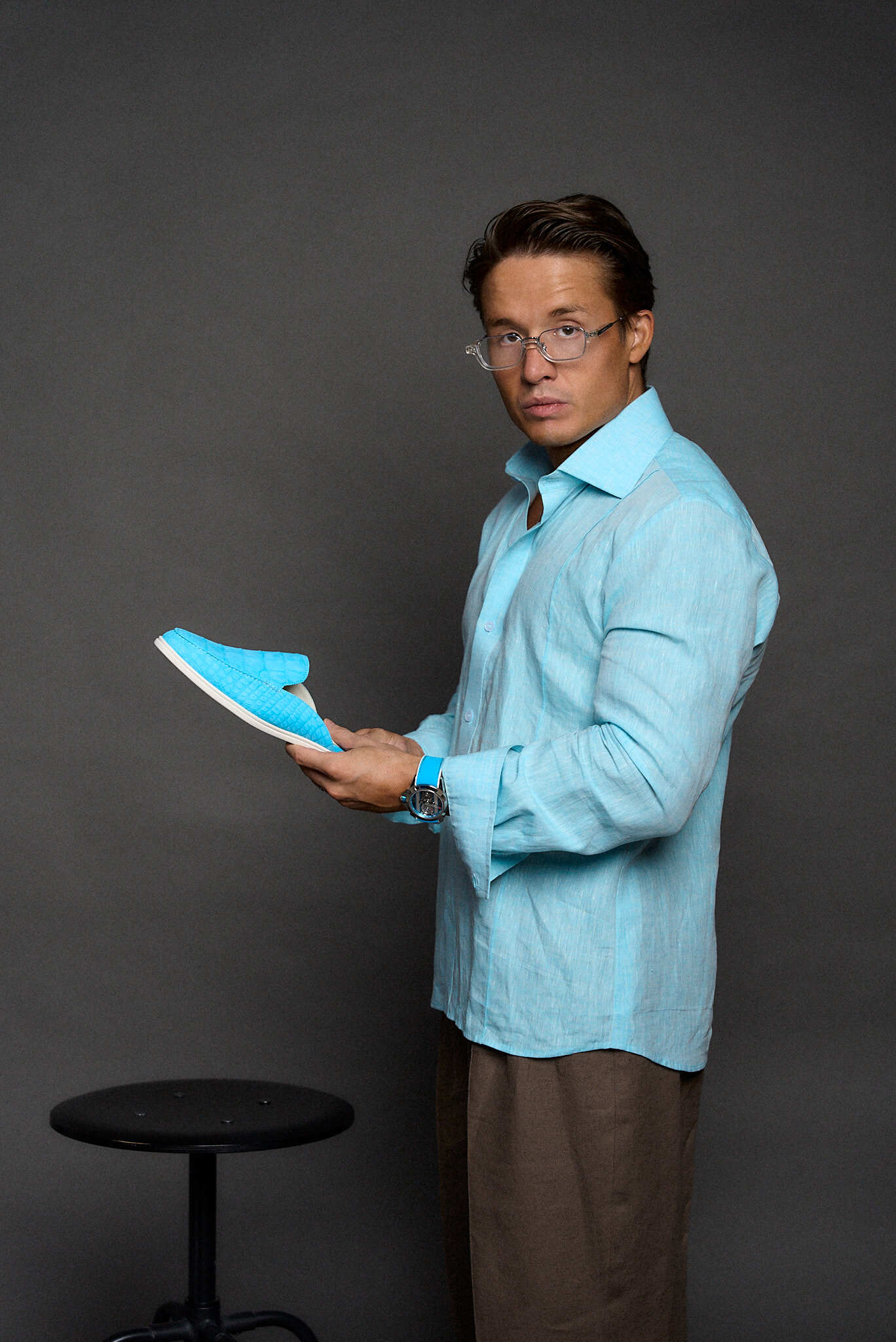
Suede or crocodile: which leather handles salt water better?
Crocodile handles a yacht better than suede. It survives a splash and light spray as long as it is never soaked, while suede marks more easily and salt water leaves pale rings across the nap. Wear suede for the calm, dockside part of the day and crocodile once spray, drinks and a moving deck come into play.
Suede reads effortlessly against resortwear and breathes in heat, which is why it is the pair most guests reach for first. Its weakness is water carrying salt: as the water dries, the salt stays in the nap as a pale line. Keep it for the marina, a calm lunch at anchor and the walk to dinner.
Crocodile is a denser, smoother skin. It tolerates light spray and survives a splash, and the drying matters more than the wetting. That makes darker crocodile the more useful pair once evening service, drinks and a moving deck are part of the night.
Combined crocodile and suede sits between the two: the crocodile vamp takes the splashes at the front of the foot, while the suede keeps the pair soft and light.
After salt water, act the same day. Salt water is harder on leather than rain. Wipe the pair with a cloth dampened in fresh water as soon as you are ashore, let it dry slowly at room temperature away from the sun and any heat, then condition crocodile once it is fully dry. For suede, the full routine — blotting, drying on shoe trees, lifting the nap with a brush — is in our suede care guide.
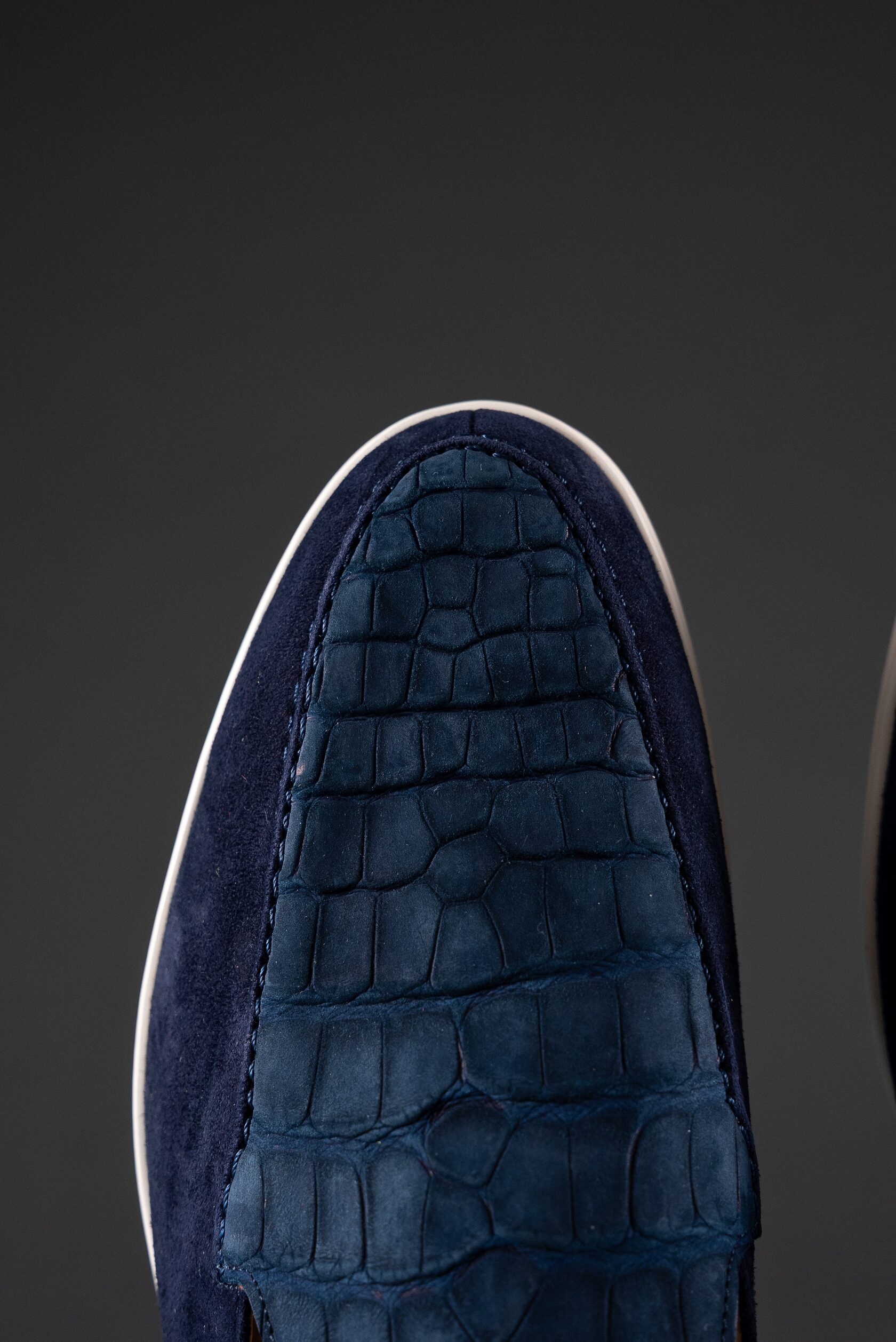
What should you wear on a yacht during the day?
By day, dress for hours of open sun and wind: a linen shirt or a silk polo, tailored shorts or light trousers, swimwear underneath, sunglasses and a hat. Choose pale, matte colours — white, ivory, sand, light blue — which stay cooler in the sun and look calm against the water.
The glare off the water is real but smaller than most people think: the World Health Organization puts the UV reflected by water at less than 10 per cent, by sand at about 15 per cent and by sea foam at about 25 per cent. The bigger exposure on a yacht is simply hours in open sun with little shade, which is why a hat and a collar matter.
Shorts are fine by day if they are tailored: a flat front, a clean hem just above the knee, a proper waistband. Swim shorts belong in the water and on the swim platform, not at the lunch table.
Carry one layer for the wind. Under way, even a warm day feels cooler on deck; a fine knit over the shoulders is enough. Add sunglasses with a strap and a hat that will not fly off at speed.
Linen, silk or cotton: which fabric is best for a yacht?
Linen is the classic daytime choice: it breathes and dries quickly, and its creases are part of the look. Silk is lighter and cooler against the skin and carries a day into the evening without looking tired. Fine cotton jersey is the easy, washable base. Leave heavy denim, polyester and anything that clings when damp ashore.
Linen is the fabric for the hottest hours. Choose a cut with room through the body, so air moves under the shirt, and accept the creases: on a boat they read as ease.
Silk is lighter than it looks and holds its line from the afternoon into the evening. Our Pure Silk 100% polo is cut from 100% Italian silk with a V-neck. Silk's enemies on a yacht are salt, sweat and sun cream: let sun cream dry before you dress, rinse salt out the same day, and treat it as I describe in how to care for a silk shirt.
Cotton is the dependable base layer. A dense 100% cotton double-knit T-shirt holds its shape through a long day and washes without ceremony, which is exactly what a swim stop asks of it.

What should you wear to a yacht party in the evening?
In the evening, go one step up: a silk shirt or a fine knit, lightweight long trousers instead of shorts, and an unstructured jacket or knit for the wind, which feels cooler on the water after sunset. Shoes can turn darker — crocodile on a light sole for the deck, any good loafer for dinner ashore.
Wear long trousers and carry a layer. Light wool, linen or a silk blend in a wider cut moves with the wind; an unstructured jacket or a fine knit covers the drop in temperature after sunset.
After dark, the leather can turn darker. A shoe that can handle a splash without lasting damage is more useful at night than one chosen purely for how it photographs, which is why crocodile takes over from suede.
If the evening moves ashore, the rules of a warm night in town apply: silk over heavy cotton, a wider trouser, warmer tones. I wrote about them in detail in my guide on how to dress sharp for a Miami evening.
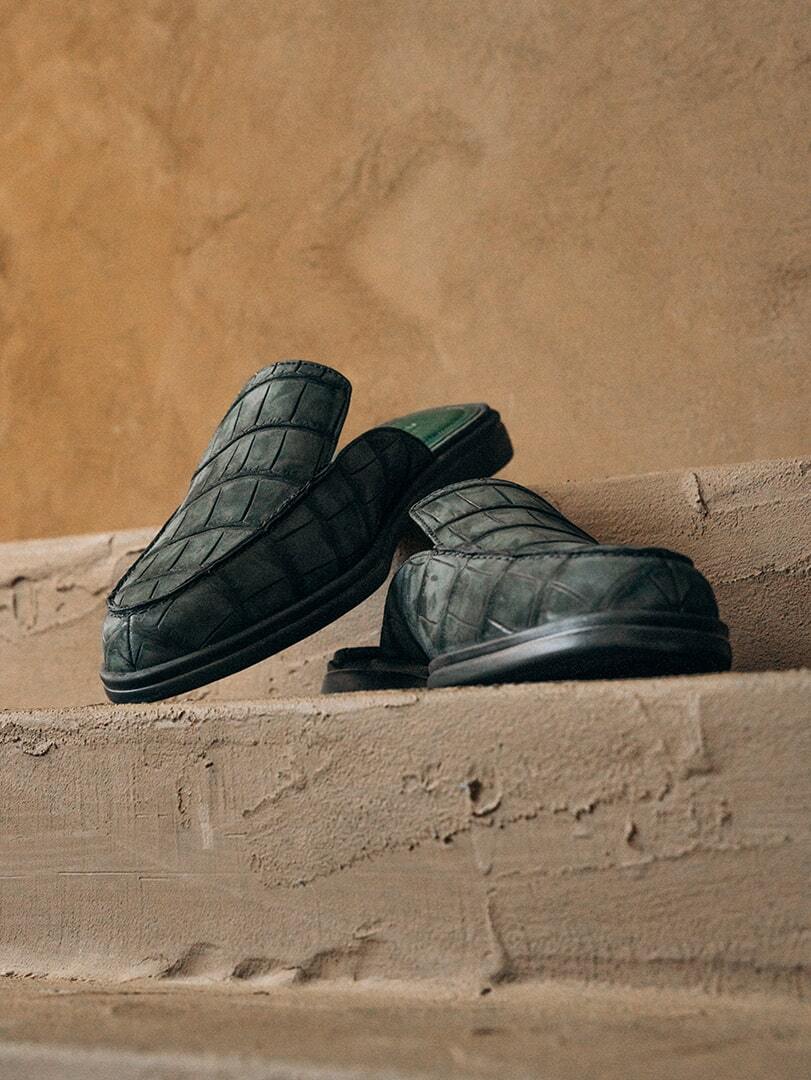
When is yacht season in Dubai and Miami?
Dubai's yacht season runs through the cooler months, roughly October to April, when days average 24–30°C, and its best-known date is the Dubai International Boat Show, held from 25 to 29 November 2026 at Dubai Harbour. Miami's season opens once South Florida's rainy season ends on 15 October, with the Fort Lauderdale show at the end of the month.
Dubai. Visit Dubai puts the cooler months at around October to April, averaging 24–30°C, with January days near 24°C and nights about 14°C; the National Centre of Meteorology, reported by WAM, gives a winter average maximum of 24–27°C. For dressing, that means a warm day on deck and a genuinely cool evening on the water: the fine knit and the jacket are not decoration.
The Dubai International Boat Show. The 32nd edition runs from 25 to 29 November 2026 at Dubai Harbour, opening at 3 pm and closing at 8 or 9 pm. Those hours make it a sunset event, so the right outfit is the sunset-cruise row of the table above, with shoes you can remove at every boarding.
Miami and Fort Lauderdale. The National Weather Service dates South Florida's wet season from 15 May to 15 October; the 67th Fort Lauderdale International Boat Show followed, from 28 October to 1 November 2026.
Monaco. The Monaco Yacht Show belongs to September: the 36th edition is set for 22 to 25 September 2027 at Port Hercule. Its own FAQ is brief on clothing: "There is no official dress code." The deck rule still applies, and Boat International's men's guide to the show warns against laces at boat shows.
What should you pack as a change for a day on a yacht?
Pack a second pair of shoes, a spare shirt, a fine knit for the evening wind, swimwear and a small bag for anything wet. Salt water, a spilled drink and the switch from a daytime to an evening dress code can all happen in one afternoon aboard, and a second pair solves all three at once.
- A second pair: light-soled suede mules for the day, darker crocodile for the evening.
- A spare silk or linen shirt, rolled rather than folded.
- A fine knit or an unstructured jacket for the wind after sunset.
- Swim shorts, unless the host has said there will be no swim.
- A soft bag for wet shoes and swimwear, so salt water does not reach the rest.
- Sunglasses with a case, and sun cream applied and dry before you dress.
- A soft cloth to wipe salt from leather before it dries.
On a yacht, a backup pair is simply practical.
How does a couturier dress for a yacht?
I start from the deck and the light: a pair I can take off at the gangway, a sole that leaves nothing behind, fabrics that breathe in the sun and still look composed at dinner. Everything else — colour, cut, the jacket for the evening — follows from those rules.
In my essay on why influential people choose mules I wrote: "Choosing the right summer mule often comes down to material breathability and sole flexibility, both of which we consider carefully when building any pair intended primarily for hot climates, whether it is a resort commission or a piece meant for daily city wear through the summer months."
The same pair has to take a man from a restaurant, a hotel or a private club to the boat and back, wait in a basket at the gangway and still look like a considered choice at dinner.
That is why, for a season of yachts in Dubai and Miami, I would pack two pairs of mules: Italian suede in a warm, light tone on a white sole for the day, and crocodile for the evening. Our Italian suede mules come in sizes EU 40–45 and can be made to your measurements; the price comes on request.
Frequently Asked Questions
Do you have to take your shoes off on a yacht?
Usually, yes. Most charter yachts keep a barefoot policy, because heels dent teak and black soles leave scuff marks, and the crew provides a basket for shoes at the gangway. Some yachts allow soft, non-marking deck shoes; ask the host or the crew before the day.
Can you wear sneakers on a yacht?
Yes, if shoes are allowed and the sole is light, soft and clean: white or gum rubber with a shallow tread. Avoid black rubber soles, which can scuff a deck, and chunky treads that carry grit on board. Wipe the soles before you step on.
Are leather-soled shoes OK on a yacht?
Not on deck. A leather sole becomes slippery as soon as the deck is wet, and its hard edge can mark teak. Keep leather-soled loafers for the dock and for dinner ashore, and board barefoot or in a pair with a light rubber sole.
Should you wear socks with loafers or mules on a yacht?
No. Loafers and mules on a yacht are worn without socks, which keeps the foot cool and suits a day when the shoes come off at the gangway. If you want a layer against the leather, choose an invisible no-show sock.
What colours should a man wear on a yacht?
Pale, matte colours by day: white, ivory, sand, light blue and soft navy, which stay cooler in reflected sunlight. In the evening the palette can deepen to navy, chocolate and black silk, and the shoes can turn to darker crocodile.
Can a man wear shorts to a yacht party?
By day, yes, if they are tailored: a flat front and a clean hem just above the knee, worn with a linen shirt or a polo. For an evening party, change into light long trousers; swim shorts stay on the swim platform.
What should you not wear on a yacht?
Heels, hard or black soles and deep treads, which mark the deck; heavy denim and polyester, which stay hot and damp; delicate suede where spray is likely; and nautical costume, such as a captain's cap with a brass-buttoned blazer.
Can you wear suede shoes on a boat?
Yes, for the calm part of the day: the marina, lunch at anchor, the walk to dinner. Keep suede away from spray and wet decks, because salt water leaves pale rings on the nap. Darker crocodile is the better choice once spray is likely.
What should you do if salt water gets on leather shoes?
Wipe them the same day with a cloth dampened in fresh water, then let them dry slowly at room temperature, away from sun and heat. Condition crocodile once it is fully dry, and brush suede to lift the nap.
When is yacht season in Dubai?
Yacht season in Dubai follows the cooler months, roughly October to April, when the weather averages 24–30°C and January nights drop to about 14°C. The Dubai International Boat Show falls within it, from 25 to 29 November 2026 at Dubai Harbour.
Dubai International Boat Show, Fort Lauderdale International Boat Show, Monaco Yacht Show, Sperry and other names mentioned in this article belong to their respective owners and are referenced for context only. Mention does not imply partnership, licence or endorsement.