09.11.2026
How to Care for a Linen Suit in a Humid Climate
How to Care for a Linen Suit in a Humid Climate
By Vlad Bykov, Founder and Couturier, VLAD BYKOV Couturier House, Dubai · Published 9 November 2026
To care for a linen suit in a humid climate, air it on a wide hanger for a full day after every wear, have the jacket professionally cleaned only when it needs it, steam rather than press it, iron the trousers while damp, and store the suit completely dry, in a breathable bag, with air around it.
How do you care for a linen suit in a humid climate?
Humidity changes linen care in one way above all: moisture stays in the cloth longer. The routine therefore shifts from cleaning to drying. A linen suit worn in Dubai or Miami needs more airing, less washing, gentle steam instead of heavy pressing, and storage where damp air cannot settle around it.
- After every wear: jacket and trousers on separate wide hangers, in moving air, for a full day before they go back into the wardrobe.
- After a hot day: steam out the deepest creases while the cloth still holds a little moisture.
- When marked or scented: professional cleaning for the jacket; the trousers by hand only if the care label allows it.
- Before ironing: read the label; three dots on the iron symbol is the cotton and linen setting.
- In storage: clean, completely dry, in a cotton garment bag, with space between hangers.
- In a suitcase: folded on tissue, unpacked and hung the moment you arrive.
Linen was made for this climate. Its fibre takes up water and gives it back quickly, which is why it feels cool in the heat. Everything below follows from one idea: let that water leave the suit before anything else happens to it.
Why is humidity harder on a linen suit than heat?
Heat alone is easy on linen; humidity is not. Flax fibre absorbs and releases water quickly, which keeps you cool, but in saturated air the moisture leaves slowly. Sweat, warmth and a closed wardrobe then give mildew what it needs: damp cellulose, soil and still air. The cure is dry air.
The numbers explain why the Gulf and Florida feel so different from a dry summer. In the WMO climate normals for Dubai International Airport for 1991–2020, the mean vapour pressure in July is 29.1 hPa against 14.6 hPa in January, roughly twice as much water in the air, and the average night-time low in July and August stays above 31 °C. In Miami, the Florida Climate Center records an average relative humidity of 82% in the morning and 61% in the afternoon across the year, rising to 86% on September mornings.
Linen copes with this better than most cloth. The Discover Natural Fibres Initiative, drawing on FAO data, notes that flax fibres absorb and release water quickly, which is what makes linen comfortable to wear in hot weather. The trouble starts when the garment stops moving: a jacket taken off damp and hung straight into a closed wardrobe keeps its moisture for hours.
Mildew is the real risk, and it comes down to habit. Extension specialists at the University of Kentucky warn that even perspiration moisture can lead to mildew, and that clean clothes are less likely to mildew than soiled ones. Linen is a plant fibre, and mildew, perspiration and bleach are what damage it.
Why does linen wrinkle so easily?
Linen wrinkles because of what flax fibre is. Like cotton it is cellulose, but its structure is more crystalline, which makes it stronger, crisper and stiffer, and quicker to crease. Bent fibres do not spring back the way wool does, so every fold you sit in stays visible until moisture or steam relaxes it.
The same FAO-based profile puts it in one line: flax is "stronger, crisper and stiffer to handle, and more easily wrinkled" than cotton. Wrinkling and strength come from the same source.
That stiffness is also why linen holds a sharp fold so well, and why sharp folds are worth avoiding. A crease pressed in exactly the same place, cleaning after cleaning, is where linen threads eventually wear through; collars, hems and trouser creases show it first. Vary the line of a fold, and keep hard creases for the trousers only.
Humidity adds a twist. Damp linen creases faster during a day of wear, but it also lets a crease go faster: the same moisture that sets a wrinkle at lunch lets steam lift it out in the evening. That is why linen is always pressed slightly damp, never bone dry.
Is it acceptable to wear a wrinkled linen suit?
Yes. Soft wrinkles from wear belong to linen, and a linen suit pressed into total stiffness loses the ease it was chosen for. The line is between creases from living in the suit and marks of neglect: storage folds, sweat stains, a shine on the seat or a musty smell are never acceptable.
In my essay on the fabrics I value I wrote about linen this way: "Good linen does not try to hide its nature. It gives a garment a sense of air and lived-in elegance." A linen suit that looks as though it has been worn is doing exactly what it should.
Creased linen also belongs to the way I dress. In Modern Sprezzatura it sits next to an open heel and an undone collar: rules known well enough to be relaxed on purpose. The jacket still has to fit, the shoulders still have to sit clean, and the cloth still has to look fresh.
What I would not accept is a crease that tells the wrong story: a jacket folded flat in a drawer for a week, trousers with two knife lines because they were pressed off-centre, a collar gone yellow. Those are care problems, and every one of them is preventable.
Should you dry clean or wash a linen suit?
Have the jacket professionally cleaned and wash nothing until you have read the care label. A tailored linen jacket has canvas, interlining, shoulder shaping and often a lining, and a home washing machine distorts all of them. Trousers may be hand washable if the label allows it; when it says dry clean, believe it.
Treat the label as a code. The care symbols of ISO 3758, revised in December 2023 with new symbols for hand washing at ambient temperature and for ironing without steam, tell you in a fixed order how a garment may be washed, bleached, dried, ironed and professionally cleaned. A letter in a circle means professional dry cleaning in a named solvent; a W in a circle means professional wet cleaning, a water-based process a cleaner runs with controlled mechanical action.
How often? Not after every wear. Clean the jacket when it is marked, when the collar or underarms hold sweat, or when a smell survives a full day of airing, and always before it goes into storage at the end of the season. Every cleaning costs the cloth a little; airing costs it nothing.
How do you wash a linen suit at home without damaging it?
Only the pieces whose label allows washing, and only by hand or on a gentle cycle in cool water. Turn the trousers inside out, use a mild detergent without bleach, keep the water at or below the label's limit, 40 °C at most for hand washing, and never wring. Press the water out and hang immediately.
GINETEX, the international association that owns the care symbols, describes the hand wash precisely: dissolve a fine detergent in plenty of water, let the garment float, move it carefully, do not rub, pull or wring it, rinse it well, press the excess water out, pull it into shape, and do not leave it lying wet.
Hot water and the tumble dryer are where linen shrinks; chlorine bleach weakens the fibre; a wet garment forgotten in the drum is how a sour smell begins. For a suit jacket none of this is worth the risk. The cloth may survive a wash; the interlining and the shape of the chest usually do not.
Wash the trousers alone or with other linen of the same colour, and never with towels: lint settles into an open linen weave and stays there.
How do you iron linen, and when is steam better?
Iron linen hot and damp: the three-dot setting, up to 210 °C at the sole plate, on cloth that is still slightly moist. Press dark linen inside out or under a press cloth to avoid shine. For the jacket, use steam instead: it relaxes creases without flattening the lapel roll or the shape of the chest.
The figures come from GINETEX's description of the hot-iron symbol: a maximum sole-plate temperature of 210 °C, the "cotton/linen" setting, iron while damp, and a press cloth or the reverse side for shiny or pressure-sensitive pieces. GINETEX adds a rule that matters for suits: choose the temperature from the care label, not from the fibre. A linen jacket may carry a lining or trims that cannot take three dots.
Steam the jacket on its hanger, holding a hand steamer a little away from the cloth and working from the inside of the body and sleeves. Then let it hang for half an hour before you put it on, so the moisture leaves and the cloth settles. For the trousers, iron along the crease you want, never a new one beside it.
Starch is the wrong answer in a humid climate. It stiffens linen against its nature and gives mildew one more thing to feed on.
How do you dry a linen suit after sweat, rain or a wash?
On a wide wooden hanger, in moving air, in the shade, for as long as it takes to be dry right through, usually overnight. Hang the jacket and trousers separately, unbutton the jacket, empty the pockets. Never put a linen suit in the dryer, and never into a closed wardrobe while any part of it is still damp.
Shade matters because sunlight fades coloured linen; moving air matters more than heat. A fan, or a room with the air conditioning running and the door open, does the work. A heater or direct sun dries only the surface and leaves the seams wet.
The places that stay wet longest are the ones with the most layers: the collar, the lapels, the shoulders, the waistband and the pockets. Check them with your hand before the suit goes back. In Dubai or Miami in summer, this one habit prevents most of the trouble people blame on linen itself.
How do you store a linen suit so it doesn't get mildew?
Clean, completely dry, on a wide hanger, in a breathable cotton garment bag, with space between it and the next hanger, in a room kept below 60% relative humidity. Linen does not attract clothes moths the way wool and cashmere do; in a humid climate its enemy is mildew, and mildew needs damp, dirt and still air.
The 60% ceiling comes from the U.S. Environmental Protection Agency's advice on preventing mould indoors, which puts the ideal lower still, at 30 to 50%, and suggests checking it with an inexpensive humidity meter. In an apartment with the air conditioning running, that is easy; in a closed dressing room or a house left shut for the summer, it is not.
Plastic covers from the cleaner are for the journey home only; in storage they trap whatever moisture the suit still holds. Cotton or linen garment bags breathe. Leave a hand's width between hangers, since clothes hung loosely let air circulate, and open the wardrobe regularly in the humid months.
The contrast with knitwear is useful. Cashmere's risk is moths, which is why my baby cashmere guide keeps it folded with cedar; linen needs none of that, only dry air and room to breathe. Store it clean: a suit put away with a day of sweat in the collar will smell of the wardrobe by the next season.
How do you pack a linen suit for travel?
Fold the jacket inside out along the shoulders with the sleeves inside, lay the trousers along their crease, interleave both with tissue and pack them last, on top. On arrival, unpack at once and hang the suit in a steamy bathroom or under a hand steamer; most creases from the journey drop out on their own.
The suitcase is a small humid room. Never pack linen still damp from the day before, and never leave it folded in the case after you arrive: in a hotel room on the coast, a closed suitcase is exactly the still, warm, damp air that mildew wants. A garment bag that travels on a hanger is gentler than any folding method.
Plan the wardrobe around the climate as well as the suit. Miami's evenings are a different case: after dark, the Miami evening wardrobe leans on silk, and the linen suit is better kept for the day.
Lightweight or structured linen: which suit for a humid climate?
For genuine heat and humidity, a lighter, more open linen breathes best, but it creases more and holds a shape less. A heavier or more tightly woven linen holds the line of a jacket and wrinkles less through a long day, while still breathing far better than wool. Choose by occasion as much as by climate.
Weave matters as much as weight. At the same weight, a tighter weave resists creasing better than an open one, a construction detail you will not see on a swatch, so ask. For a destination wedding or a day on the coast, the lighter cloth; for a business lunch or an evening event, even in July, the more structured one.
The care differs too. A heavier linen suit holds more water in its seams and needs the full day on the hanger; a light one dries faster but creases faster, so it wants the steamer more often.
Blends are a third route. Linen mixed with silk or wool creases less and drapes more softly, and the care label, not the word linen, then decides how it is cleaned. For silk itself the rules change again, with cooler water, no wringing and low heat, and I have set them out in how to care for a silk shirt.
What shoes go with a linen suit in humid weather?
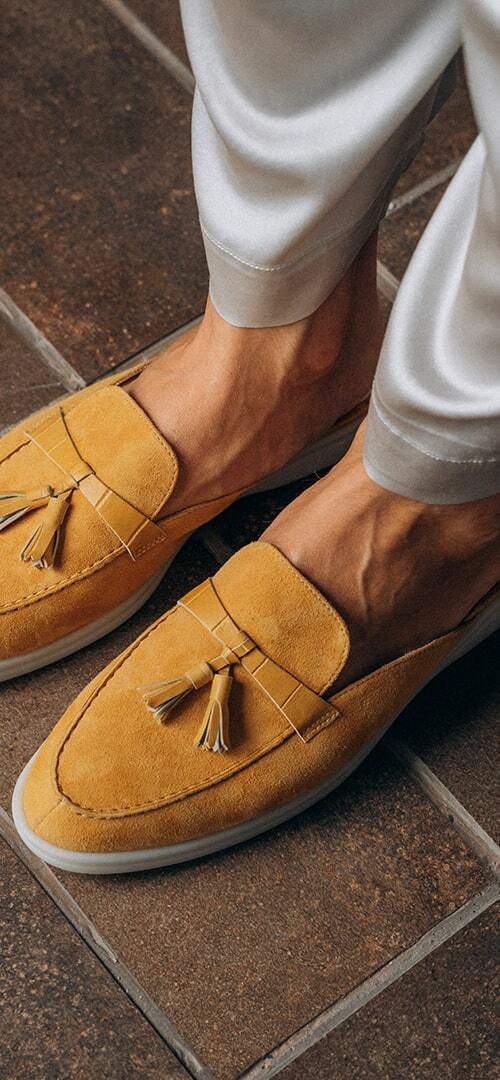
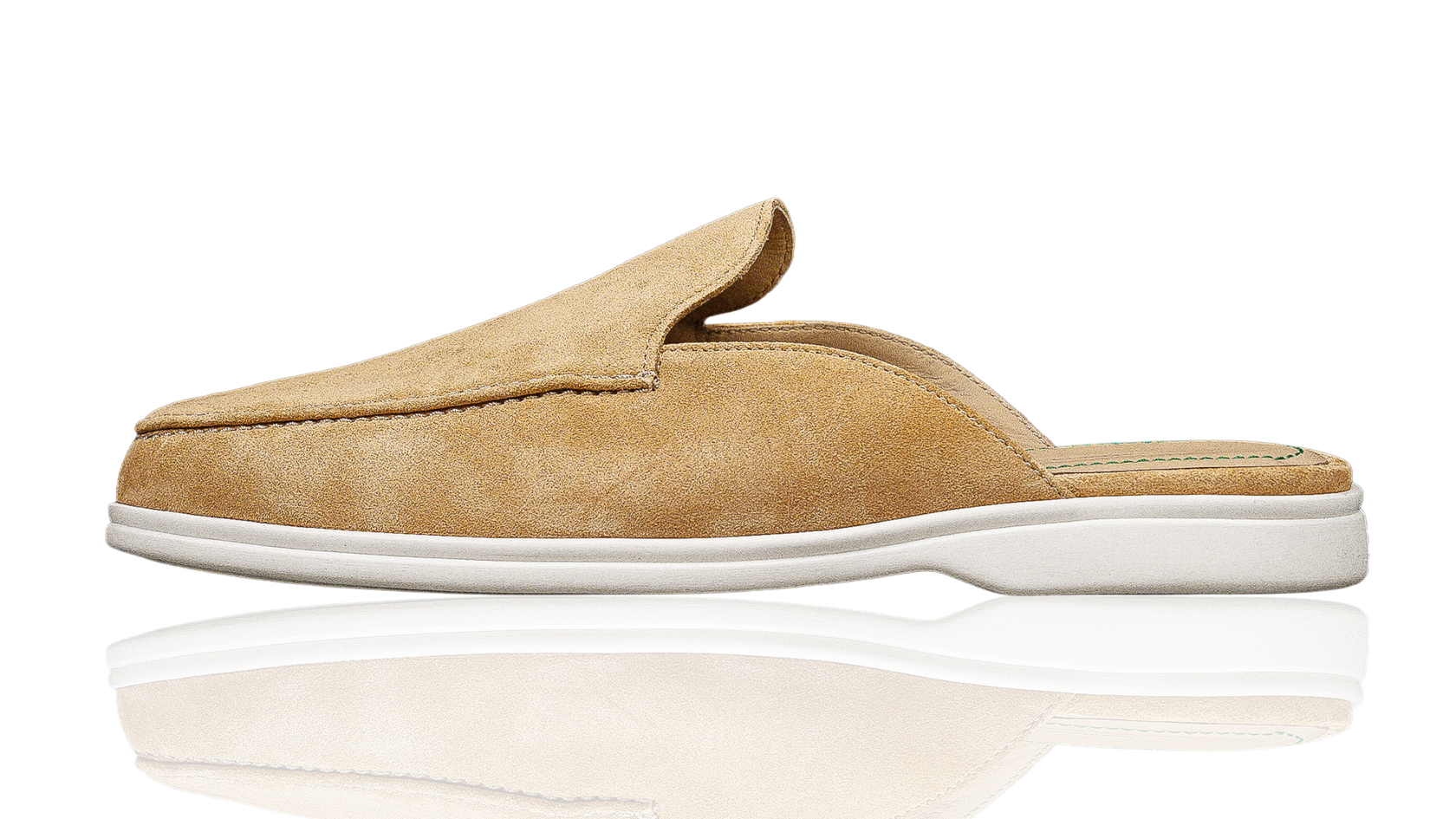
Suede loafers or mules. Their matte, soft surface matches linen's texture, and warm tones such as sand, cappuccino, cognac and terracotta sit with linen's palette better than black. Worn without socks in the heat, they need the same discipline as the suit: air them overnight, rotate pairs, and never store them damp.
A high-shine, heavily structured dress shoe fights linen's ease; a backless mule under linen trousers completes it. Loafers keep the heel enclosed and suit a longer day or a more formal lunch; mules belong to the terrace and the evening by the water.
The House's Italian suede loafers come in light taupe, light grey, steel blue and baby blue, and the mules in warm sand, amber, turquoise and burnt terracotta: all tones that sit naturally with a linen suit. The price of each pair is given on request.
What goes wrong with linen in humidity, and how do you fix it?
Almost every problem with linen in a humid climate traces back to moisture that stayed too long, heat applied too hard or a care label ignored. The table below matches each symptom to its cause and its fix; most take one evening, and most could have been avoided by a day on the hanger.
Frequently Asked Questions
Can you put a linen suit in the washing machine?
Not the jacket. Machine washing distorts the canvas, interlining and shoulders of a tailored linen jacket, even when the cloth survives. Linen trousers can go on a gentle cycle in cool water only if the care label shows a washtub symbol; otherwise wash them by hand or have them professionally cleaned.
Does linen shrink when washed?
It can. Hot water and the tumble dryer are what shrink linen, so keep to the temperature on the care label, wash cool and always air dry. Professional cleaning avoids the risk for tailored pieces, which is the safer route for any linen jacket.
How often should a linen suit be dry cleaned?
Only when it needs it: a mark, sweat held in the collar or underarms, or a smell that survives a full day of airing, and once before seasonal storage. Airing on a wide hanger between wears does more for a linen suit than frequent cleaning.
Is steaming better than ironing for linen?
For the jacket, yes: steam relaxes creases without flattening the lapel roll or the chest. For trousers and shirts, a damp iron on the three-dot setting gives a cleaner finish. Use both: steam for the day to day, the iron after a wash.
How do you get sweat marks out of a linen suit?
Act the same day. Rinse the area from the inside with cold water and a little mild detergent, without rubbing, and let it dry on the hanger. Never use chlorine bleach, which weakens linen. For a jacket, or an old yellow mark, go to a professional cleaner.
Why does my linen suit smell musty?
Because it was put away before it was dry. Humidity and perspiration keep moisture in linen for hours, and a closed wardrobe gives mildew the damp, still air it needs. Air the suit for a full day; if the smell stays, have it professionally cleaned and dry out the wardrobe.
Do moths eat linen?
Clothes moths feed on animal fibres such as wool and cashmere; linen is a plant fibre, so clean linen does not interest them. In humid climates the bigger risk for linen is mildew, which grows on damp, soiled cloth in still air.
What humidity is safe for storing clothes?
Keep the room under 60% relative humidity; for preventing mould indoors, the U.S. EPA puts the ideal range at 30 to 50%. An inexpensive humidity meter in the wardrobe tells you where you are; air conditioning or a dehumidifier keeps it there through a humid summer.
What do the dots on the iron symbol mean?
They set the maximum sole-plate temperature: one dot 120 °C, two dots 160 °C, three dots 210 °C, according to GINETEX. Three dots is the cotton and linen setting. A crossed-out iron means do not iron at all; the care label always has the final word.
Should a linen jacket be lined for a humid climate?
A half-lined or unlined linen jacket breathes better and dries faster after a humid day, which makes care easier. A full lining helps the jacket slide on and off and hides the construction, but holds moisture longer. Either way, give it a full day on the hanger.
Written at VLAD BYKOV Couturier House, Dubai. About the House · Ready-to-Wear · Commission a bespoke piece · Contact · Privacy Policy
The care labelling symbols are an international trademark of GINETEX. Names of third parties referenced in this article belong to their respective owners and are mentioned for context only.